


Association between fasting glucose and all-cause mortality according to sex and age: a prospective cohort study
- PMID: 28811570
- PMCID: PMC5557842
- DOI: 10.1038/s41598-017-08498-6
Association between fasting glucose and all-cause mortality according to sex and age: a prospective cohort study
Abstract
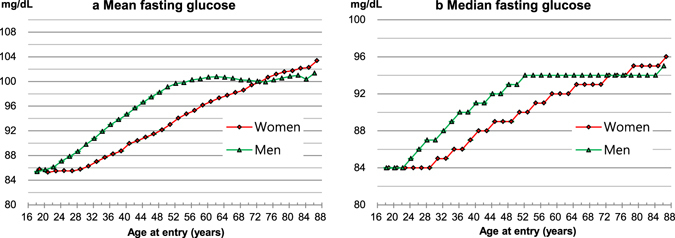
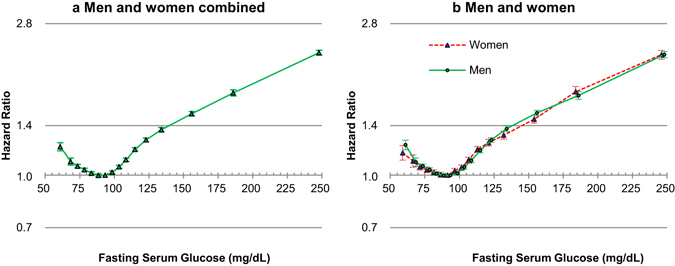
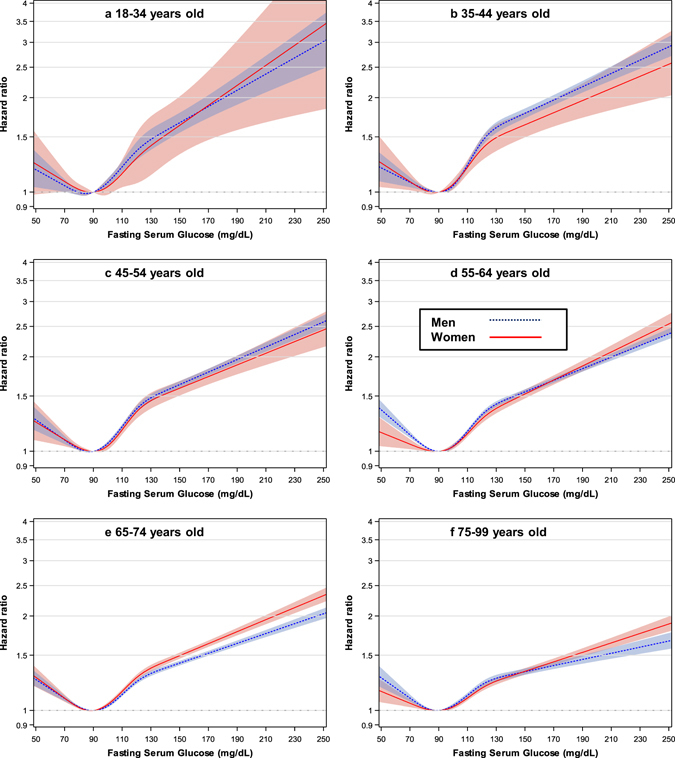
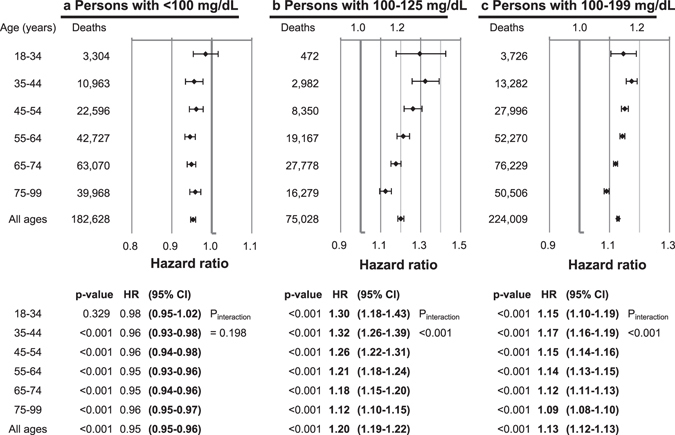
The association of fasting glucose with the risk of death according to sex and age remains unclear, and insufficient information is available on sex- and age-specific glucose concentrations within ethnic groups. This study analyzed a sample of 12,455,361 Korean adults who participated in health examinations during 2001-2004, and were followed up until 2013. Men had 3.0 mg/dL (0.167 mmol/L) higher mean glucose concentrations than women (94.7 vs. 91.7 mg/dL), although women over 73 years had higher levels. For glucose levels of 100-199 mg/dL, each 18 mg/dL (1 mmol/L) increase in fasting glucose increased mortality by 13% (HR = 1.13, [95% CI 1.12 to 1.13], p < 0.001). In individuals with fasting glucose levels of 100-125 mg/dL, each 18 mg/dL increase in fasting glucose was associated with a 30% increase in the risk for mortality (1.30, [1.18 to 1.43]) in those aged 18-34 years, a 32% increase (1.32, [1.26 to 1.39]) in those aged 35-44 years, and a 10% increase (1.10, [1.02 to 1.19]) in those aged 75-99 years. The fasting glucose levels associated with the lowest mortality were 80-94 mg/dL regardless of sex and age. Prediabetes (100-125 mg/dL) was associated with higher mortality. The associations of hyperglycemia with mortality were stronger at younger ages.
Conflict of interest statement
The authors declare that they have no competing interests.
Figures
References
-
- Expert Committee on the Diagnosis and Classification of Diabetes Mellitus Report of the expert committee on the diagnosis and classification of diabetes mellitus. Diabetes Care. 2003;26(Suppl 1):S5–20. - PubMed
-
- World Health Organization & International Diabetes Federation. Definition and diagnosis of diabetes mellitus and intermediate hyperglycemia: report of a WHO/IDF consultation., (World Health Organization, 2006).
-
- DECODE Study Group et al. Is the current definition for diabetes relevant to mortality risk from all causes and cardiovascular and noncardiovascular diseases? Diabetes Care26, 688–696 (2003). - PubMed
Publication types
MeSH terms
Substances
LinkOut - more resources
Full Text Sources
Other Literature Sources
Medical
Molecular Biology Databases
