. 2017 Aug 15;7(1):8182.
doi: 10.1038/s41598-017-08567-w.

Development of a Primary Human Co-Culture Model of Inflamed Airway Mucosa

Affiliations

Development of a Primary Human Co-Culture Model of Inflamed Airway Mucosa

Lael M Yonker et al. Sci Rep. .

Abstract

Neutrophil breach of the mucosal surface is a common pathological consequence of infection. We present an advanced co-culture model to explore neutrophil transepithelial migration utilizing airway mucosal barriers differentiated from primary human airway basal cells and examined by advanced imaging. Human airway basal cells were differentiated and cultured at air-liquid interface (ALI) on the underside of 3 µm pore-sized transwells, compatible with the study of transmigrating neutrophils. Inverted ALIs exhibit beating cilia and mucus production, consistent with conventional ALIs, as visualized by micro-optical coherence tomography (µOCT). µOCT is a recently developed imaging modality with the capacity for real time two- and three-dimensional analysis of cellular events in marked detail, including neutrophil transmigratory dynamics. Further, the newly devised and imaged primary co-culture model recapitulates key molecular mechanisms that underlie bacteria-induced neutrophil transepithelial migration previously characterized using cell line-based models. Neutrophils respond to imposed chemotactic gradients, and migrate in response to Pseudomonas aeruginosa infection of primary ALI barriers through a hepoxilin A3-directed mechanism. This primary cell-based co-culture system combined with µOCT imaging offers significant opportunity to probe, in great detail, micro-anatomical and mechanistic features of bacteria-induced neutrophil transepithelial migration and other important immunological and physiological processes at the mucosal surface.


Conflict of interest statement

The authors declare that they have no competing interests.

Figures
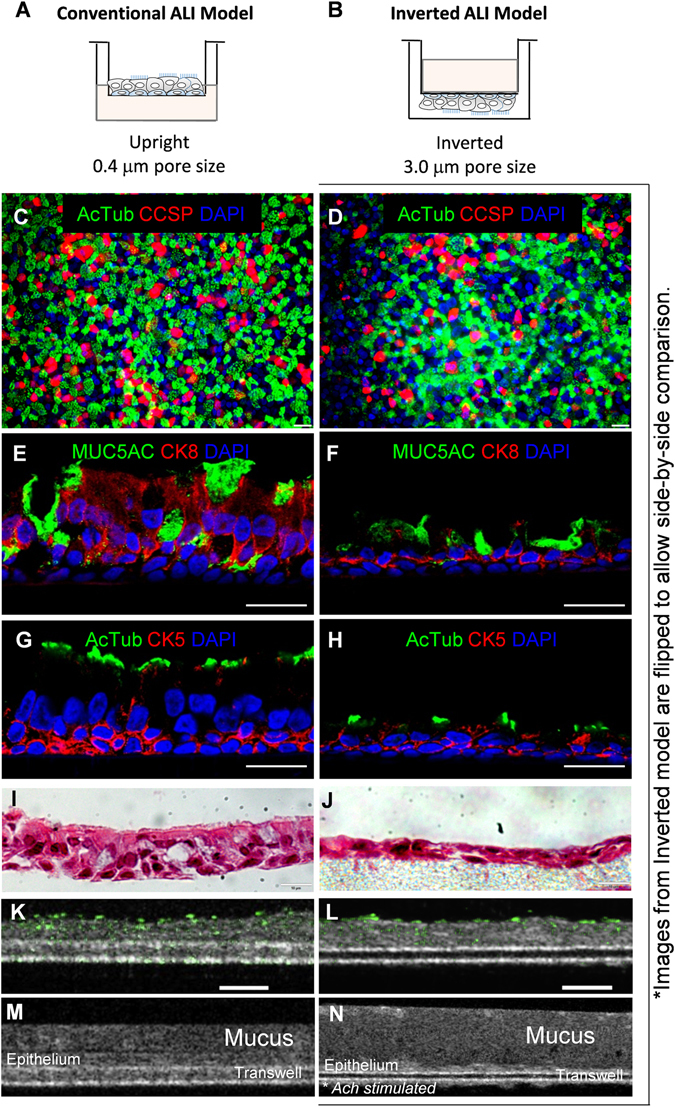
Figure 1
Figure 1
Establishment and characterization of inverted air-liquid interface (ALI) culture system compatible with the study of neutrophil transepithelial migration. In the conventional ALI model (A), human airway basal cells are seeded on the top of 0.4 µm pore sized transwell membrane. The medium is added in the lower chamber to initiate and maintain air-liquid interface for the mucociliary differentiation. In inverted ALI model (B) for neutrophil migration study, human airway basal cells are seeded on the reverse side of 3 µm pore sized transwell membrane. The medium is added to the upper chamber to initiate and maintain air-liquid interface for the mucociliary differentiation (see Method Section for the detailed description). For comparative purposes, images are oriented with the epithelial layer above the plane of the transwell filter. Conventional (C) and inverted (D) ALI transwells were wholemount stained for AcTub+ ciliated cells, CCSP+ Club cells, and DAPI+ nuclei. Scale bar, 25 µm. Conventional (E,G) and inverted (F,H) transwells were immunostained for differentiation marker CK8, goblet cell marker MUC5AC, ciliated cells marker acetylated tubulin (AcTub) and stem cell marker CK5 in transverse sections of ALI transwell membranes. Scale bar, 20 µm. H&E staining also was used to display pseudostratified epithelium in the conventional (I) and inverted (J) models. µOCT images of washed human airway basal cell-derived epithelium in conventional (K) and inverted (L) orientations with a thresholded map of intensity variation over time overlaid in green to accentuate beating cilia, scale bar 50 µm. µOCT analysis of an unwashed human airway basal cell-derived epithelium with mucus intact in conventional (M) and inverted (N) orientations. Images were analyzed at 3 different areas in >3 separate experiments. Representative images are displayed.
Figure 2
Figure 2
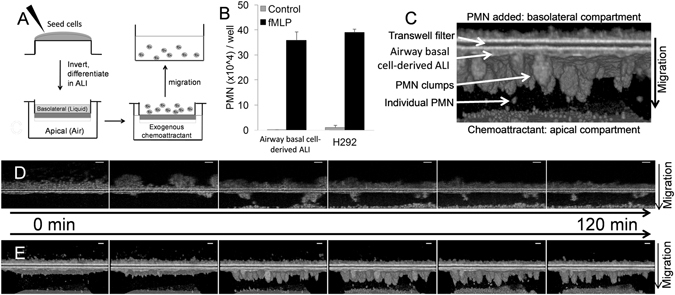
Neutrophil migration in response to an imposed chemoattractant gradient across human airway basal cell-derived ALI cultured epithelial barriers. (A) Model schematic of neutrophil transepithelial migration is shown. (B) Quantitative MPO read out of fMLP-induced neutrophil migration across epithelium derived from human airway basal cells grown under ALI conditions and H292 cell monolayers, performed in triplicate and replicated ≥3 times with similar results. (C) µOCT image of fMLP-induced neutrophil migration is labeled to identify key features within the image. (D) Progressive time-lapse µOCT images are shown of neutrophil migration across human airway basal cell-derived epithelial barriers in response to fMLP gradients over a two hour time course in both 2- and (E) 3-dimensions. (PMN = neutrophil). Each depicted migration image was examined by µOCT and is representative of 3 separate experiments.
Figure 3
Figure 3
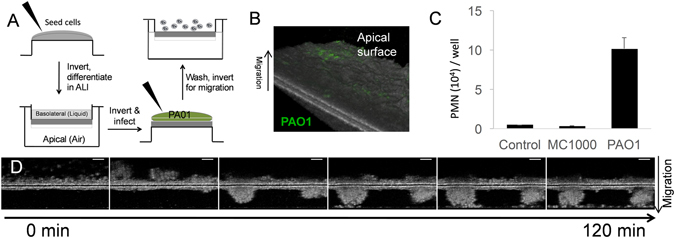
Infection with Pseudomonas aeruginosa induces neutrophil migration across the human airway basal cell-derived epithelium. (A) Schematic of neutrophil migration induced by PAO1 infection is shown. (B) GFP-expressing PAO1 was visualized on mucosal layer of human airway basal cell-derived epithelium using fluorescence-enhanced µOCT imaging. (C) Neutrophil migration across human airway basal cell-derived epithelium was assessed by MPO activity in response to epithelial infection with PAO1 and a non-pathogenic E.coli, MC1000, performed in triplicate and replicated >3 times with similar results. (D) Progressive time-lapse µOCT images are shown of neutrophil migration across the human airway basal cell-derived epithelium in response to apical epithelial PAO1 infection. µOCT images are representative of 3 separate experiments.
Figure 4
Figure 4
Inhibition of hepoxilin A3 reduces PAO1-induced neutrophil migration across human airway basal cell-derived epithelial barriers. Time-lapse µOCT images of neutrophil transepithelial migration following epithelial treatment with (A) vehicle control (DMSO 1:1000) or (B) CDC, a 12-LO inhibitor. (C) Neutrophil migration of single, representative experiment was quantified by µOCT time course plot following epithelial treatment with 12-LO inhibitor CDC, or vehicle control (DMSO 1:1000). (D) Neutrophil migration was quantified using myeloperoxidase in response to PAO1 infection or an imposed gradient of fMLP following epithelial treatment with 12-LO inhibitor CDC, or vehicle control (DMSO 1:1000). Data displayed combined results from two internally controlled, independent experiments (PAO1 infection: n = 4 for each condition). (E) Time course plot comparison of single, representative µOCT imaging quantifies migration visualized following epithelial treatment with HxA3 antagonist or control (HBSS) at the apical surface. (F) Neutrophil migration in response to epithelial infection with PAO1 or an imposed gradient of fMLP in the presence or absence of HxA3 antagonist was quantified by myeloperoxidase assay. Data combined results from two internally controlled, independent experiments (PAO1 infection: n = 4 for each condition). µOCT images are representative of at least 2 separate experiments.

References

    1. Marrie TJ. Community-acquired pneumonia: epidemiology, etiology, treatment. Infectious disease clinics of North America. 1998;12:723–740. doi: 10.1016/S0891-5520(05)70207-5. - DOI - PubMed
    1. McIntosh K. Community-acquired pneumonia in children. The New England journal of medicine. 2002;346:429–437. doi: 10.1056/NEJMra011994. - DOI - PubMed
    1. Brazil JC, Louis NA, Parkos CA. The role of polymorphonuclear leukocyte trafficking in the perpetuation of inflammation during inflammatory bowel disease. Inflamm Bowel Dis. 2013;19:1556–1565. doi: 10.1097/MIB.0b013e318281f54e. - DOI - PMC - PubMed
    1. Burns AR, Smith CW, Walker DC. Unique structural features that influence neutrophil emigration into the lung. Physiol Rev. 2003;83:309–336. doi: 10.1152/physrev.00023.2002. - DOI - PubMed
    1. Chin AC, Parkos CA. Pathobiology of neutrophil transepithelial migration: implications in mediating epithelial injury. Annu Rev Pathol. 2007;2:111–143. doi: 10.1146/annurev.pathol.2.010506.091944. - DOI - PubMed

Publication types

MeSH terms

Substances