. 2017 Aug 15;7(1):8251.
doi: 10.1038/s41598-017-08749-6.

Identification, synthesis and biological activity of alkyl-guanidine oligomers as potent antibacterial agents

Affiliations

Identification, synthesis and biological activity of alkyl-guanidine oligomers as potent antibacterial agents

C Zamperini et al. Sci Rep. .

Abstract

In the last two decades, the repertoire of clinically effective antibacterials is shrinking due to the rapidly increasing of multi-drug-resistant pathogenic bacteria. New chemical classes with innovative mode of action are required to prevent a return to the pre-antibiotic era. We have recently reported the identification of a series of linear guanidine derivatives and their antibacterial properties. A batch of a promising candidate for optimization studies (compound 1) turned out to be a mixture containing two unknown species with a better biological activity than the pure compound. This serendipitous discovery led us to investigate the chemical nature of the unknown components of the mixture. Through MS analysis coupled with design and synthesis we found that the components were spontaneously generated oligomers of the original compound. Preliminary biological evaluations eventually confirmed the broad-spectrum antibacterial activity of this new family of molecules. Interestingly the symmetric dimeric derivative (2) exhibited the best profile and it was selected as lead compound for further studies.


Conflict of interest statement

The authors declare that they have no competing interests.

Figures

Figure 1
Figure 1
Structures of compound 1 and of the dimers (symmetric and asymmetric: 2 and 3 respectively) and trimers (symmetric and asymmetric: 4 and 5 respectively) studied in this work.
Figure 2
Figure 2
Mass spectrum obtained by direct injection of a sample of the mixture. Conditions described in “Methods - General chemistry”.
Figure 3
Figure 3
Chromatographic profile obtained after blank substraction of a sample of the first batch (10 mg/mL) by LC–MS:A (tR = 12.40 min) monomer (1); B (tR = 13.34 min) = dimer; C (tR = 13.74 min) = trimer. Chromatographic method and conditions are reported in “Methods - Chromatographic separation”.
Figure 4
Figure 4
Proposed fragmentation pattern for the structures of dimeric moiety and their calculated exact mass. Spectral details are reported in “Supplementary Information”.
Figure 5
Figure 5
Synthesis of monomer (1). Reagents and conditions: (i) NaN3, DMF, 50 °C, 16 h; (ii) 1,3-Bis(tert-butoxycarbonyl)-2-methyl-2-thiopseudourea, DIPEA, CH3CN/CH3OH, 40 °C, 16 h; (iii) CsOH·H2O, molecular sieves, 6, dry DMF, r.t., 24 h; (iv) H2, Pd/C, i-PrOH, r.t., 4 h; (v) N,N′-Di-Boc-N-methylcyclopropyl-pyrazole-1-carboxamidine, DIPEA, THF, 16 h, r.t.; (vi) TFA 10%, dry DCM, r.t., 7 h.
Figure 6
Figure 6
Synthesis of symmetric dimer (2). Reagents and conditions: (i) Triphosgene, DIPEA, dry THF, 0 °C to r.t., 10 min; (ii) 10, DIPEA, NaI, dry DCM, 40 °C, 48 h; (iii) TFA 10%, dry DCM, r.t., 7 h.
Figure 7
Figure 7
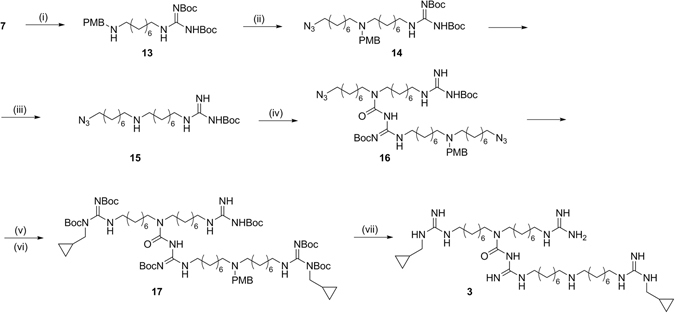
Synthesis of asymmetric dimer (3). Reagents and conditions: (i) 1) p-Anisaldehyde, CH3OH, r.t., 3 h; 2) NaBH4, 0 °C, 1 h; (ii) 6, NaI, DMF, r.t., 48 h; (iii) CAN, t-BuOH/CH3OH, 55 °C, 5 h; (iv) 14, TEA, dry THF, ref., 2 h; (v) H2, Pd/C, i-PrOH, r.t., 16 h; (vi) N,N′-Di-Boc-N-methylcyclopropyl-pyrazole-1-carboxamidine, DIPEA, THF, r.t., 16 h; (vii) TFA 10%, dry DCM, r.t., 7 h.
Figure 8
Figure 8
Synthesis of symmetric trimer (4). Reagents and conditions: (i) CAN,CH3CN/H2O, r.t., 16 h; (ii) 11, DIPEA, NaI, dry DCM, ref., 8 h; (iii) TFA 10%, dry DCM, r.t., 7 h.
Figure 9
Figure 9
Synthesis of the asymmetric trimer (5). Reagents and condition: (i) N,N′-Di-Boc-N-methylcyclopropyl-pyrazole-1-carboxamidine, DIPEA, CH3CN/CH3OH, 50 °C, 16 h; (ii) CsOH·H2O, molecular sieves, 6, dry DMF, r.t., 24 h; (iii) FmocCl, DIPEA, dry DCM, 0 °C to r.t., 2 h; (iv) 21, TEA, THF, ref., 10 h; (v) Piperidine 20%, DMF, r.t., 1 h; (vi) 22, TEA, dry THF, ref., 16 h; (vii) H2, Pd/C, i-PrOH, r.t., 1.5 h; (viii) N,N′-Di-Boc-1H-pyrazole-1-carboxamidine, DIPEA, THF, r.t.,16 h; (ix) Piperidine 20%, DMF, r.t., 5 h; (x) TFA 10%, dry DCM, r.t., 10 h.

References

    1. WHO Antimicrobial resistance. Bull. World Health Organ. 2014;61:383–94. - PMC - PubMed
    1. O’neill, J. Tackling Drug-Resistant Infections Globally: Final Report and Recommendations the Review on Antimicrobial Resistance. (2016).
    1. Rice LB. Federal Funding for the Study of Antimicrobial Resistance in Nosocomial Pathogens: No ESKAPE. J. Infect. Dis. 2008;197:1079–1081. doi: 10.1086/533452. - DOI - PubMed
    1. Spellberg B, Gilbert DN. The future of antibiotics and resistance: A tribute to a career of leadership by John Bartlett. Clin. Infect. Dis. 2014;59:S71–S75. doi: 10.1093/cid/ciu392. - DOI - PMC - PubMed
    1. Spellberg B, et al. The epidemic of antibiotic-resistant infections: a call to action for the medical community from the Infectious Diseases Society of America. Clin.Infect.Dis. 2008;46:155–164. doi: 10.1086/524891. - DOI - PubMed

MeSH terms