


Natural and artificial feeding management before weaning promote different rumen microbial colonization but not differences in gene expression levels at the rumen epithelium of newborn goats
- PMID: 28813529
- PMCID: PMC5558975
- DOI: 10.1371/journal.pone.0182235
Natural and artificial feeding management before weaning promote different rumen microbial colonization but not differences in gene expression levels at the rumen epithelium of newborn goats
Abstract
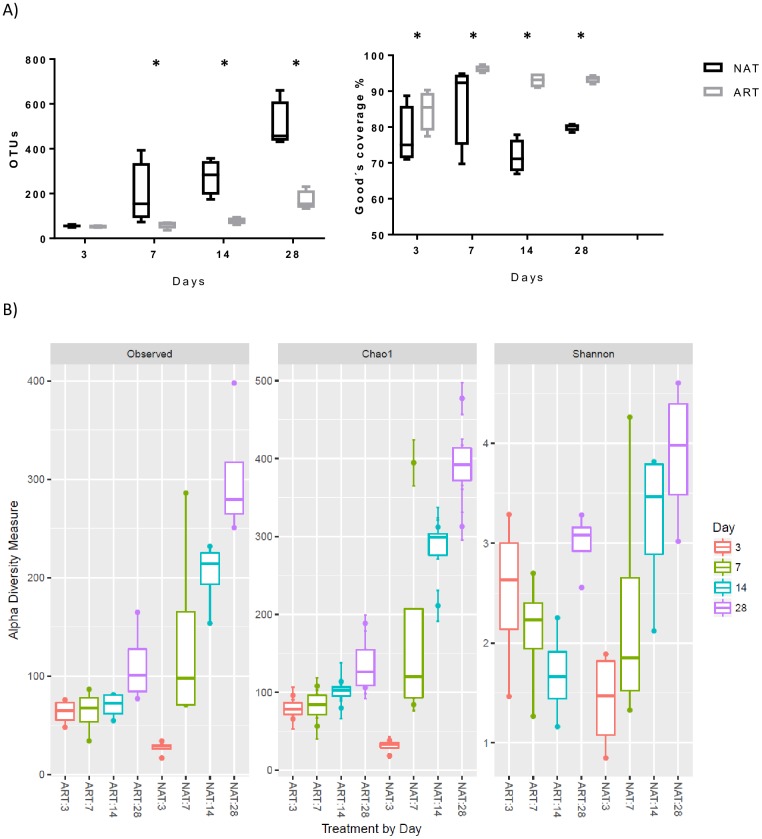
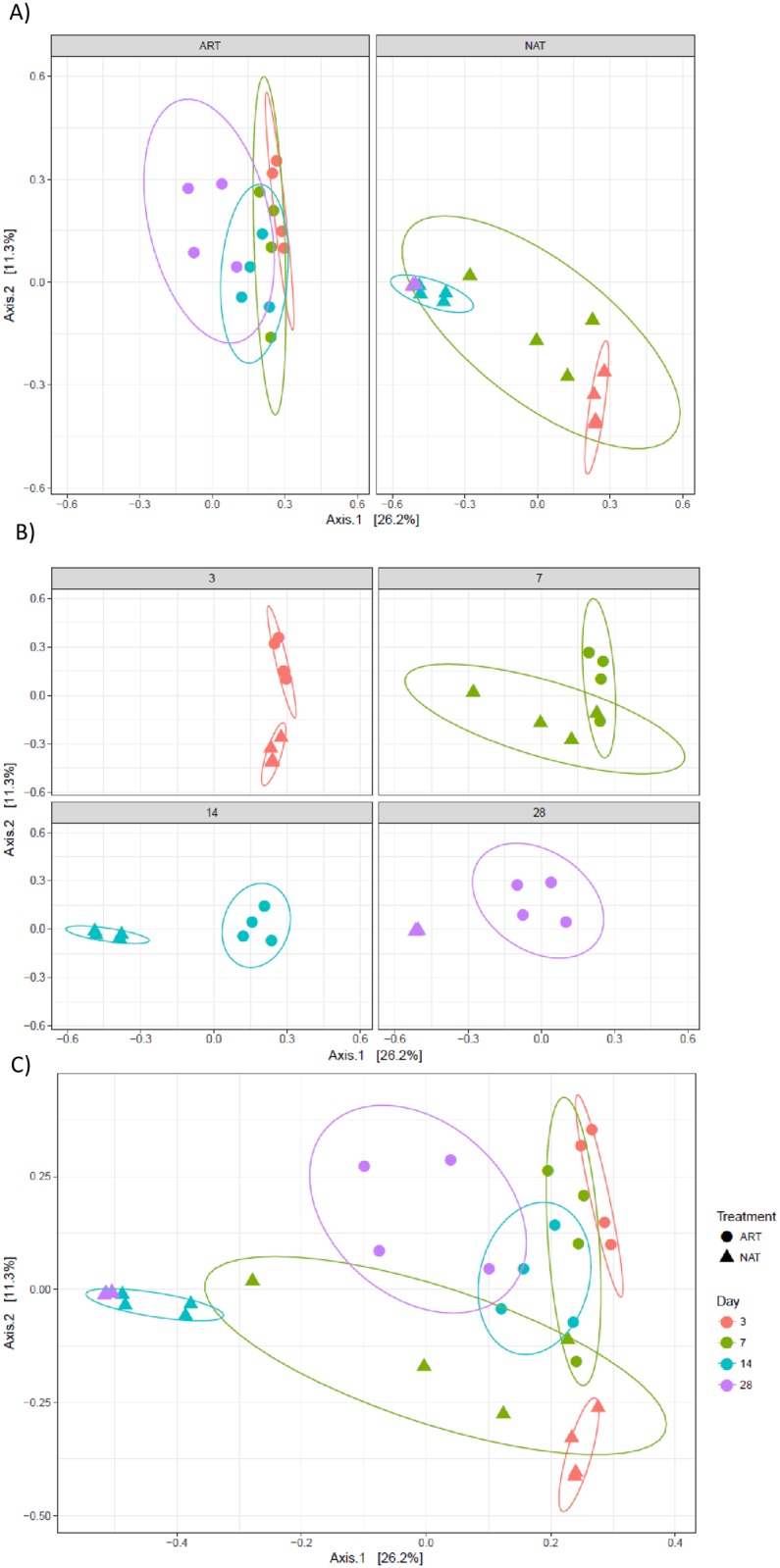
The aim of this work was to evaluate the effect of feeding management during the first month of life (natural with the mother, NAT, or artificial with milk replacer, ART) on the rumen microbial colonization and the host innate immune response. Thirty pregnant goats carrying two fetuses were used. At birth one kid was taken immediately away from the doe and fed milk replacer (ART) while the other remained with the mother (NAT). Kids from groups received colostrum during first 2 days of life. Groups of four kids (from ART and NAT experimental groups) were slaughtered at 1, 3, 7, 14, 21 and 28 days of life. On the sampling day, after slaughtering, the rumen content was sampled and epithelial rumen tissue was collected. Pyrosequencing analyses of the bacterial community structure on samples collected at 3, 7, 14 and 28 days showed that both systems promoted significantly different colonization patterns (P = 0.001). Diversity indices increased with age and were higher in NAT feeding system. Lower mRNA abundance was detected in TLR2, TLR8 and TLR10 in days 3 and 5 compared to the other days (7, 14, 21 and 28). Only TLR5 showed a significantly different level of expression according to the feeding system, presenting higher mRNA abundances in ART kids. PGLYRP1 showed significantly higher abundance levels in days 3, 5 and 7, and then experienced a decline independently of the feeding system. These observations confirmed a highly diverse microbial colonisation from the first day of life in the undeveloped rumen, and show that the colonization pattern substantially differs between pre-ruminants reared under natural or artificial milk feeding systems. However, the rumen epithelial immune development does not differentially respond to distinct microbial colonization patterns.
Conflict of interest statement
Figures
References
-
- Henderson G, Cox F, Ganesh S, Jonker A, Young W, Global Rumen Census Collaborators, et al. Rumen microbial community composition varies with diet and host, but a core microbiome is found across a wide geographical range. Sci Rep. 2015; 5: 14567 doi: 10.1038/srep14567 - DOI - PMC - PubMed
-
- Heinrichs J. Rumen development in the dairy calf. Adv Dairy Technol. 2005; 17: 179–187.
-
- Yáñez-Ruiz DR, Abecia L, Newbold CJ. Manipulating rumen microbiome and fermentation through interventions during early life: a review. Front Microbiol. 2015; 14; 6:1133 doi: 10.3389/fmicb.2015.01133 - DOI - PMC - PubMed
-
- Yáñez-Ruiz DR, Macías B, Pinloche E, Newbold CJ. The persistence of bacterial and methanogenic archaeal communities residing in the rumen of young lambs. FEMS Microbiol Ecol. 2010; 72: 272–278. doi: 10.1111/j.1574-6941.2010.00852.x - DOI - PubMed
-
- Abecia L, Martín-García AI, Martínez G, Newbold CJ, Yáñez-Ruiz DR. Nutritional intervention in early life to manipulate rumen microbial colonization and methane output by kid goats postweaning. J Anim Sci. 2013; 91: 4832–4840. doi: 10.2527/jas.2012-6142 - DOI - PubMed
MeSH terms
Substances
LinkOut - more resources
Full Text Sources
Other Literature Sources
Medical
Miscellaneous
