Comparison of Coronary CT Angiography, SPECT, PET, and Hybrid Imaging for Diagnosis of Ischemic Heart Disease Determined by Fractional Flow Reserve
- PMID: 28813561
- PMCID: PMC5710451
- DOI: 10.1001/jamacardio.2017.2471
Comparison of Coronary CT Angiography, SPECT, PET, and Hybrid Imaging for Diagnosis of Ischemic Heart Disease Determined by Fractional Flow Reserve
Abstract
Importance: At present, the choice of noninvasive testing for a diagnosis of significant coronary artery disease (CAD) is ambiguous, but nuclear myocardial perfusion imaging with single-photon emission tomography (SPECT) or positron emission tomography (PET) and coronary computed tomography angiography (CCTA) is predominantly used for this purpose. However, to date, prospective head-to-head studies are lacking regarding the diagnostic accuracy of these imaging modalities. Furthermore, the combination of anatomical and functional assessments configuring a hybrid approach may yield improved accuracy.
Objectives: To establish the diagnostic accuracy of CCTA, SPECT, and PET and explore the incremental value of hybrid imaging compared with fractional flow reserve.
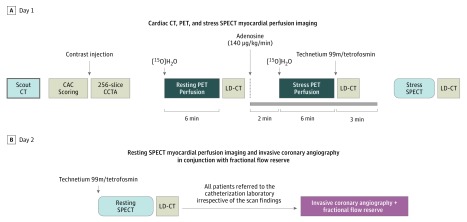
Design, setting, and participants: A prospective clinical study involving 208 patients with suspected CAD who underwent CCTA, technetium 99m/tetrofosmin-labeled SPECT, and [15O]H2O PET with examination of all coronary arteries by fractional flow reserve was performed from January 23, 2012, to October 25, 2014. Scans were interpreted by core laboratories on an intention-to-diagnose basis. Hybrid images were generated in case of abnormal noninvasive anatomical or functional test results.
Main outcomes and measures: Hemodynamically significant stenosis in at least 1 coronary artery as indicated by a fractional flow reserve of 0.80 or less and relative diagnostic accuracy of SPECT, PET, and CCTA in detecting hemodynamically significant CAD.
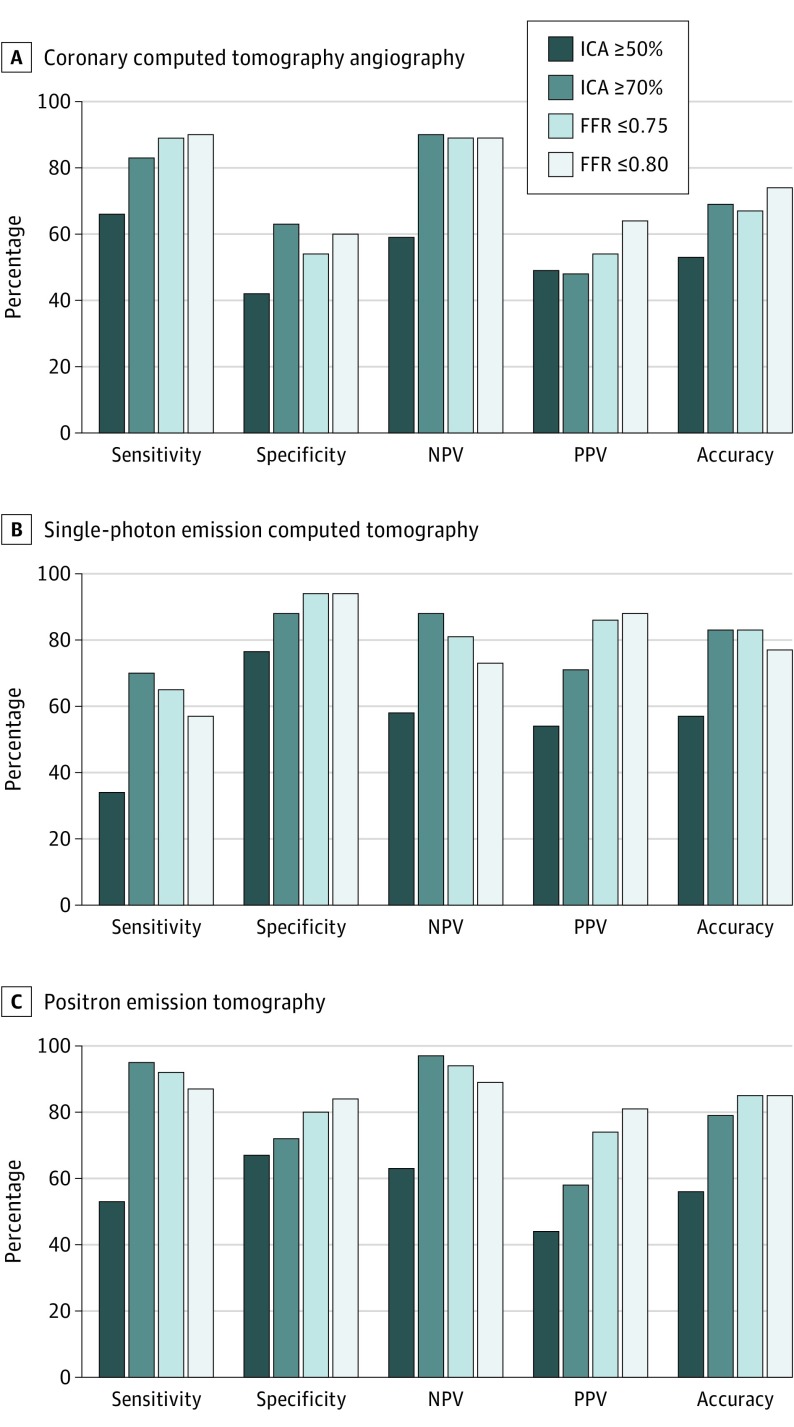
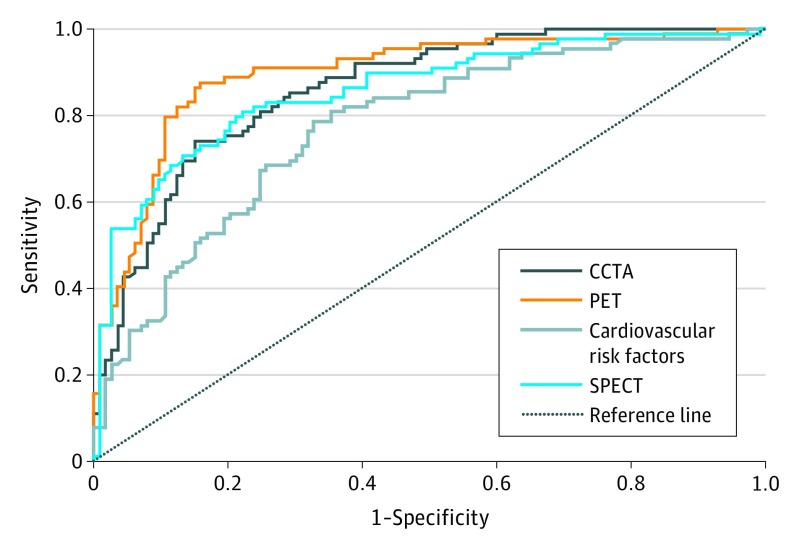
Results: Of the 208 patients in the study (76 women and 132 men; mean [SD] age, 58 [9] years), 92 (44.2%) had significant CAD (fractional flow reserve ≤0.80). Sensitivity was 90% (95% CI, 82%-95%) for CCTA, 57% (95% CI, 46%-67%) for SPECT, and 87% (95% CI, 78%-93%) for PET, whereas specificity was 60% (95% CI, 51%-69%) for CCTA, 94% (95% CI, 88%-98%) for SPECT, and 84% (95% CI, 75%-89%) for PET. Single-photon emission tomography was found to be noninferior to PET in terms of specificity (P < .001) but not in terms of sensitivity (P > .99) using the predefined absolute margin of 10%. Diagnostic accuracy was highest for PET (85%; 95% CI, 80%-90%) compared with that of CCTA (74%; 95% CI, 67%-79%; P = .003) and SPECT (77%; 95% CI, 71%-83%; P = .02). Diagnostic accuracy was not enhanced by either hybrid SPECT and CCTA (76%; 95% CI, 70%-82%; P = .75) or by PET and CCTA (84%; 95% CI, 79%-89%; P = .82), but resulted in an increase in specificity (P = .004) at the cost of a decrease in sensitivity (P = .001).
Conclusions and relevance: This controlled clinical head-to-head comparative study revealed PET to exhibit the highest accuracy for diagnosis of myocardial ischemia. Furthermore, a combined anatomical and functional assessment does not add incremental diagnostic value but guides clinical decision-making in an unsalutary fashion.
Conflict of interest statement
Figures
Comment in
-
SPECT, PET, and CTA-Acronyms or Better Imaging?JAMA Cardiol. 2017 Oct 1;2(10):1108-1109. doi: 10.1001/jamacardio.2017.2588. JAMA Cardiol. 2017. PMID: 28813569 No abstract available.
References
-
- Di Carli MF, Hachamovitch R. New technology for noninvasive evaluation of coronary artery disease. Circulation. 2007;115(11):1464-1480. - PubMed
-
- Gaemperli O, Bengel FM, Kaufmann PA. Cardiac hybrid imaging. Eur Heart J. 2011;32(17):2100-2108. - PubMed
-
- Kajander S, Joutsiniemi E, Saraste M, et al. Cardiac positron emission tomography/computed tomography imaging accurately detects anatomically and functionally significant coronary artery disease. Circulation. 2010;122(6):603-613. - PubMed
-
- Danad I, Raijmakers PG, Appelman YE, et al. Hybrid imaging using quantitative H215O PET and CT-based coronary angiography for the detection of coronary artery disease. J Nucl Med. 2013;54(1):55-63. - PubMed
-
- Tonino PA, De Bruyne B, Pijls NH, et al. ; FAME Study Investigators . Fractional flow reserve versus angiography for guiding percutaneous coronary intervention. N Engl J Med. 2009;360(3):213-224. - PubMed
Publication types
MeSH terms
Substances
LinkOut - more resources
Full Text Sources
Other Literature Sources
Medical
Miscellaneous