


Innate immune signaling in the ventral tegmental area contributes to drug-primed reinstatement of cocaine seeking
- PMID: 28813640
- PMCID: PMC6252252
- DOI: 10.1016/j.bbi.2017.08.012
Innate immune signaling in the ventral tegmental area contributes to drug-primed reinstatement of cocaine seeking
Abstract
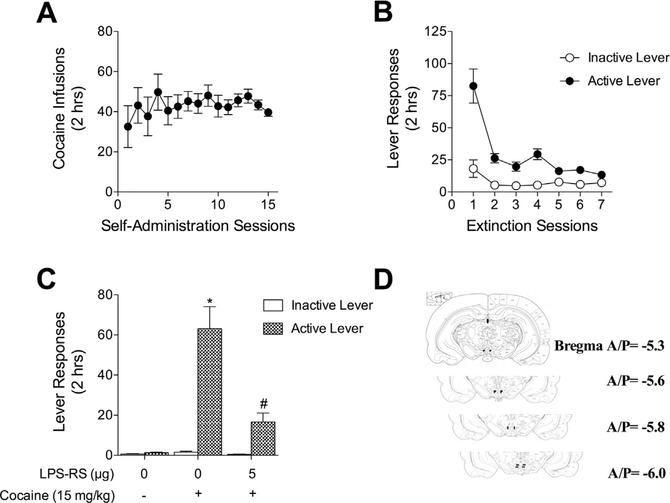
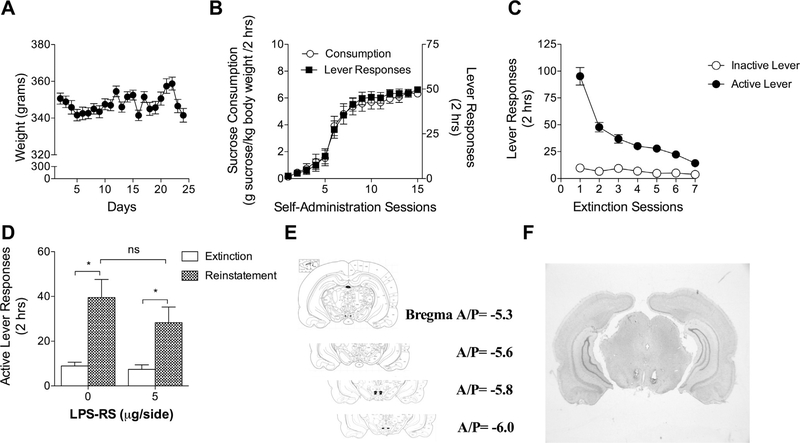
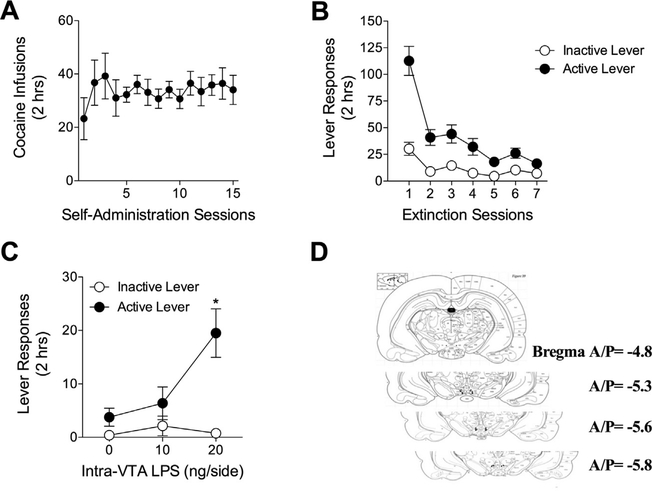
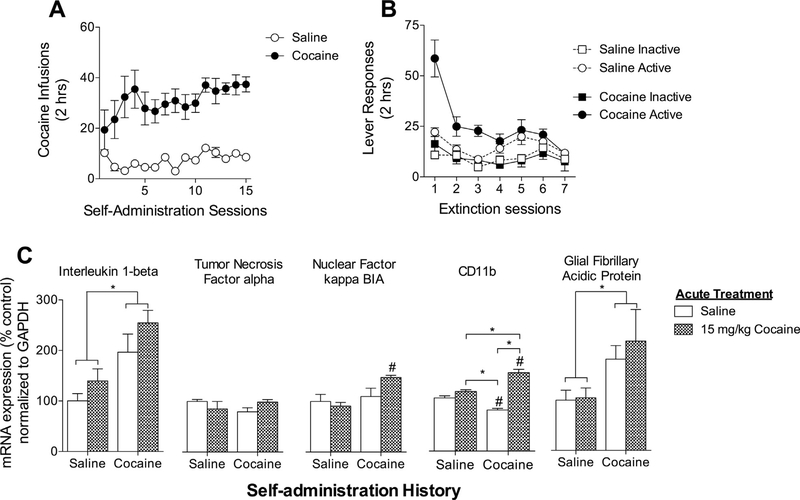
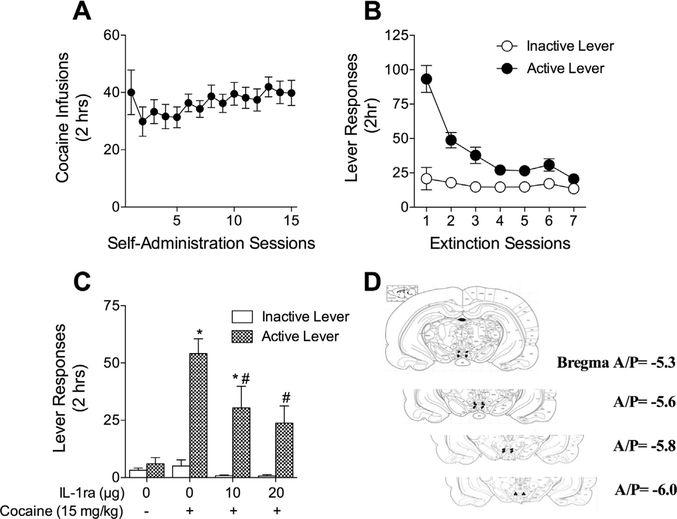
Cocaine addiction is a chronic relapsing disorder characterized by persistent perturbations to an organism's homeostatic processes that result in maladaptive drug seeking. Although considerable attention has been directed at the consequences of neuronal changes following chronic cocaine taking, few studies have examined the role of microglia, the brain's resident immune cells, following chronic cocaine administration. Toll-Like Receptor 4 (TLR4) is a molecular pattern receptor that recognizes pathogens, danger signals, and xenobiotics and induces proinflammatory signaling in the central nervous system. TLR4 is generally considered to be expressed primarily by microglia. Here, we used a rodent model of cocaine addiction to investigate the role of TLR4 in the ventral tegmental area (VTA) in cocaine seeking. Male Sprague-Dawley rats were trained to self-administer cocaine in daily 2-h sessions for 15days. Following self-administration, rats underwent extinction training and were tested in a drug-primed reinstatement paradigm. Pharmacological antagonism of TLR4 in the VTA using lipopolysaccharide from the bacterium Rhodobacter sphaeroides (LPS-RS) significantly reduced cocaine-primed reinstatement of drug seeking but had no effect on sucrose seeking. TLR4 activation within the VTA using the TLR4 activator, lipopolysaccharide, was sufficient to moderately reinstate cocaine seeking. We also assessed changes in proinflammatory cytokine expression in the VTA following cocaine self-administration. Cocaine self-administration increased the expression of mRNA for the proinflammatory cytokine interleukin-1ß, but not tumor necrosis factor alpha, in the VTA. Pharmacological antagonism of the interleukin-1 receptor in the VTA reduced cocaine-primed drug seeking. These results are consistent with the hypothesis that chronic cocaine produces inflammatory signaling that contributes to cocaine seeking.
Keywords: Addiction; Cocaine; Cytokines; Interleukin-1ß; Neuroinflammation.
Copyright © 2017. Published by Elsevier Inc.
Figures
References
-
- Alfonso-Loeches S, Pascual-Lucas M, Blanco AM, Sanchez-Vera I, Guerri C, 2010. Pivotal role of TLR4 receptors in alcohol-induced neuroinflammation and brain damage. J. Neurosci 3, 8285–8295. http://dx.doi.org/10.1523/JNEUROSCI.0976-10.2010. - DOI - PMC - PubMed
-
- Araos P, Pedraz M, Serrano A, Lucena M, Barrios V, García-Marchena N, Campos-Cloute R, Ruiz JJ, Romero P, Suárez J, Baixeras E, de la Torre R, Montesinos J, Guerri C, Rodríguez-Arias M, Miñarro J, Martínez-Riera R, Torrens M, Chowen JA, Argente J, Mason BJ, Pavón FJ, Rodríguez de Fonseca F, 2015. Plasma profile of pro-inflammatory cytokines and chemokines in cocaine users under outpatient treatment: influence of cocaine symptom severity and psychiatric co-morbidity: Inflammation and cocaine addiction. Addict. Biol 20, 756–772. http://dx.doi.org/10.1111/adb.12156. - DOI - PubMed
-
- Avital A, Goshen I, Kamsler A, Segal M, Iverfeldt K, Richter-Levin G, Yirmiya R, 2003. Impaired interleukin-1 signaling is associated with deficits in hippocampal memory processes and neural plasticity. Hippocampus 13,826–834. http://dx.doi.org/10.1002/hipo.10135. - DOI - PubMed
-
- Bajo M, Varodayan FP, Madamba SG, Robert AJ, Casal LM, Oleata CS, Siggins GR, Roberto M, 2015. IL-1 interacts with ethanol effects on GABAergic transmission in the mouse central amygdala. Front. Pharmacol 6 http://dx.doi.org/10.3389/fphar.2015.00049. - DOI - PMC - PubMed
MeSH terms
Substances
Grants and funding
LinkOut - more resources
Full Text Sources
Other Literature Sources
Medical
