


Serum ghrelin is associated with risk of colorectal adenocarcinomas in the ATBC study
- PMID: 28814486
- PMCID: PMC5815951
- DOI: 10.1136/gutjnl-2016-313157
Serum ghrelin is associated with risk of colorectal adenocarcinomas in the ATBC study
Abstract
Background: Colorectal cancers are the third most common cancers in women and men in the USA. While dietary and lifestyle factors such as Western diet, physical inactivity and obesity have been linked to an increased risk of this malignancy, the mechanisms for these associations are unclear. GI hormones, including ghrelin, are involved in energy balance by mediating appetite and metabolism; however, the association between ghrelin and colorectal cancer has not been studied.
Methods: We conducted a case-control study nested within the all-male Alpha-Tocopherol, Beta-Carotene Cancer Prevention Study of Finnish smokers (aged 50-69 years) to examine serum ghrelin concentration and colorectal cancer risk. Data from 284 colon and 239 rectal cancers and 523 controls (matched on age, date of blood draw and serum availability) were analysed. ORs and 95% CIs were calculated using multivariable (conditional) logistic regression.
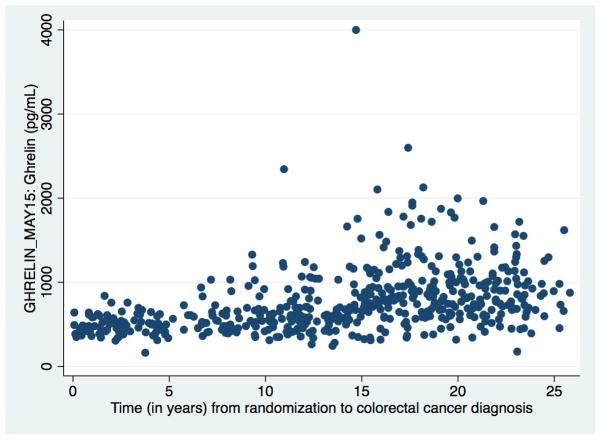
Results: Overall, low-serum ghrelin was significantly associated with increased risk of colorectal cancer (Q1 vs Q4: OR:1.57, 95% CI 1.05 to 2.34). For individuals developing tumours within 10 years of blood draw, those in the lowest quartile of serum ghrelin concentrations were statistically significantly more likely to develop colorectal cancers than those with higher serum ghrelin concentrations (OR: 10.86, 95% CI 5.01 to 23.55). However, for individuals with tumours developing more than 20 years after blood draw, low-serum ghrelin concentrations were associated with a decreased risk of colorectal cancer relative to those with the highest serum ghrelin concentrations (OR: 0.26, 95% CI 0.11 to 0.64).
Conclusion: Low-serum ghrelin was associated with an increased colorectal cancer risk within 10 years of blood draw with a decreased risk for developing colorectal cancer more than 20 years after blood draw. These results suggest that ghrelin concentrations may vary across the carcinogenic process.
Keywords: colon cancer; gastrointestinal hormones; ghrelin; rectal cancer.
© Article author(s) (or their employer(s) unless otherwise stated in the text of the article) 2018. All rights reserved. No commercial use is permitted unless otherwise expressly granted.
Conflict of interest statement
Competing interests: None declared.
Figures
Comment in
-
Plasma ghrelin is probably not a useful biomarker for risk prediction or early detection of colorectal cancer.Gut. 2019 Feb;68(2):373-374. doi: 10.1136/gutjnl-2018-316110. Epub 2018 Feb 28. Gut. 2019. PMID: 29491131 Free PMC article. No abstract available.
References
-
- Ferlay JSI, Ervik M, Dikshit R, Eser S, Mathers C, Rebelo M, Parkin DM, Forman D, Bray F. GLOBOCAN 2012 v1.0, Cancer Incidence and Mortality Worldwide: IARC CancerBase No. 11 [Internet] Lyon, France: International Agency for Research on Cancer; 2013.
-
- World Cancer Research Fund/American Institute for Cancer Research. Food, Nutrition, Physical Activity and the Prevention of Cancer: a Global Perspective. Washington DC: AICR; 2007.
MeSH terms
Substances
Grants and funding
LinkOut - more resources
Full Text Sources
Other Literature Sources
Medical
