. 2017 Oct 13;91(21):e01058-17.
doi: 10.1128/JVI.01058-17. Print 2017 Nov 1.

BA71ΔCD2: a New Recombinant Live Attenuated African Swine Fever Virus with Cross-Protective Capabilities

Affiliations

BA71ΔCD2: a New Recombinant Live Attenuated African Swine Fever Virus with Cross-Protective Capabilities

Paula L Monteagudo et al. J Virol. .

Abstract

African swine fever is a highly contagious viral disease of mandatory declaration to the World Organization for Animal Health (OIE). The lack of available vaccines makes its control difficult; thus, African swine fever virus (ASFV) represents a major threat to the swine industry. Inactivated vaccines do not confer solid protection against ASFV. Conversely, live attenuated viruses (LAV), either naturally isolated or obtained by genetic manipulation, have demonstrated reliable protection against homologous ASFV strains, although little or no protection has been demonstrated against heterologous viruses. Safety concerns are a major issue for the use of ASFV attenuated vaccine candidates and have hampered their implementation in the field so far. While trying to develop safer and efficient ASFV vaccines, we found that the deletion of the viral CD2v (EP402R) gene highly attenuated the virulent BA71 strain in vivo Inoculation of pigs with the deletion mutant virus BA71ΔCD2 conferred protection not only against lethal challenge with the parental BA71 but also against the heterologous E75 (both genotype I strains). The protection induced was dose dependent, and the cross-protection observed in vivo correlated with the ability of BA71ΔCD2 to induce specific CD8+ T cells capable of recognizing both BA71 and E75 viruses in vitro Interestingly, 100% of the pigs immunized with BA71ΔCD2 also survived lethal challenge with Georgia 2007/1, the genotype II strain of ASFV currently circulating in continental Europe. These results open new avenues to design ASFV cross-protective vaccines, essential to fight ASFV in areas where the virus is endemic and where multiple viruses are circulating.IMPORTANCE African swine fever virus (ASFV) remains enzootic in most countries of Sub-Saharan Africa, today representing a major threat for the development of their swine industry. The uncontrolled presence of ASFV has favored its periodic exportation to other countries, the last event being in Georgia in 2007. Since then, ASFV has spread toward neighboring countries, reaching the European Union's east border in 2014. The lack of available vaccines against ASFV makes its control difficult; so far, only live attenuated viruses have demonstrated solid protection against homologous experimental challenges, but they have failed at inducing solid cross-protective immunity against heterologous viruses. Here we describe a new LAV candidate with unique cross-protective abilities: BA71ΔCD2. Inoculation of BA71ΔCD2 protected pigs not only against experimental challenge with BA71, the virulent parental strain, but also against heterologous viruses, including Georgia 2007/1, the genotype II strain of ASFV currently circulating in Eastern Europe.

Keywords: African swine fever virus; CD8 T cells; cross-protection; live attenuated virus; vaccine.


Figures

FIG 1
FIG 1
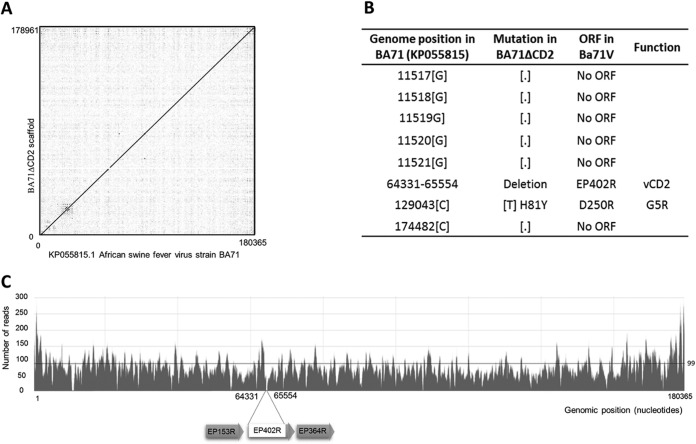
BA71ΔCD2 is genetically stable in COS-1 cells. (A) Dot plot representing the conservation of the sequence of BA71ΔCD2 after passages in COS-1 cells compared with the BA71 parental strain. The continuous line of dots with a slope of 1 represents the undisturbed segment of conservation, disrupted only in the region where the EP402R gene was deleted. (B) Detailed table showing the differences observed between the genomes. (C) Depth of the genome sequence obtained. The partial deletion of the EP402R gene and the two genes flanking the region are schematically represented below the plot.
FIG 2
FIG 2
TK is essential for BA71 growing in porcine alveolar macrophages (PAMs) in vitro, while CD2v is not. PAMs were infected at a multiplicity of infection (MOI) of 1 with the following virus stocks: BA71 (BA71 grown in macrophages), BA71-Cos (BA71 grown in COS-1 cells), BA71ΔCD2 (BA71Cos deficient in the CD2v gene grown in COS-1 cells), and BA71ΔTK (BA71-Cos lacking the thymidine kinase gene and grown in COS-1 cells), and the kinetics of virus production was moniotored by harvesting of the cell supernatants at different times. All samples were directly titrated by plaque assay in COS-1 cells, and the results were plotted in the logarithmic scale as PFU per milliliter of cell supernatant.
FIG 3
FIG 3
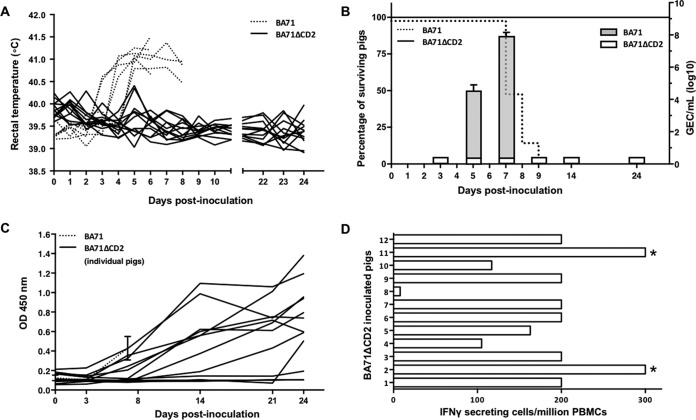
CD2v deletion attenuates BA71. Pigs were immunized with 103 PFU of either BA71 (discontinuous lines) or BA71ΔCD2 (continuous lines) and different parameters were monitored, including fever, viremia, death, and induction of specific antibodies and T cells. (A) Rectal temperatures were taken for individual pigs at different days after infection with either BA71 (discontinuous line) or BA71ΔCD2 (continuous line). (B) Average viremia kinetics from pigs immunized with BA71 (gray bars) or BA71ΔCD2 (white bars) are represented together with their corresponding standard deviations (right y axis). Virus titers are represented in the logarithmic scale as genome-equivalent copies per milliliter of serum. The percentage of surviving pigs after infection with BA71 (discontinuous line) or BA71ΔCD2 (continuous line) is also represented (left y axis). (C) The induction of ASFV-specific antibodies was measured by ELISA, and data corresponding to the kinetics of antibody induction for the 12 individual pigs inoculated with BA71ΔCD2 (continuous lines) are shown as optical density values. Averages and standard deviations for 6 pigs infected with BA71 are also represented. (D) Data correspond to the number of ASFV-specific T cells detectable in blood of the 12 pigs inoculated with BA71ΔCD2 24 days after its administration. Values correspond to the number of T cells that specifically secrete IFN-γ after BA71ΔCD2 in vitro stimulation per million peripheral blood mononuclear cells (PBMCs). *, ≥300 IFN-γ-secreting cells.
FIG 4
FIG 4
Homologous protection afforded by BA71ΔCD2. The degree of protection afforded by the different doses of BA71ΔCD2 (continuous lines) after BA71 lethal challenge is shown by comparing the fever (A) and the viremia (B) kinetics after BA71 challenge and monitoring the proportion of surviving pigs left in each group (C). Data plotted in panels A and B correspond to average values per animal group and time tested, while error bars represent the standard deviations. The levels of ASFV-specific antibodies (gray bars, left y axis) and T cells (▲, right y axis) found in the blood of the individual pigs just before BA71 challenge are also shown (D). Control, challenge control (discontinuous lines). *, ≥300 IFN-γ-secreting cells; +, BA71ΔCD2-inoculated pigs not protected against BA71 lethal challenge.
FIG 5
FIG 5
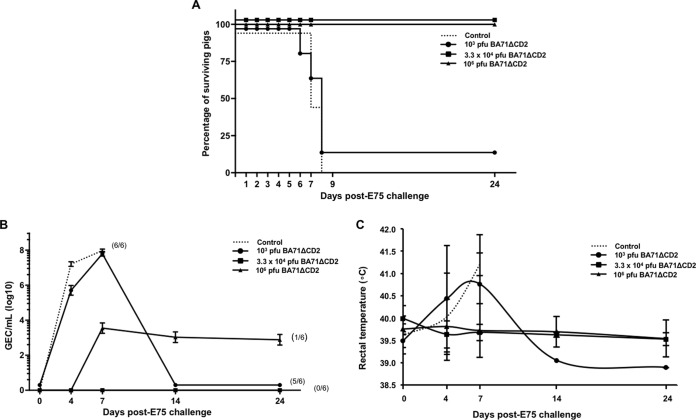
Heterologous protection afforded by BA71ΔCD2. The degrees of protection afforded by the different doses of BA71ΔCD2 after E75 lethal challenge were evaluated by moniotoring the proportion of surviving pigs left in each group (A) and comparing the viremia (B) and the fever (C) kinetics after E75 challenge. Data plotted in panels B and C correspond to average values per animal group and time tested, while error bars represent the standard deviations. Control, challenge control (discontinuous lines) and groups with different doses of BA71ΔCD2 (continuous lines).
FIG 6
FIG 6
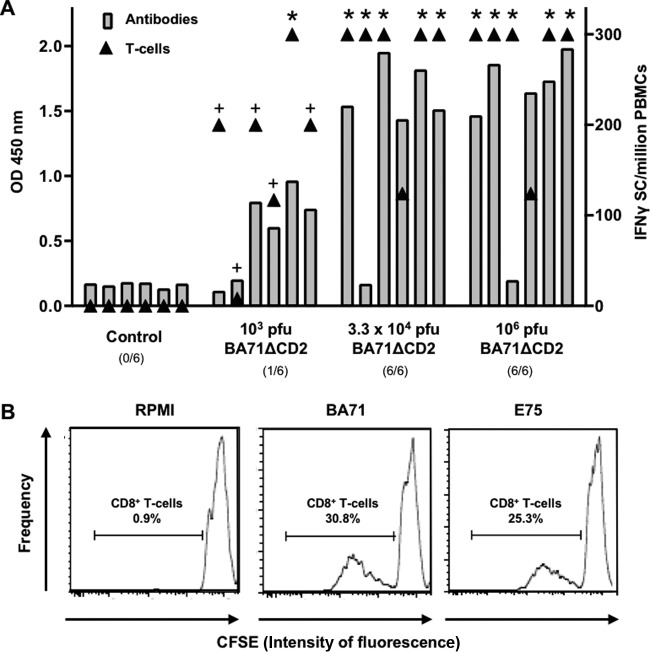
Cross-protection correlates with the ability of BA71ΔCD2 to induce cross-reactive CD8+ T cells. The levels of ASFV-specific antibodies (gray bars, left y axis) and T cells (▲, right y axis) found in the blood of individual BA71ΔCD2-inoculated pigs just before E75 challenge are shown (A). The percentage of CD8+ T cells specifically proliferating in response to in vitro BA71 or E75 stimulation is also shown (B). The histogram displays the results obtained from a BA71ΔCD2-inoculated pig that survived E75 challenge, using PBMCs obtained just before E75 challenge. *, ≥300 IFN-γ secreting cells; +, BA71ΔCD2-inoculated pigs not protected against E75 lethal challenge.
FIG 7
FIG 7
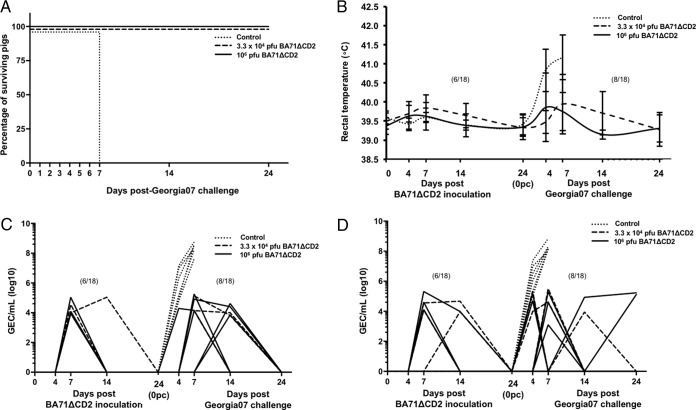
BA71ΔCD2 protects against Georgia 2007/1 heterologous challenge. The degrees of protection afforded by the different doses of BA71ΔCD2 were evaluated after Georgia 2007/1 lethal challenge by monitoring the proportion of surviving pigs left in each group (A) and by comparing the kinetics of fever (B), viremia (C), and ASFV nasal secretion (D). Data plotted in panels B, C, and D correspond to individual animals, and fever, viremia, and nasal secretion were monitored not only after Georgia 2007/1 challenge but also from the day of BA71ΔCD2 immunization. The proportion of pigs with fever and/or ASFV positive, before and/or after challenge, is shown in parentheses. Control, challenge control (discontinuous lines).
FIG 8
FIG 8
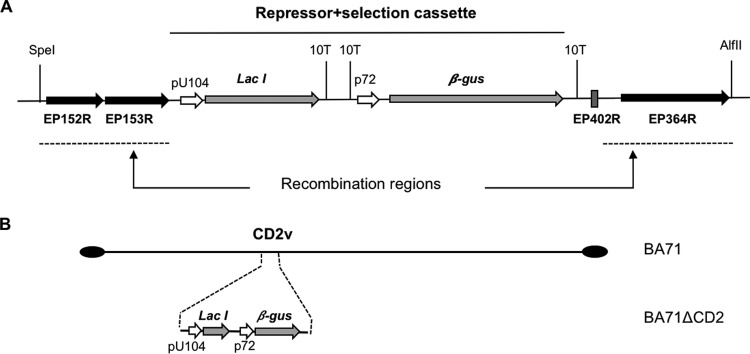
Schematic representation of pLacI.ΔCD2 plasmid and recombinant virus BA71ΔCD2. (A) The pLacI.ΔCD2 plasmid, the LacI repressor gene under the control of the ASFV early/late promoter pU104, and the marker β-glucuronidase gene under the control of the late p72 promoter are flanked by the recombination regions that consist of the EP152R and EP153R genes (upstream) and the EP364R gene and a 36-bp region of the EP402R gene (downstream). (B) BA71ΔCD2 recombinant virus lacks the EP402R gene (encoding the CD2v protein) and instead contains the LacI repressor gene under the control of the ASFV early/late promoter pU104 and the marker β-glucuronidase gene under the control of the p72 promoter.

References

    1. Oura CAL, Arias M. 2012. African swine fever, p 1067–1079 In Manual of diagnostic tests and vaccines for terrestrial animals, 7th ed, vol 2 World Organisation for Animal Health, Paris, France: https://www.oie.int/doc/ged/D12009.PDF.
    1. Jori F, Vial L, Penrith ML, Pérez-Sánchez R, Etter E, Albina E, Michaud V, Roger F. 2013. Review of the sylvatic cycle of African swine fever in sub-Saharan Africa and the Indian Ocean. Virus Res 173:212–227. doi: 10.1016/j.virusres.2012.10.005. - DOI - PubMed
    1. Rowlands RJ, Michaud V, Heath L, Hutchings G, Oura C, Vosloo W, Dwarka R, Onashvili T, Albina E, Dixon LK. 2008. African swine fever virus isolate, Georgia, 2007. Emerg Infect Dis 14:1870–1874. doi: 10.3201/eid1412.080591. - DOI - PMC - PubMed
    1. Oganesyan AS, Petrova ON, Korennoy FI, Bardina NS, Gogin AE, Dudnikov SA. 2013. African swine fever in the Russian Federation: spatio-temporal analysis and epidemiological overview. Virus Res 173:204–211. doi: 10.1016/j.virusres.2012.12.009. - DOI - PubMed
    1. Gogin A, Gerasimov V, Malogolovkin A, Kolbasov D. 2013. African swine fever in the North Caucasus region and the Russian Federation in years 2007–2012. Virus Res 173:198–203. doi: 10.1016/j.virusres.2012.12.007. - DOI - PubMed

Publication types

MeSH terms