. 2017 Aug 16;7(1):8465.
doi: 10.1038/s41598-017-08721-4.

Emotions alter muscle proprioceptive coding of movements in humans

Affiliations

Emotions alter muscle proprioceptive coding of movements in humans

Rochelle Ackerley et al. Sci Rep. .

Abstract

Emotions can evoke strong reactions that have profound influences, from gross changes in our internal environment to small fluctuations in facial muscles, and reveal our feelings overtly. Muscles contain proprioceptive afferents, informing us about our movements and regulating motor activities. Their firing reflects changes in muscle length, yet their sensitivity can be modified by the fusimotor system, as found in animals. In humans, the sensitivity of muscle afferents is modulated by cognitive processes, such as attention; however, it is unknown if emotional processes can modulate muscle feedback. Presently, we explored whether muscle afferent sensitivity adapts to the emotional situation. We recorded from single muscle afferents in the leg, using microneurography, and moved the ankle joint of participants, while they listened to evocative classical music to induce sad, neutral, or happy emotions, or sat passively (no music). We further monitored their physiological responses using skin conductance, heart rate, and electromyography measures. We found that muscle afferent firing was modified by the emotional context, especially for sad emotions, where the muscle spindle dynamic response increased. We suggest that this allows us to prime movements, where the emotional state prepares the body for consequent behaviour-appropriate reactions.


Conflict of interest statement

The authors declare that they have no competing interests.

Figures
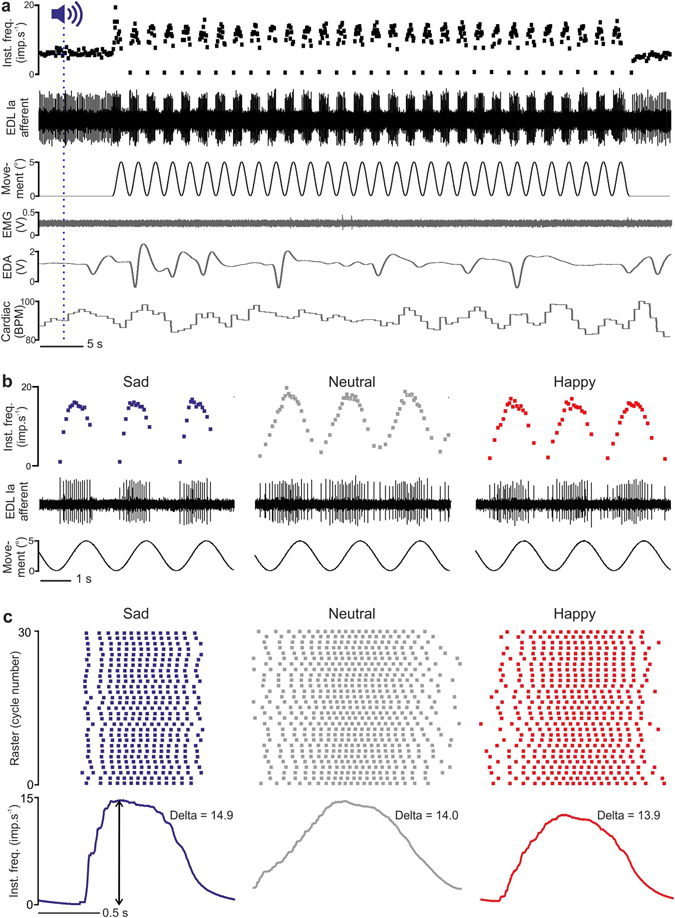
Figure 1
Figure 1
Responses from a single muscle afferent (from extensor digitorum longus, EDL) to movements during different emotional music. (a) Recordings to a full movement sequence during sad music. The top trace shows the instantaneous frequency of muscle afferent firing, with its activity shown below. The third trace shows the imposed sinusoidal movement, with a lack of concomitant EMG activity below. The fifth trace shows fluctuations in the electrodermal activity and the below trace demonstrates cardiac frequency. (b) For the same unit, activity is shown during three movements (bottom trace), over sad, neutral, and happy conditions. Differences can be seen in the instantaneous frequency (top) and unit firing (middle) between the conditions, with decreased activity during muscle shortenings in the sad condition. (c) Raster plots of spike activity for each condition are shown for the full movement, per sinusoid, with the mean response below. The dynamic response was measured by delta (change in the instantaneous frequency curve) for each condition.
Figure 2
Figure 2
Modulation of the muscle afferent dynamic responses over the conditions for the full group of units (left) and a sub-set with the additional no music condition (right). The top graphs show the overall changes in instantaneous firing frequency (delta). (a) A significant increase in delta was found during the sad condition, over the neutral and happy conditions for all units, which was also found in (b) the sub-set with the additional no music condition. Means with SEM are shown. The bottom row shows the spread of the population. (c) The distribution of delta (as a percentage) in comparison to the neutral music condition for all units. (d) The same distributions are shown for the sub-set of units with the no music condition. In both (c) and (d), the delta in the sad condition was significantly increased. *p < 0.05.
Figure 3
Figure 3
Changes in emotional ratings and physiological states over the conditions. (a) VAS ratings in the sad-happy dimension are shown over the emotional music conditions tested in the microneurography experiment. There was a significant difference between all the conditions. Physiological measures over all the experimental conditions (sad/happy/neutral music and no music). (b) Electrodermal activity was significantly increased during happy music, and there was a significant difference between sad and neutral music. (c) The mean heart rate was significantly higher during happy, as compared to neutral music. (d) Heart rate variability also changed with sad and happy emotions; a significant increase was found over the neutral music, and additionally, the sad emotion condition was significantly higher than the no music condition (not indicated for clarity). Means are shown with SEM, *p < 0.05.

References

    1. Johnson-laird PN, Oatley K. The language of emotions: An analysis of a semantic field. Cogn. Emot. 1989;3:81–123. doi: 10.1080/02699938908408075. - DOI
    1. Gandevia SC, Burke D. Does the nervous system depend on kinaesthetic information to control natural limb movements? Behav. Brain Sci. 1992;15:614–632. doi: 10.1017/S0140525X0006893X. - DOI
    1. Proske U, Gandevia SC. The kinaesthetic senses. J. Physiol. 2009;587:4139–46. doi: 10.1113/jphysiol.2009.175372. - DOI - PMC - PubMed
    1. Cacioppo JT, Petty RE, Losch ME, Kim HS. Electromyographic activity over facial muscle regions can differentiate the valence and intensity of affective reactions. J. Pers. Soc. Psychol. 1986;50:260–268. doi: 10.1037/0022-3514.50.2.260. - DOI - PubMed
    1. van Loon AM, van den Wildenberg WPM, van Stegeren AH, Ridderinkhof KR, Hajcak G. Emotional stimuli modulate readiness for action: A transcranial magnetic stimulation study. Cogn. Affect. Behav. Neurosci. 2010;10:174–181. doi: 10.3758/CABN.10.2.174. - DOI - PubMed

Publication types
