


Amygdala-centred functional connectivity affects daily cortisol concentrations: a putative link with anxiety
- PMID: 28814810
- PMCID: PMC5559590
- DOI: 10.1038/s41598-017-08918-7
Amygdala-centred functional connectivity affects daily cortisol concentrations: a putative link with anxiety
Abstract
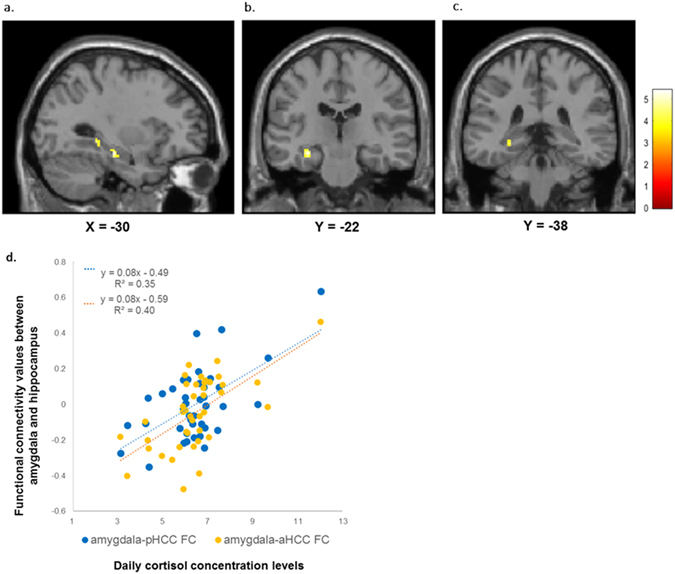
The amygdala plays a critical role in emotion. Its functional coupling with the hippocampus and ventromedial prefrontal cortex extending to a portion of the anterior cingulate cortex (ACC) is implicated in anxiogenesis and hypothalamic-pituitary-adrenal (HPA) system regulation. However, it remains unclear how amygdala-centred functional connectivity (FC) affects anxiety and cortisol concentrations in everyday life. Here, we investigate the relationship between daily cortisol concentrations (dCOR) and amygdala-centred FC during emotional processing in forty-one healthy humans. FC analyses revealed that higher dCOR predicted strengthened amygdala-centred FC with the hippocampus and cerebellum, but inhibited FC with the supramarginal gyrus and a perigenual part of the ACC (pgACC) when processing fearful faces (vs. neutral faces). Notably, the strength of amygdala-hippocampus FC mediated the positive relationship between cortisol and anxiety, specifically when the effect of amygdala-pgACC FC, a presumptive neural indicator of emotional control, was taken into account. Individuals with diminished connectivity between the amygdala and pgACC during fear-related processing might be more vulnerable to anxiogenesis as it pertains to greater circulating cortisol levels in everyday life. Individual functional patterns of amygdala-hippocampal-pgACC connectivity might provide a key to understand the complicate link between cortisol and anxiety-related behaviors.
Conflict of interest statement
Author H.T. received grants support from Astellas Pharma, Inc., MSD Inc., the Sanofi-Aventis Corp, and Otsuka Pharmaceutical Inc. All the authors except H.T. declare no conflict of interest associated with this manuscript.
Figures



References
Publication types
MeSH terms
Substances
LinkOut - more resources
Full Text Sources
Other Literature Sources
Medical
