


Emerging Gene Therapies for Genetic Hearing Loss
- PMID: 28815315
- PMCID: PMC5612923
- DOI: 10.1007/s10162-017-0634-8
Emerging Gene Therapies for Genetic Hearing Loss
Abstract
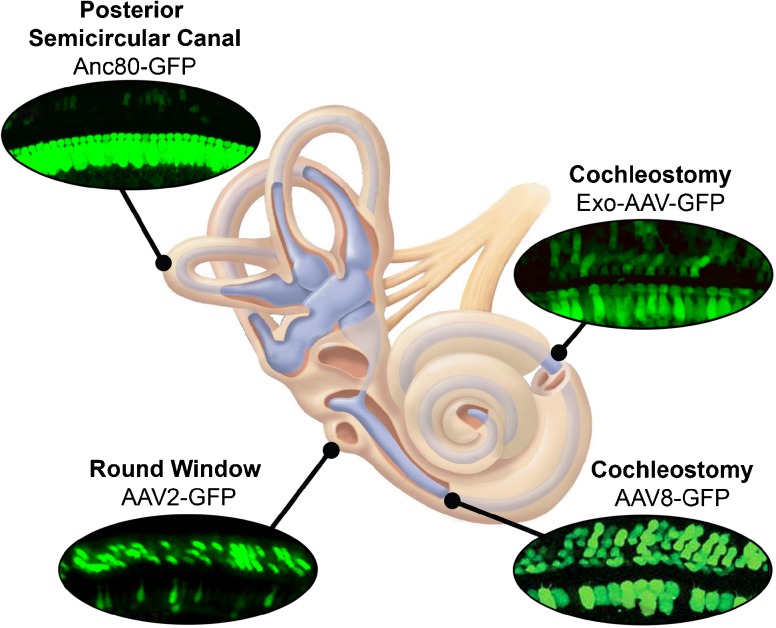
Gene therapy, or the treatment of human disease using genetic material, for inner ear dysfunction is coming of age. Recent progress in developing gene therapy treatments for genetic hearing loss has demonstrated tantalizing proof-of-principle in animal models. While successful translation of this progress into treatments for humans awaits, there is growing interest from patients, scientists, clinicians, and industry. Nonetheless, it is clear that a number of hurdles remain, and expectations for total restoration of auditory function should remain tempered until these challenges have been overcome. Here, we review progress, prospects, and challenges for gene therapy in the inner ear. We focus on technical aspects, including routes of gene delivery to the inner ear, choice of vectors, promoters, inner ear targets, therapeutic strategies, preliminary success stories, and points to consider for translating of these successes to the clinic.
Keywords: cochlea; gene therapy; genetic deafness; hair cell; inner ear; spiral ganglion neuron; vestibular; viral vectors.
Figures
References
-
- Adato A, Vreugde S, Joensuu T, Avidan N, Hamalainen R, Belenkiy O, Olender T, Bonne-Tamir B, Ben-Asher E, Espinos C, Millán JM. USH3A transcripts encode clarin-1, a four-transmembrane-domain protein with a possible role in sensory synapses. Eur J Hum Genet. 2002;10:339–350. doi: 10.1038/sj.ejhg.5200831. - DOI - PubMed
-
- Ahmad S, Tang W, Chang Q, Qu Y, Hibshman J, Li Y, Söhl G, Willecke K, Chen P, Lin X. Restoration of connexin26 protein level in the cochlea completely rescues hearing in a mouse model of human connexin30-linked deafness. Proc Natl Acad Sci. 2007;104:1337–1341. doi: 10.1073/pnas.0606855104. - DOI - PMC - PubMed
Publication types
MeSH terms
Grants and funding
LinkOut - more resources
Full Text Sources
Other Literature Sources
Medical
