


Treadmill training and body weight support for walking after stroke
- PMID: 28815562
- PMCID: PMC6483714
- DOI: 10.1002/14651858.CD002840.pub4
Treadmill training and body weight support for walking after stroke
Abstract
Background: Treadmill training, with or without body weight support using a harness, is used in rehabilitation and might help to improve walking after stroke. This is an update of the Cochrane review first published in 2003 and updated in 2005 and 2014.
Objectives: To determine if treadmill training and body weight support, individually or in combination, improve walking ability, quality of life, activities of daily living, dependency or death, and institutionalisation or death, compared with other physiotherapy gait-training interventions after stroke. The secondary objective was to determine the safety and acceptability of this method of gait training.
Search methods: We searched the Cochrane Stroke Group Trials Register (last searched 14 February 2017), the Cochrane Central Register of Controlled Trials (CENTRAL) and the Database of Reviews of Effects (DARE) (the Cochrane Library 2017, Issue 2), MEDLINE (1966 to 14 February 2017), Embase (1980 to 14 February 2017), CINAHL (1982 to 14 February 2017), AMED (1985 to 14 February 2017) and SPORTDiscus (1949 to 14 February 2017). We also handsearched relevant conference proceedings and ongoing trials and research registers, screened reference lists, and contacted trialists to identify further trials.
Selection criteria: Randomised or quasi-randomised controlled and cross-over trials of treadmill training and body weight support, individually or in combination, for the treatment of walking after stroke.
Data collection and analysis: Two review authors independently selected trials, extracted data, and assessed risk of bias and methodological quality. The primary outcomes investigated were walking speed, endurance, and dependency.
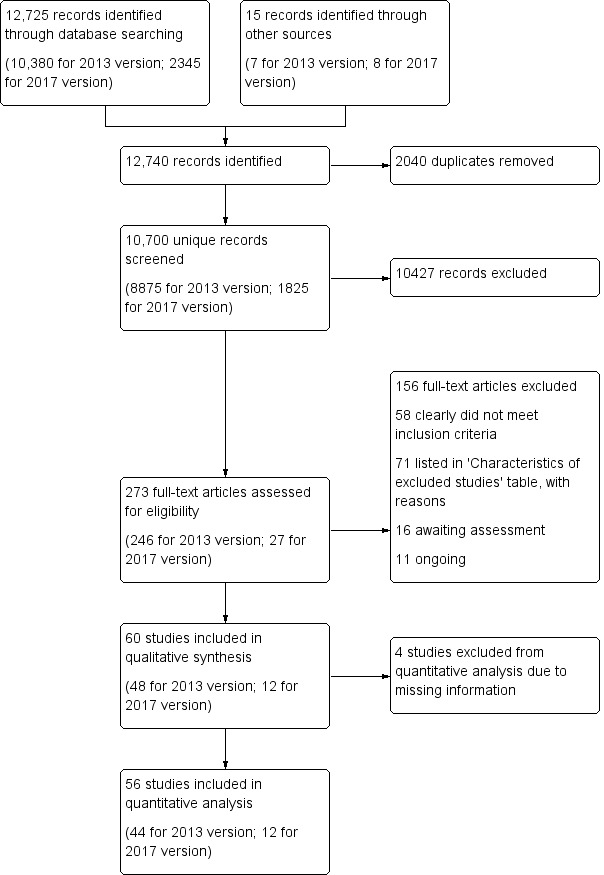
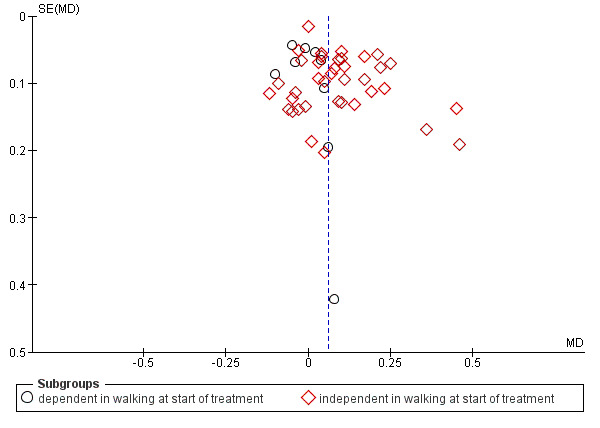
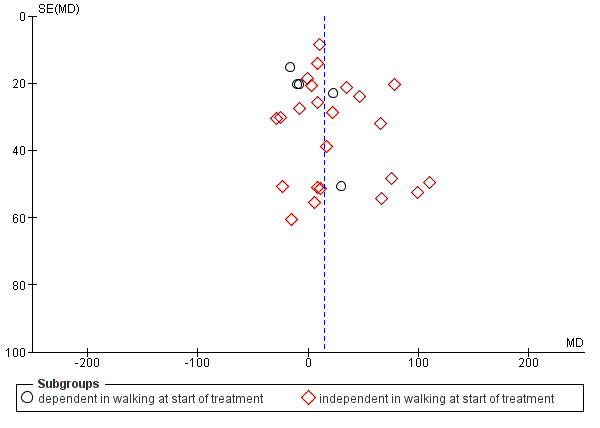
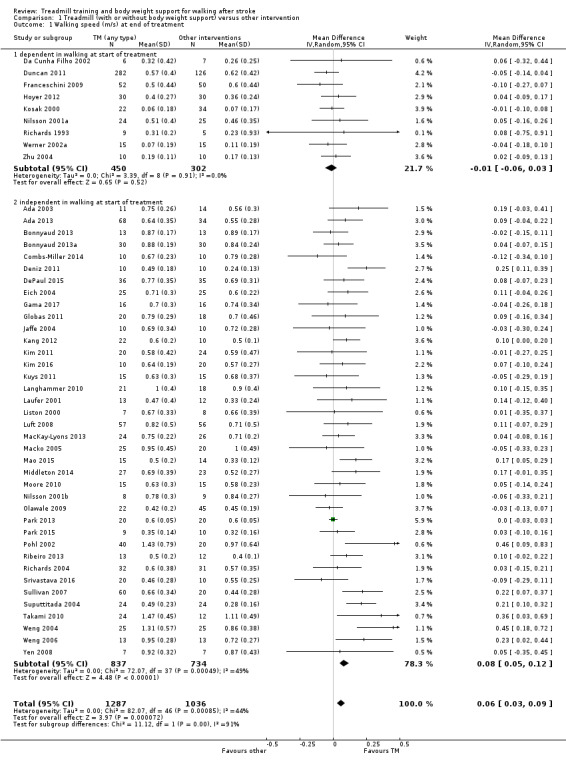
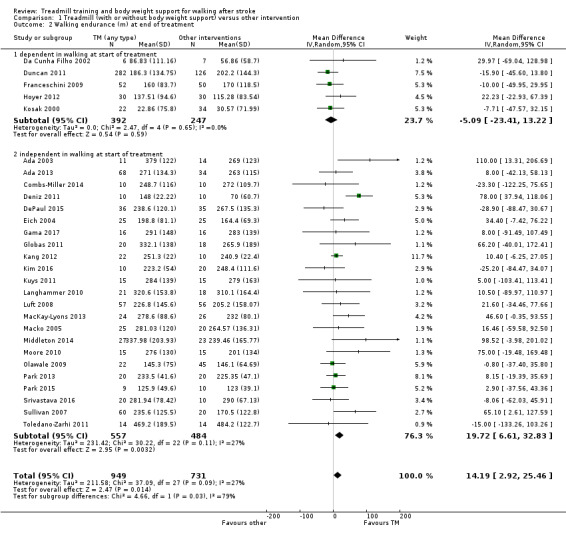
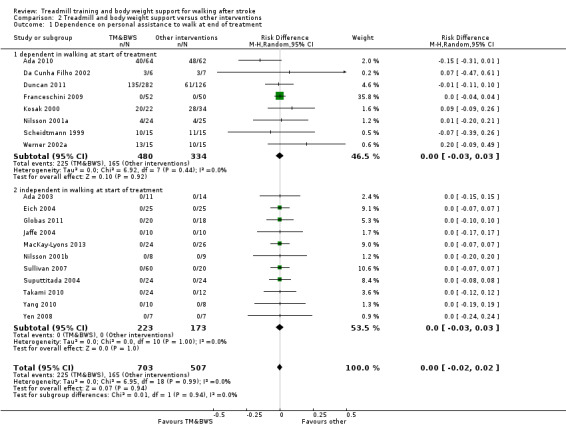
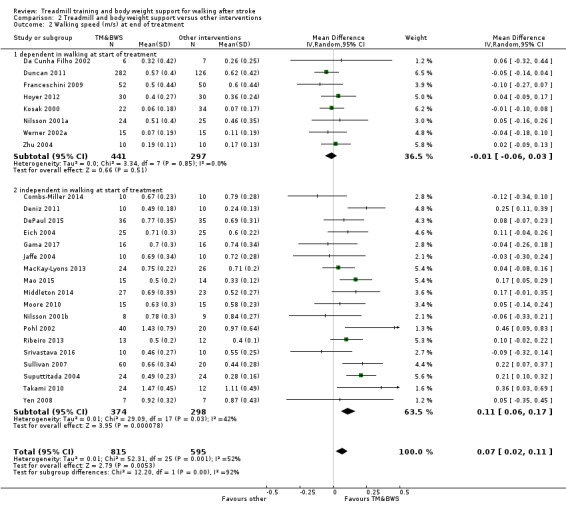
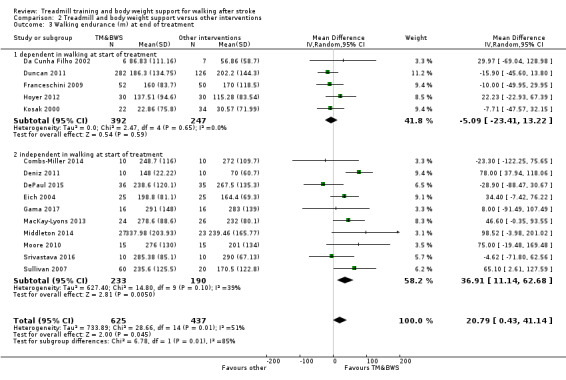
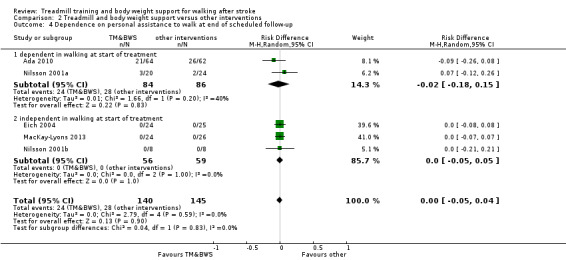
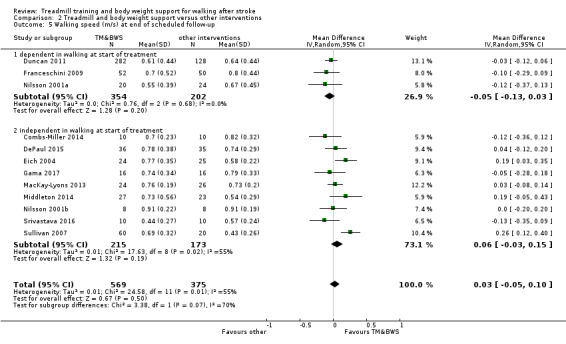
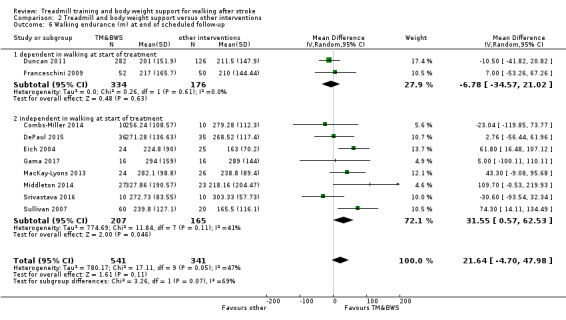
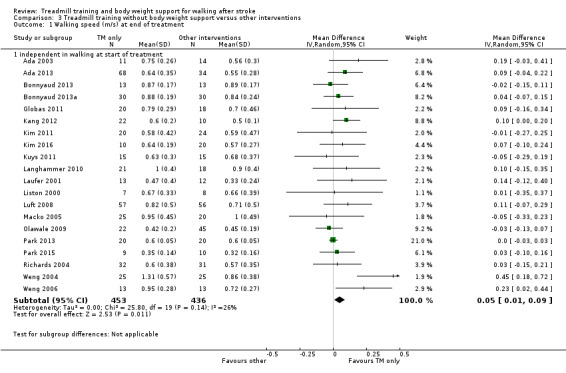
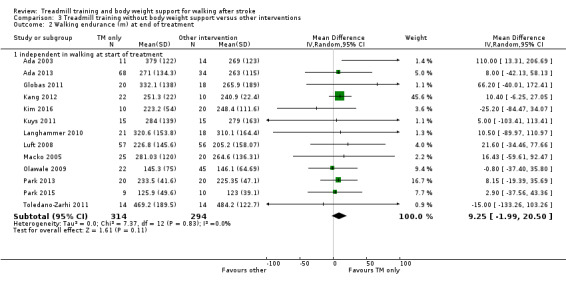
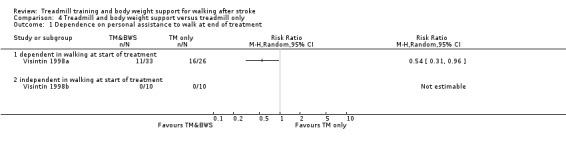
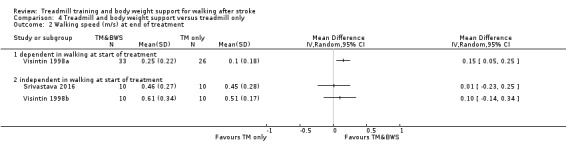
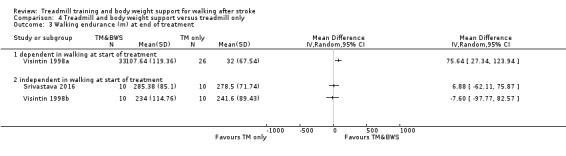
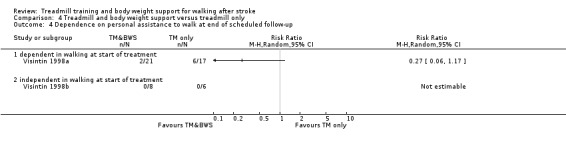
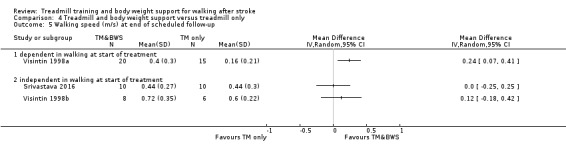
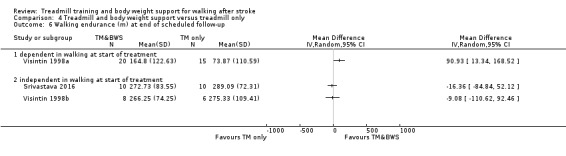
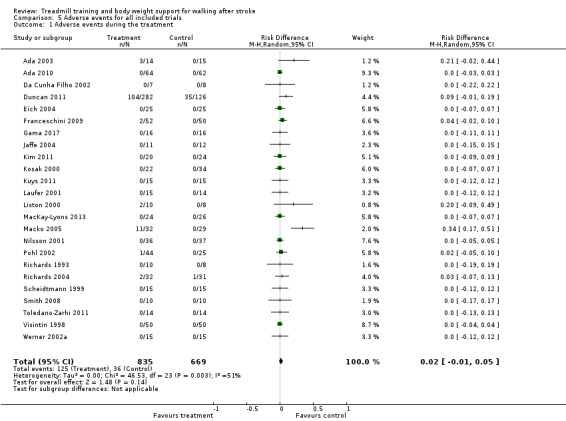
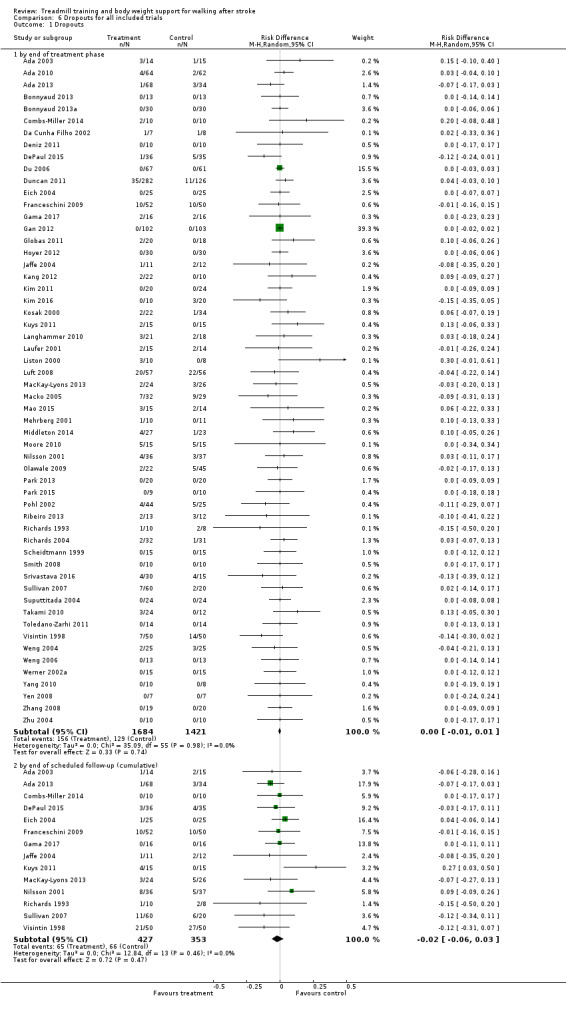
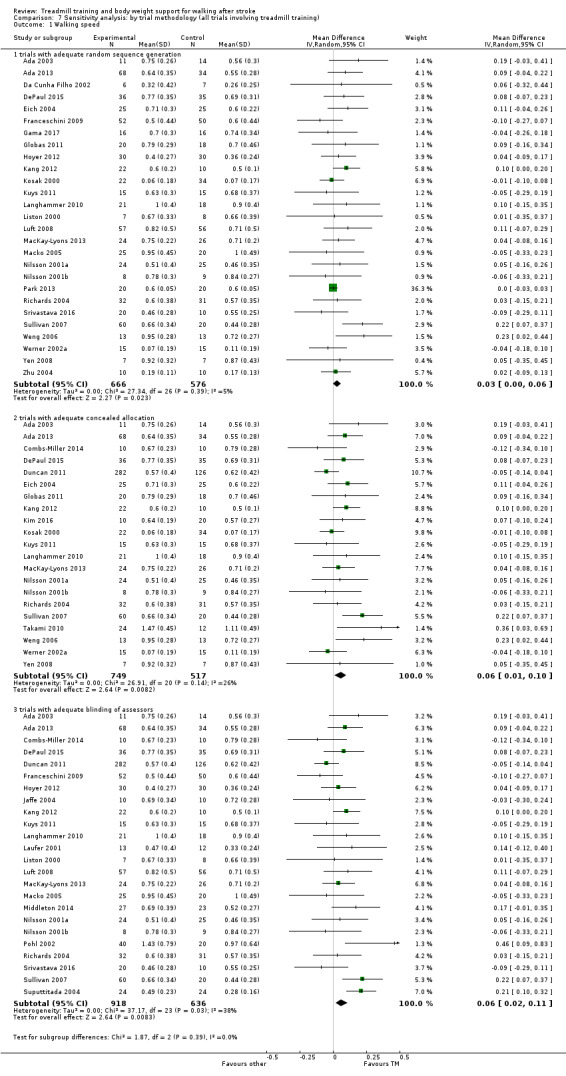
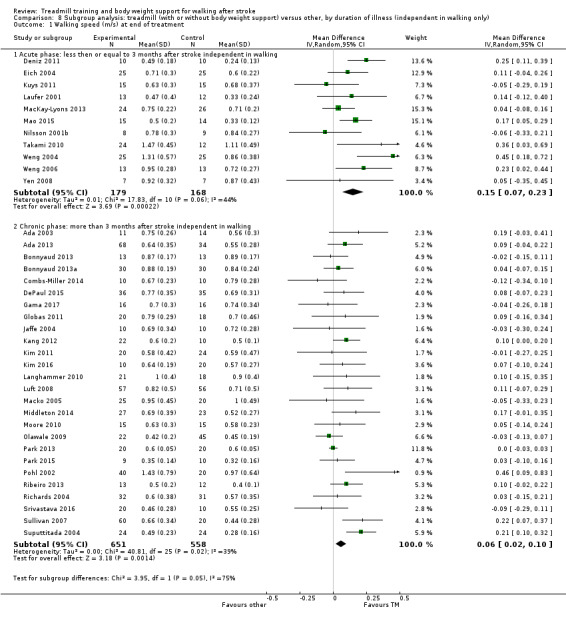
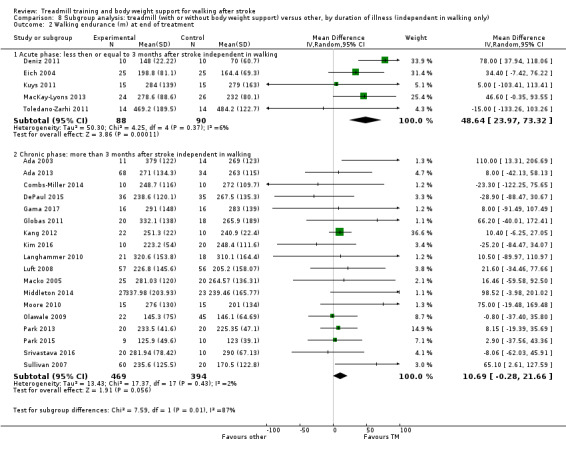
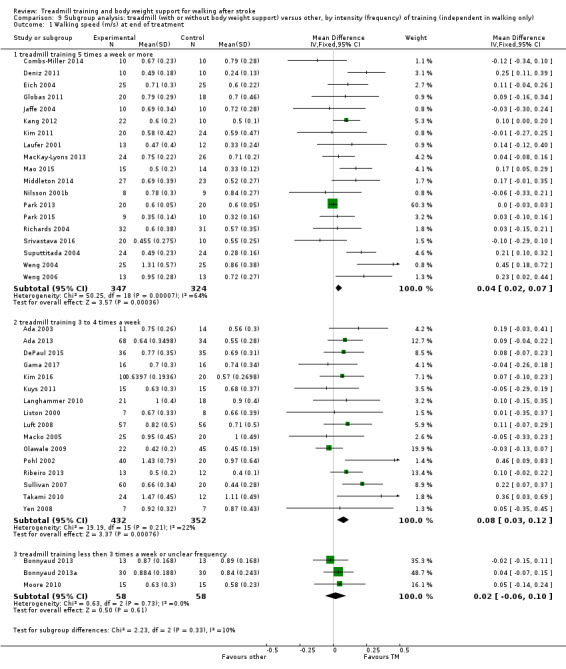
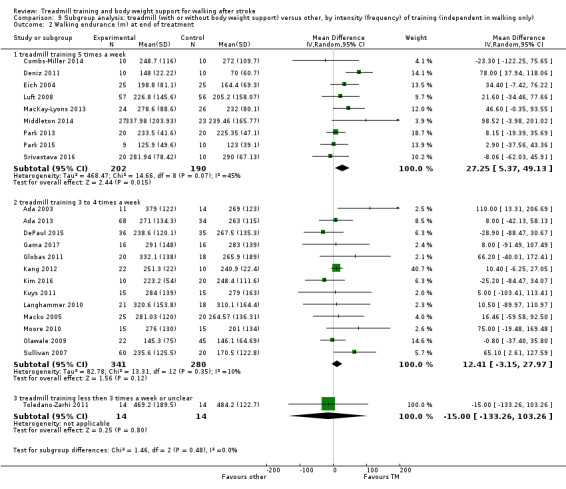
Main results: We included 56 trials with 3105 participants in this updated review. The average age of the participants was 60 years, and the studies were carried out in both inpatient and outpatient settings. All participants had at least some walking difficulties and many could not walk without assistance. Overall, the use of treadmill training did not increase the chances of walking independently compared with other physiotherapy interventions (risk difference (RD) -0.00, 95% confidence interval (CI) -0.02 to 0.02; 18 trials, 1210 participants; P = 0.94; I² = 0%; low-quality evidence). Overall, the use of treadmill training in walking rehabilitation for people after stroke increased the walking velocity and walking endurance significantly. The pooled mean difference (MD) (random-effects model) for walking velocity was 0.06 m/s (95% CI 0.03 to 0.09; 47 trials, 2323 participants; P < 0.0001; I² = 44%; moderate-quality evidence) and the pooled MD for walking endurance was 14.19 metres (95% CI 2.92 to 25.46; 28 trials, 1680 participants; P = 0.01; I² = 27%; moderate-quality evidence). Overall, the use of treadmill training with body weight support in walking rehabilitation for people after stroke did not increase the walking velocity and walking endurance at the end of scheduled follow-up. The pooled MD (random-effects model) for walking velocity was 0.03 m/s (95% CI -0.05 to 0.10; 12 trials, 954 participants; P = 0.50; I² = 55%; low-quality evidence) and the pooled MD for walking endurance was 21.64 metres (95% CI -4.70 to 47.98; 10 trials, 882 participants; P = 0.11; I² = 47%; low-quality evidence). In 38 studies with a total of 1571 participants who were independent in walking at study onset, the use of treadmill training increased the walking velocity significantly. The pooled MD (random-effects model) for walking velocity was 0.08 m/s (95% CI 0.05 to 0.12; P < 0.00001; I2 = 49%). There were insufficient data to comment on any effects on quality of life or activities of daily living. Adverse events and dropouts did not occur more frequently in people receiving treadmill training and these were not judged to be clinically serious events.
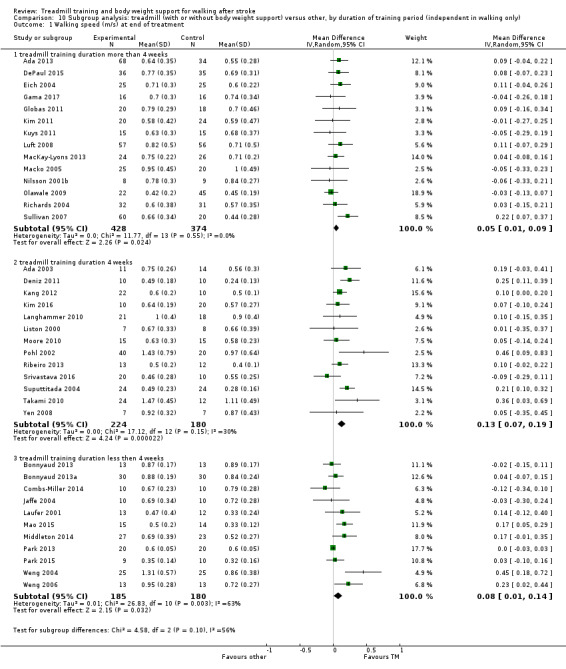
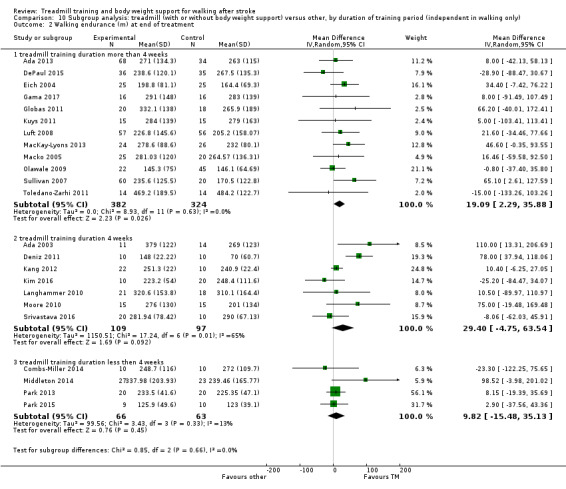
Authors' conclusions: Overall, people after stroke who receive treadmill training, with or without body weight support, are not more likely to improve their ability to walk independently compared with people after stroke not receiving treadmill training, but walking speed and walking endurance may improve slightly in the short term. Specifically, people with stroke who are able to walk (but not people who are dependent in walking at start of treatment) appear to benefit most from this type of intervention with regard to walking speed and walking endurance. This review did not find, however, that improvements in walking speed and endurance may have persisting beneficial effects. Further research should specifically investigate the effects of different frequencies, durations, or intensities (in terms of speed increments and inclination) of treadmill training, as well as the use of handrails, in ambulatory participants, but not in dependent walkers.
Conflict of interest statement
Bernhard Elsner: none known. Simone Thomas: none known. Jan Mehrholz: author of one included trial (Pohl 2002). He did not participate in quality assessment and data extraction for this study.
Figures

Update of
-
Treadmill training and body weight support for walking after stroke.Cochrane Database Syst Rev. 2014 Jan 23;2014(1):CD002840. doi: 10.1002/14651858.CD002840.pub3. Cochrane Database Syst Rev. 2014. Update in: Cochrane Database Syst Rev. 2017 Aug 17;8:CD002840. doi: 10.1002/14651858.CD002840.pub4. PMID: 24458944 Free PMC article. Updated.
References
References to studies included in this review
Ada 2003 {published and unpublished data}
-
- Ada L, Dean C, Crompton S, Hall J, Bampton J. The efficacy of treadmill training in improving walking in individuals after stroke in the community: a placebo‐controlled, randomised trial. VIIth International Physiotherapy Congress. Sydney: Australian Physiotherapy Association, 2002:61.
-
- Ada L, Dean C, Hall J, Bampton J, Crompton S. A treadmill and overground walking program improves walking in individuals residing in the community after stroke: a placebo‐controlled, randomised trial. 14th International Congress of The World Confederation for Physical Therapy. Spain, Barcelona. 2003:RR‐PL‐1170. - PubMed
-
- Ada L, Dean CM, Hall JM, Bampton J, Crompton S. A treadmill and overground walking program improves walking in individuals residing in the community after stroke: a placebo‐controlled randomised trial. Internal Medicine Journal 2004;34(1‐2):A7. - PubMed
-
- Ada L, Dean CM, Hall JM, Bampton J, Crompton S. A treadmill and overground walking program improves walking in persons residing in the community after stroke: a placebo‐controlled, randomized trial. Archives of Physical Medicine and Rehabilitation 2003; Vol. 84, issue 10:1486‐91. - PubMed
-
- NCT00167531. The efficacy of treadmill training in establishing walking after stroke. clinicaltrials.gov (first received 12 September 2005).
Ada 2010 {published data only}
-
- Ada L, Dean C, Morris M. Establishing walking using treadmill training in non‐ambulatory patients during inpatient stroke rehabilitation: the MOBILISE trial. Australian Journal of Physiotherapy 2009;4 Suppl:2.
-
- Ada L, Dean C, Morris M, Simpson J, Katrak P. Establishing walking using treadmill walking with body weight support in subacute non‐ambulatory stroke: the MOBILISE Trial I. International Journal of Stroke 2010;5:24‐5.
-
- Ada L, Dean CM, Morris ME, Simpson JM, Katrak P. Randomized trial of treadmill walking with body weight support to establish walking in subacute stroke: the MOBILISE trial. Stroke 2010;41(6):1237‐42. - PubMed
-
- Dean C, Ada L, Bampton J, Morris M, Katrak P, Potts S. Improving walking speed and capacity using treadmill walking with body weight support in subacute non‐ambulatory stroke: the Mobilise trial II. International Journal of Stroke 2010;5:12‐3.
Ada 2013 {published data only}
-
- ACTRN12607000227493. AMBULATE: 2 months versus 4 months of walking training to improve community ambulation after stroke. www.anzctr.org.au (first received 24 April 2007).
-
- Ada L, Dean C, Lindley R. Randomized trial of treadmill training to improve walking in community‐dwelling people after stroke: the AMBULATE trial. International Journal of Stroke 2013;8(6):436‐44. - PubMed
-
- Ada L, Dean CM, Lindley R, Vargas J. Improving walking after stroke: the Ambulate trial. Neurorehabilitation and Neural Repair 2012;26(6):674‐5.
-
- Lindley RI, Dean C, Ada L. Can treadmill training improve walking in the chronic phase of stroke? The AMBULATE randomised controlled trial. Cerebrovascular Diseases 2012; Vol. 33, issue Suppl 2:61.
Bonnyaud 2013 {published data only}
-
- Bonnyaud C, Pradon D, Zory R, Bensmail D, Vuillerme N, Roche N. Does a single gait training session performed either overground or on a treadmill induce specific short‐term effects on gait parameters in patients with hemiparesis? A randomized controlled study. Topics in Stroke Rehabilitation 2013;20:509‐18. - PubMed
Bonnyaud 2013a {published data only}
-
- Bonnyaud C, Pradon D, Zory R, Bussel B, Bensmail D, Vuillerme N, et al. Effects of a gait training session combined with a mass on the non‐paretic lower limb on locomotion of hemiparetic patients: a randomized controlled clinical trial. Gait & Posture 2013;37:627‐30. - PubMed
-
- Bonnyaud C, Zory R, Robertson J, Bensmail D, Vuillerme N, Roche N. Effect of an overground training session versus a treadmill training session on timed up and go in hemiparetic patients. Topics in Stroke Rehabilitation 2014;21:477‐83. - PubMed
Combs‐Miller 2014 {published data only}
-
- Combs SA, Tucker L, Harmeyer A, Ertel T, Colburn D, Parameswaran AK. Body weight‐supported treadmill training vs. over‐ground walking training for persons with chronic stroke: a randomized controlled trial. Archives of Physical Medicine & Rehabilitation 2012;93(10):e36.
-
- Combs‐Miller SA, Kalpathi PA, Colburn D, Ertel T, Harmeyer A, Tucker L, et al. Body weight‐supported treadmill training vs. overground walking training for persons with chronic stroke: a pilot randomized controlled trial. Clinical Rehabilitation 2014;28:873‐84. - PubMed
-
- NCT01180738. Body weight supported treadmill training vs. overground walking training in persons with chronic stroke. clinicaltrials.gov/show/NCT01180738 (first received 9 August 2010).
Da Cunha Filho 2002 {published and unpublished data}
-
- Cunha Filho IT. Acute Stroke Rehabilitation Outcomes with Supported Treadmill Ambulation Training [PhD thesis]. Texas Woman's University, 2001.
-
- Cunha Filho IT, Lim PA, Qureshy H, Henson H, Monga T, Protas EJ. Gait outcomes after acute stroke rehabilitation with supported treadmill ambulation training: a randomized controlled pilot study. Archives of Physical Medicine and Rehabilitation 2002;83(9):1258‐65. - PubMed
-
- Cunha Filho IT, Lim PAC, Qureshy H, Henson H, Monga T, Protas EJ. A comparison of regular rehabilitation and regular rehabilitation with supported treadmill ambulation training for acute stroke patients. Journal of Rehabilitation Research and Development 2001;38(2):245‐55. - PubMed
-
- Lim PAC, Henson H, Cunha I, Qureshy H, Monga TN, Protas EJ. Body weight‐supported gait training in stroke patients. American Journal of Physical Medicine 2000;79(2):203.
-
- NCT00037895. Stroke rehabilitation outcomes with supported treadmill ambulation training. clinicaltrials.gov (first received 24 May 2002).
Deniz 2011 {published data only}
-
- Deniz L, Armagan O, Ozgen M, Oner S. Effectiveness of gait training with partial body‐weight support in subacute stroke patients. Turk Serebrovaskuler Hastaliklar Dergisi 2011;17(1):13‐9.
DePaul 2015 {published data only}
-
- DePaul VG, Wishart LR, Richardson J, Thabane L, Ma J, Lee TD. Varied overground walking training versus body‐weight‐supported treadmill training in adults within 1 year of stroke: a randomized controlled trial. Neurorehabilitation and Neural Repair 2015;29:329‐40. - PubMed
Du 2006 {published data only}
-
- Du JB, Song WQ, Wang MB. The application of partial body weight support treadmill training in hemiplegia rehabilitation after stroke. Chinese Journal of Cerebrovascular Diseases 2006;3(8):361‐4.
Duncan 2011 {published data only}
-
- Duncan P, Sullivan K, Behrman A, Azen S, Wu S, Dobkin B, et al. Locomotor Experience Applied Post‐Stroke (LEAPS): a randomized controlled trial. International Journal of Stroke 2008;3(Suppl 1):132.
-
- Duncan PW, Sullivan KJ, Behrman AL, Azen SP, Wu SS, Nadeau SE, et al. Locomotor Experience Applied Post‐Stroke (LEAPS): a randomized controlled trial (abstract ‐ CT P20). International Stroke Conference; 2008 February 20‐22. New Orleans (USA): American Stroke Association, 2008.
Eich 2004 {published data only}
-
- Eich HJ, Hesse S, Mach H. Aerobic endurance training of hemiparetic patients who are able to walk, results of a prospective randomised study [Aerobes ausdauertraining gehfähiger hemiparetischer patienten, ergebnisse einer prospektiven randomisierten studie]. Deutsche Zeitschrift fur Sportmedizin 2003;54(7‐8):S98.
-
- Eich HJ, Mach H, Werner C, Hesse S. Aerobic treadmill plus Bobath walking training improves walking in subacute stroke: a randomised controlled trial. Clinical Rehabilitation 2004;18:640‐51. - PubMed
-
- Eich HJ, Parchmann H, Hesse S, Mach H, Werner C. Aerobic treadmill training plus physiotherapy improves walking ability in subacute stroke patients. A randomized controlled study. Neurologie und Rehabilitation 2004;10(4):187‐216.
-
- Hesse S, Eich HJ, Mach H, Parchmann H, Werner C. Aerobic treadmill training plus physiotherapy improves walking speed and capacity in subacute, moderately affected patients after stroke [Aerobes laufbandtraining plus physiotherapie verbessert das gehen von mäßig schwer betroffenen patienten nach schlaganfall]. Neurologie und Rehabilitation 2005;11(1):7‐12.
-
- Hesse S, Eich HJ, Mach H, Werner C. Aerobic treadmill training of ambulatory hemiparetic patients: a randomised study. 3rd World Congress in Neurological Rehabilitation; 2002; Venice (Italy). World Federation for NeuroRehabilitation, 2002.
Franceschini 2009 {published data only}
-
- Franceschini M, Carda S, Agosti M, Antenucci R, Malgrati D, Cisari C. Walking after stroke: what does treadmill training with body weight support add to overground gait training in patients early after stroke? A single‐blind, randomized, controlled trial. Stroke 2009;40(9):3079‐85. - PubMed
-
- Saccavini M, Zaccaria B, Franceschini M, Maestrini E, Agosti M, Mammi P, et al. Treadmill walking with bodyweight support in stroke patients during acute phase: a randomized controlled trial. Cerebrovascular Diseases 2009;27(Suppl 6):216‐7.
Gama 2017 {published data only}
-
- Gama GL, Celestino ML, Barela JA, Forrester L, Whittal J, Barela AM. Effects of gait training with body weight support on a treadmill versus overground in individuals with stroke. Archives of Physical Medicine and Rehabilitation 2017;98(4):738‐45. - PubMed
Gan 2012 {published data only}
-
- Gan SW, Azarcon AC, Cadiao JJ, Gabua AM, Javier RS, Orayle EM, et al. A randomized controlled trial on the efficacy of body weight support overground ambulation versus body weight support treadmill training among post‐stroke patients of a tertiary hospital. Physical Medicine and Rehabilitation 2012;1:S182.
Globas 2011 {published data only}
-
- Globas C, Becker C, Cerny J, Lam JM, Lindemann U, Forrester LW, et al. Chronic stroke survivors benefit from high‐intensity aerobic treadmill exercise: a randomized controlled trial. Neurorehabilitation and Neural Repair 2011;26(1):85‐95. - PubMed
-
- Globas C, Becker C, Cerny J, Lam JM, Lindemann U, Forrester LW, et al. Elderly chronic stroke survivors benefit from aerobic treadmill exercise: a randomized, controlled trial. Stroke 2011;42(3):e323. - PubMed
-
- NCT00614224. Structural neuroplasticity associated with aerobic treadmill training in geriatric chronic stroke survivors. clinicaltrials.gov. (first received 31 January 2008).
Hoyer 2012 {published data only}
-
- Hoyer E, Jahnsen R, Stanghelle JK, Strand LI. Body weight supported treadmill training versus traditional training in patients dependent on walking assistance after stroke: a randomized controlled trial. Disability Rehabilitation 2012;34(3):210‐9. - PubMed
Jaffe 2004 {published and unpublished data}
-
- Brown DA, Jaffe DL, Buckley EL. Use of virtual objects to improve gait velocity in individuals with post‐stroke hemiplegia. Neurology Report 2002;26:105.
-
- Jaffe DL. Results using stepping‐over response training to improve walking in individuals with poststroke hemiplegia. 3rd National Rehabilitation Research and Development Conference. Arlington (USA), 2002. - PubMed
-
- Jaffe DL. Using virtual reality to improve walking following stroke. Center on Disabilities Technology and Persons with Disabilities Conference. Northridge, California (USA), 2002.
-
- Jaffe DL, Brown DA. Improving stepping‐over responses in the elderly using simulated obstacles. www.stanford.edu/˜dljaffe/SOR/jaffe.pdf (accessed prior to 14 July 2017).
-
- Jaffe DL, Brown DA, Pierson‐Carey CD, Buckley EL, Lew HL. Stepping over obstacles to improve walking in individuals with poststroke hemiplegia. Journal of Rehabilitation Research and Development 2004;41(3A):283‐92. - PubMed
Kang 2012 {published data only}
-
- Kang H‐K, Kim Y, Chung Y, Hwang S. Effects of treadmill training with optic flow on balance and gait in individuals following stroke: randomized controlled trials. Clinical Rehabilitation 2012;26(3):246‐55. - PubMed
Kim 2011 {published data only}
-
- Kim C, Gong W, Kim S. The effects of lower extremity muscle strengthening exercise and treadmill walking exercise on the gait and balance of stroke patients. Journal of Physical Therapy Science 2011;23(3):405‐8.
Kim 2016 {published data only}
-
- Kim N, Lee BH, Kim Y, Min W. Effects of virtual reality treadmill training on community balance confidence and gait in people post‐stroke: a randomized controlled trial. Journal of Experimental Stroke and Translational Medicine 2016;9:1‐7.
Kosak 2000 {published and unpublished data}
-
- Kosak M, Reding M. Early aggressive mobilization is as effective as treadmill training for ambulation recovery in patients with stroke. Journal of Stroke and Cerebrovascular Diseases 1998;7(5):372.
-
- Kosak MC, Brennan JA, Slomovicz LG, Tachkov A, Reding MJ. Body weight supported treadmill training versus traditional physical therapy. Stroke 1997;28(1):268.
-
- Kosak MC, Reding MJ. Comparison of partial body weight‐supported treadmill gait training versus aggressive bracing assisted walking post stroke. Neurorehabilitation and Neural Repair 2000;14(1):13‐9. - PubMed
Kuys 2011 {published data only}
-
- ACTRN12607000412437. Treadmill walking to improve walking and fitness following stroke: a single blinded pilot randomised controlled trial. www.anzctr.org.au (first received 16 May 2007).
-
- Kuys S, Brauer S, Ada L. Treadmill training to improve walking following stroke: a randomised controlled trial. International Journal of Stroke 2008;3(Suppl):347.
-
- Kuys SS, Brauer SG, Ada L. High‐intensity treadmill walking during inpatient rehabilitation: feasibility of a randomised trial. Australian Journal of Physiotherapy 2009, issue 4 Suppl:12‐3.
-
- Kuys SS, Brauer SG, Ada L. Higher‐intensity treadmill walking during rehabilitation after stroke in feasible and not detrimental to walking pattern or quality: a pilot randomized trial. Clinical Rehabilitation 2011;25(4):316‐26. - PubMed
Langhammer 2010 {published data only}
-
- Langhammer B, Johan, Stanghelle K. Outdoors or indoors walking, what is more beneficial? A comparison of exercise methods in a randomized trial. Brain Injury 2010;24(3):172.
-
- Langhammer B, Stanghelle JK. Exercise on a treadmill or walking outdoors? A randomized controlled trial comparing effectiveness of two walking exercise programmes late after stroke. Clinical Rehabilitation 2010;24(1):46‐54. - PubMed
-
- Langhammer B, Stanghelle JK. Improving gait after stroke‐treadmill or walking; quantity or quality. Journal of Cyber Therapy and Rehabilitation 2009;2(3):191‐8.
Laufer 2001 {published data only}
-
- Laufer Y, Dickstein R, Chefez Y, Marcovitz E. The effect of treadmill training on the ambulation of stroke survivors in the early stages of rehabilitation: a randomized study. Journal of Rehabilitation Research and Development 2001;38(1):69‐78. - PubMed
Liston 2000 {published and unpublished data}
-
- Liston R, Mickelborough J, Harris B, Hann AW, Tallis RC. Conventional physiotherapy and treadmill re‐training for higher‐level gait disorders in cerebrovascular disease. Age & Ageing 2000;29(4):311‐8. - PubMed
-
- Mickelborough J, Liston R, Harris B, Wynn Hann A, Tallis RC. An evaluation of conventional physiotherapy and treadmill re‐training of higher‐level gait disorders in patients with cerebral multi‐infarct states. Age & Ageing 1999;28 Suppl 2:54.
Luft 2008 {published data only}
MacKay‐Lyons 2013 {published data only}
-
- MacKay‐Lyons M, McDonald A, Matheson J, Howlett J. Physiological changes following a 12‐week program of body‐weight supported treadmill training early post‐stroke: a randomized clinical trial. International Journal of Stroke 2008;3(Suppl):348.
-
- Mackay‐Lyons M, McDonald A, Matheson J, Eskes G, Klus MA. Dual effects of body‐weight supported treadmill training on cardiovascular fitness and walking ability early after stroke: a randomized controlled trial. Neurorehabilitation and Neural Repair 2013;27(7):644‐53. - PubMed
Macko 2005 {published and unpublished data}
-
- Clark B, Harris‐Love M, Forrester L, Macko R, Smith GV. Effects of treadmill training on dynamic balance measures in chronic hemiparesis. 3rd World Congress in Neurological Rehabilitation; Venice (Italy). World Federation for NeuroRehabilitation, 2002.
-
- Clark B, Harris‐Love M, Forrester L, Macko R, Smith GW. Effects of treadmill training on dynamic balance measures in chronic hemiparesis. Neurorehabilitation and Neural Repair 2001;15(4):315.
-
- Ivey FM, Ryan AS, Hafer‐Macko CE, Goldberg AP, Macko RF. Treadmill aerobic training improves glucose tolerance and indices of insulin sensitivity in disabled stroke survivors: a preliminary report. Stroke 2007;38(10):2752‐8. - PubMed
-
- Limpar P, Macko RF, Sorkin JD, Katzel LI, Hanley DF. Safety of treadmill aerobic exercise in chronic hemiparetic stroke patients. Stroke 2004;35(1):286.
-
- Macko RF, Ivey FM, Forrester LW, Hanley D, Sorkin JD, Katzel LI, et al. Treadmill exercise rehabilitation improves ambulatory function and cardiovascular fitness in patients with chronic stroke: a randomized, controlled trial. Stroke 2005;36(10):2206‐11. - PubMed
Mao 2015 {published data only}
Mehrberg 2001 {published data only}
-
- Mehrberg RD, Flick C, Dervay J, Carmody J, Carrington C, Jermer M. Clinical evaluation of a new over ground partial body weight support assistive device in hemiparetic stroke patients. Archives of Physical Medicine & Rehabilitation 2001;82:1293.
Middleton 2014 {published data only}
Moore 2010 {published data only}
-
- Moore JL, Roth EJ, Killian C, Hornby TG. Locomotor training improves daily stepping activity and gait efficiency in individuals poststroke who have reached a "plateau" in recovery. Stroke 2010;41(1):129‐35. - PubMed
Nilsson 2001 {published and unpublished data}
-
- Hansen PD, Grimby G, Carlsson J, Nilsson L. Body‐weight‐support gait training. Clinical Rehabilitation 2002;16(3):343‐5. - PubMed
-
- Nilsson L, Carlsson J, Danielsson A, Fugl‐Meyer A, Hellstrom K, Kristensen L, et al. Walking training of patients with hemiparesis at an early stage after stroke. 14th International Congress of The World Confederation for Physical Therapy; Barcelona (Spain). 2003:RR‐PL‐1729.
-
- Nilsson L, Carlsson J, Danielsson A, Fugl‐Myer A, Hellstrom K, Kristensen L, et al. Walking training of patients with hemiparesis at an early stage after stroke: a comparison of walking training on a treadmill with body weight support and walking training on the ground. Clinical Rehabilitation 2001;15(5):515‐27. - PubMed
Nilsson 2001a {published and unpublished data}
-
- Nilsson L, Carlsson J, Danielsson A, Fugl‐Myer A, Hellstrom K, Kristensen L, et al. Walking training of patients with hemiparesis at an early stage after stroke: a comparison of walking training on a treadmill with body weight support and walking training on the ground. Clinical Rehabilitation 2001;15(5):515‐27. - PubMed
Nilsson 2001b {published and unpublished data}
-
- Nilsson L, Carlsson J, Danielsson A, Fugl‐Myer A, Hellstrom K, Kristensen L, et al. Walking training of patients with hemiparesis at an early stage after stroke: a comparison of walking training on a treadmill with body weight support and walking training on the ground. Clinical Rehabilitation 2001;15(5):515‐27. - PubMed
Olawale 2009 {published data only}
-
- Olawale O, Appiah‐Kubi K, Jones‐Okai D. Exercise training improves walking function in an African group of stroke survivors: a randomized controlled trial. Physiotherapy 2007;93(Suppl 1):s562‐3. - PubMed
-
- Olawale OA, Jaja SI, Anigbogu CN, Appiah‐Kubi KO, Jones‐Okai D. Effects of two exercise training techniques on walking function in adult patients with stroke. Nigerian Quarterly Journal of Hospital Medicine 2009;19(2):88‐94. - PubMed
-
- Olawale OA, Jaja SI, Anigbogu CN, Appiah‐Kubi KO, Jones‐Okai D. Exercise training improves walking function in an African group of stroke survivors: a randomized controlled trial. Clinical Rehabilitation 2011;5:442‐50. - PubMed
Park 2013 {published data only}
-
- Park IM, Lee YS, Moon BM, Sim SM. A comparison of the effects of overground gait training and treadmill gait training according to stroke patients' gait velocity. Journal of Physical Therapy Science 2013;25:379‐82.
Park 2015 {published data only}
-
- Park J, Park S‐Y, Kim Y‐W, Woo Y. Comparison between treadmill training with rhythmic auditory stimulation and ground walking with rhythmic auditory stimulation on gait ability in chronic stroke patients: a pilot study. NeuroRehabilitation 2015;37:193‐202. - PubMed
Pohl 2002 {published data only}
-
- Mehrholz J, Ritschel C, Ruckriem S, Pohl M. Speed‐dependent treadmill training in hemiparetic stroke patients. A randomized controlled trial. 14th International Congress of The World Confederation for Physical Therapy; Barcelona (Spain). 2003:RR‐PL‐0168.
-
- Pohl M, Mehrholz J, Ritschel C, Ruckriem S. Speed‐dependent treadmill training in ambulatory hemiparetic stroke patients: a randomized controlled trial. Neurorehabilitation and Neural Repair 2001;15:311. - PubMed
-
- Pohl M, Mehrholz J, Ritschel C, Ruckriem S. Speed‐dependent treadmill training in ambulatory hemiparetic stroke patients: a randomized controlled trial. Stroke 2002;33:553‐8. - PubMed
-
- Pohl M, Mehrholz J, Ritschel C, Ruckriem S. Speed‐dependent treadmill training in ambulatory stroke patients: a randomized controlled trial. 3rd World Congress in Neurological Rehabilitation. Venice, Italy, 2002:T3. - PubMed
Ribeiro 2013 {published data only}
-
- Ribeiro T, Britto H, Oliveira D, Silva E, Galvao E, Lindquist A. Effects of treadmill training with partial body weight support and the proprioceptive neuromuscular facilitation method on hemiparetic gait: a randomized controlled study. European Journal of Physical and Rehabilitation Medicine 2013;49:451‐61. - PubMed
Richards 1993 {published data only}
-
- Malouin F, Richards CL, Wood‐Dauphinee S, Williams JI. Effects of an intense task‐oriented gait‐training program in acute stroke patients: a pilot study. In: Woollacott M, Horak F editor(s). Posture and Gait: Control Mechanisms. Portland (ORE): University of Oregon Books, 1992:407‐10.
-
- Malouin F, Richards CL, Wood‐Dauphinee S, Williams JY. Effects of early and intensive gait training in stroke patients: a pilot study. Physical Therapy 1991;71(6):S58.
-
- Malouin F, Richards Cl, Wood‐Dauphinee S, Williams JI. A randomized controlled trial comparing early and intensive task‐specific therapy to conventional therapy in acute‐stroke patients. Canadian Journal of Rehabilitation 1993;7(1):27‐8.
-
- Malouin F, Richards Cl, Wood‐Dauphinee S, Williams JI. Early standing and intensive locomotor training after stroke. International Congress on Stroke Rehabilitation. Berlin: German Society for Neurological Rehabilitation, 1993:41.
-
- Richards CL, Malouin F. Evaluation and therapy of disturbed motor control in spastic paresis: therapeutic considerations for locomotor disorders. Neurology Report 1997;21:85‐90.
Richards 2004 {published data only}
-
- Richards CL, Malouin F, Bravo G, Dumas F, Wood‐Dauphinee S. The role of technology in task‐oriented locomotor training in acute stroke: a randomized controlled trial. 14th International Congress of The World Confederation for Physical Therapy; Barcelona (Spain). 2003:RR‐PL‐1592.
-
- Richards CL, Malouin F, Bravo G, Dumas F, Wood‐Dauphinee S. The role of technology in task‐oriented training in persons with subacute stroke: a randomized controlled trial. Neurorehabilitation & Neural Repair 2004;18(4):199‐211. - PubMed
Scheidtmann 1999 {published and unpublished data}
-
- Scheidtmann K, Brunner H, Muller F, Weinandy‐Trapp M, Wulf D, Koenig E. Treadmill training in early poststroke patients ‐ do timing and walking ability matter? [Sequenzeffekte in der laufbandtherapie]. Neurological Rehabilitation 1999;5(4):198‐202.
Smith 2008 {published data only}
-
- Smith PS. The Effect of Treadmill Training on Functional Limitation and Disability Measures in Persons in the Chronic Stage of Recovery from Stroke [PhD Thesis]. Texas Woman's University, 2006.
-
- Smith PS, Thompson M. Treadmill training post stroke: are there any secondary benefits? A pilot study. Clinical Rehabilitation 2008;22(10‐11):997‐1002. - PubMed
Srivastava 2016 {published data only}
-
- Srivastava A, Taly AB, Gupta A, Kumar S, Murali T. Bodyweight‐supported treadmill training for retraining gait among chronic stroke survivors: a randomized controlled study. Annals of Physical and Rehabilitation Medicine 2016;59:235‐41. - PubMed
Sullivan 2007 {published data only}
-
- Carey JR. Locomotor and strength training in adults who were ambulatory after stroke: invited commentary. Physical Therapy 2007;87(12):1603‐5. - PubMed
-
- Klassen T, Mulroy SJ, Sullivan KJ. Gait parameters associated with responsiveness to a task‐specific and/or strength training program post‐stroke. Journal of Neurologic Physical Therapy 2005;29(4):198.
-
- Mulroy SJ, Klassen T, Gronley JK, Eberly VJ, Brown DA, Sullivan KJ. Gait parameters associated with responsiveness to treadmill training with body‐weight support after stroke: an exploratory study. Physical Therapy 2010;90(2):209‐23. - PubMed
-
- Sullivan KJ, Brown DA, Klassen T, Mulroy S, Ge T, Azen SP, et al. Effects of task‐specific locomotor and strength training in adults who were ambulatory after stroke: results of the STEPS randomized clinical trial. Physical Therapy 2007;87(12):1580‐602. - PubMed
-
- Sullivan KJ, Brown DA, Mulroy S, Winstein CJ. Author response: Locomotor and strength training in adults who were ambulatory after stroke. Physical Therapy 2007;87(12):1605‐7. - PubMed
Suputtitada 2004 {published data only}
-
- Suputtitada A, Yooktanan P, Rarerng‐Ying T. Effect of partial body weight support treadmill training in chronic stroke patients. Chotmaihet Thangphaet 2004;87 Suppl 2:S107‐11. - PubMed
Takami 2010 {published data only}
-
- Takami A, Wakayama S. Effects of partial body weight support while training acute stroke patients to walk backwards on a treadmill ‐ a controlled clinical trial using randomized allocation. Journal of Physical Therapy Science 2010;22(2):177‐87.
Toledano‐Zarhi 2011 {published data only}
-
- Toledano A, Katz‐Leurer M, Carmeli E, Kamerman T, Merzeliak O, Adler Y, et al. A pilot randomized clinical trial of an early supervised aerobic exercise training program after minor ischemic strokes. Stroke 2009;40(4):e252.
-
- Toledano‐Zarhi A, Tanne D, Carmeli E, Katz‐Leurer M. Feasibility, safety and efficacy of an early aerobic rehabilitation program for patients after minor ischemic stroke: a pilot randomized controlled trial. NeuroRehabilitation 2011;28(2):85‐90. - PubMed
Visintin 1998 {published and unpublished data}
-
- Barbeau H, Visintin M. Optimal outcomes obtained with body‐weight support combined with treadmill training in stroke subjects. Archives of Physical Medicine & Rehabilitation 2003;84(10):1458‐65. - PubMed
-
- Selzer ME, Zorowitz RD. Frontiers in neurorehabilitation: translating basic research into clinical advances. Journal of Neurologic Rehabilitation 1998;12:149‐51.
-
- Visintin M, Barbeau H, Korner‐Bitensky N, Mayo NE. A new approach to retrain gait in stroke patients through body weight support and treadmill stimulation. Stroke 1998;29(6):1122‐8. - PubMed
-
- Visintin M, Korner‐Bitensky N, Barbeau H, Mayo N. A new approach to retraining gait following stroke through body weight support and treadmill simulation. 12th International Congress of the World Confederation of Physical Therapy. Washington DC: American Physical Therapy Association, 1995:812.
Visintin 1998a {published and unpublished data}
-
- Visintin M, Barbeau H, Korner‐Bitensky N, Mayo NE. A new approach to retrain gait in stroke patients through body weight support and treadmill stimulation. Stroke 1998;29(6):1122‐8. - PubMed
Visintin 1998b {published and unpublished data}
-
- Visintin M, Barbeau H, Korner‐Bitensky N, Mayo NE. A new approach to retrain gait in stroke patients through body weight support and treadmill stimulation. Stroke 1998;29(6):1122‐8. - PubMed
Weng 2004 {published data only}
-
- Weng CS, Bi S, Tian Z, Yu ZZ, Xu J, Bi SQ, et al. Application of structured speed‐dependent treadmill training in hemiplegic patients after stroke. Zhongguo Linchuang Kangfu 2004;8(34):7617‐9.
Weng 2006 {published data only}
-
- Weng CS, Wang J, Pan XY, Yu ZZ, Wang G, Gao LP, et al. Effectiveness of backward walking treadmill training in lower extremity function after stroke. Zhonghua Yi Xue Za Zhi 2006;86(37):2635‐8. - PubMed
Werner 2002a {published and unpublished data}
-
- Hesse S, Werner C, Bardeleben A, Frankenberg S. Treadmill therapy with partial body weight support and an automated gait trainer for restoration of gait after stroke: a randomized study. 3rd World Congress in Neurological Rehabilitation. Venice (Italy), 2002:T1.
-
- Hesse S, Werner C, Bardeleben A, Frankenberg S. Treadmill therapy with partial body weight support and an automated gait trainer for restoration of gait after stroke: a randomized study. Neurorehabilitation & Neural Repair 2001;15:310‐1. - PubMed
-
- Hesse S, Werner C, Frankenberg S, Bardeleben A. Electromechanical gait trainer for restoration of gait after stroke. 1st World Congress of the International Society of Physical Rehabilitation Medicine (ISPRM); 2001 July 7‐13. 2001:489‐94.
-
- Werner C, Frankenberg S, Treig T, Konrad M, Hesse S. Treadmill training with partial body weight support and an electromechanical gait trainer for restoration of gait in subacute stroke patients: a randomized crossover study. Stroke 2002;33:2895‐901. - PubMed
Yang 2010 {published data only}
-
- Yang YR, Chen IH, Liao KK, Huang CC, Wang RY. Cortical reorganization induced by body weight‐supported treadmill training in patients with hemiparesis of different stroke durations. Archives of Physical Medicine and Rehabilitation 2010;91(4):513‐8. - PubMed
Yen 2008 {published data only}
-
- Yen CL, Wang RY, Liao KK, Huang CC, Yang YR. Gait training induced change in corticomotor excitability in patients with chronic stroke. Neurorehabilitation & Neural Repair 2008;22(1):22‐30. - PubMed
Zhang 2008 {published data only}
-
- Zhang J‐P, Wang J‐H, Cao P‐W, Chen M. The effect of body weight supported treadmill training on drop foot of hemiplegia. Sichuan Medical Journal 2008;10:1331‐4.
-
- Zhang J‐P, Wang J‐H, Chen W, Liu D‐Y. The effect of body‐weight supported treadmill training on drop foot of hemiplegia. Journal of Rehabilitation Medicine 2008;46(Suppl):104.
Zhu 2004 {published data only}
-
- Zhu HX, Dou ZL, Li K, Lan Y, Hu XQ. A preliminary investigation on the correlation of partial body weight support training with hemiplegic gait and ambulation function after brain injury. Zhongguo Linchuang Kangfu 2004;8(25):5205‐7.
References to studies excluded from this review
Aschbacher 2006 {published data only}
-
- Aschbacher B. Comparing gait training in patients after stroke with task oriented physiotherapy or robot‐assisted treadmill training, a feasibility study (as supplied prior to 14 July 2017). Data on file 2006.
Bayat 2005 {published data only}
-
- Bayat R, Barbeau H, Lamontagne A. Speed and temporal‐distance adaptations during treadmill and overground walking following stroke. Neurorehabilitation & Neural Repair 2005;2:115‐24. - PubMed
Bleckert 2006 {published data only}
-
- Bleckert MG, Felder H, Grunebert C. Treadmill therapy in the acute rehabilitation stage in hemiparetic patients [Laufbandtherapie in der akuten rehabilitationsphase bei patienten mit hemiparese. Pilotstudie zum vergleich lansamer und schneller ganggeschwindigkeiten]. Physioscience 2006;2(2):67‐72.
Blennerhassett 2004 {published data only}
-
- Blennerhassett J, Dite W. A randomised controlled trial evaluating additional task‐related practice during stroke rehabilitation. Australian Journal of Physiotherapy 2003;49(4 Suppl):s6‐7. - PubMed
-
- Blennerhassett J, Dite W. Additional task‐related practice improves mobility and upper limb function early after stroke: a randomised controlled trial. Australian Journal of Physiotherapy 2004;50(4):219‐24. - PubMed
Borsje 2003 {unpublished data only}
-
- Borsje S, Hochstenbach JBH, Postema K, Mulder TH. Clinical value of motor imagery and bodyweight supported treadmill training for recovery of gait performance of stroke patients in the early phase. European Stroke Conference; 2003 May 21‐24. Valencia (Spain), 2003.
Brissot 2006 {published data only}
-
- NCT00284115. Efficacy of a mechanical gait repetitive training technique in hemiparetic stroke patients. clinicaltrials.gov (first received 30 January 2006).
Caldwell 2000 {unpublished data only}
-
- Caldwell C, Medley A. Effects of bicycling, treadmill, and variable surfaces on gait in people following a CVA. Neurology Report 2000;24(5):203.
Daly 2004 {published data only}
-
- Daly JJ, Roenigk K, Holcomb J, Rogers JM, Butler K, Gansen J, et al. A randomized controlled trial of functional neuromuscular stimulation in chronic stroke subjects. Stroke 2006;37(1):172‐8. - PubMed
-
- Daly JJ, Roenigk KL, Butler KM, Gansen JL, Fredrickson E, Marsolais EB, et al. Response of sagittal plane gait kinematics to weight‐supported treadmill training and functional neuromuscular stimulation following stroke. Journal of Rehabilitation Research & Development 2004;41(6):807‐20. - PubMed
-
- Daly JJ, Rogers J, Strasshofer B, Debogorski AA, Roenigk K, Ruff RL. Treadmill training, weight support, and FNS for stroke gait training. Platform and poster presentations for CSM 2003. Neurology Report 2002;26(4):202‐3.
-
- Daly JJ, Ruff RL. Feasibility of combining multi‐channel functional neuromuscular stimulation with weight‐supported treadmill training. Journal of the Neurological Sciences 2004;225(1‐2):105‐15. - PubMed
-
- Daly JJ, Sng K, Roenigk K, Fredrickson E, Dohring M. Intra‐limb coordination deficit in stroke survivors and response to treatment. Gait & Posture 2007;25(3):412‐8. - PubMed
Daly 2011 {published data only}
-
- Daly J, Zimbelman J, Roenigk K, McCabe J, Rogers J, Butler K, et al. Recovery of coordinated gait: randomized controlled stroke trial of functional electrical stimulation (FES) versus no FES, with weight‐supported treadmill and over‐ground training. Neurorehabilitation & Neural Repair 2011;25(7):588‐96. - PubMed
Dean 2000 {published and unpublished data}
-
- Dean CM, Richards CL, Malouin F. Task‐related circuit training improves performance of locomotor tasks in chronic stroke: a randomized, controlled pilot study. Archives of Physical Medicine & Rehabilitation 2000;81(4):409‐17. - PubMed
-
- Richards CL. Task‐oriented gait training for patients with cerebral palsy and stroke. 2nd World Congress in Neurological Rehabilitation. Toronto, 1999:218‐27.
-
- Richards CL, Malouin F, Dean C. Maximizing locomotor recovery after stroke. Archives of Physiology & Biochemistry 2000;108(1‐2):1.
DEGAS 2007 {published data only}
-
- Mehrholz J, Werner C, Hesse S, Pohl M. Immediate and long‐term functional impact of repetitive locomotor training as an adjunct to conventional physiotherapy for non‐ambulatory patients after stroke. Disability and Rehabilitation 2008;30(11):830‐6. - PubMed
-
- Pohl M, Mehrholz J, Rutte K, Dressler C, Gold S, Werner C, et al. Results of aerobic exercise training in patients after stroke. Gait trainer vs conventional therapy. A randomized controlled longitudinal study. First results. Neurologie und Rehabilitation 2003;9(6):S6‐7.
-
- Pohl M, Mehrholz J, Werner C, Hesse S. Comparison of aerobic exercise training in patients after stroke ‐ gait trainer versus conventional physiotherapy. A randomized controlled longitudinal study [Vergleich der aeroben ubungsintensitat bei patienten nach schlaganfall ‐ gangtrainer versis konventionelle physiotherapie. Eine randomisierte and kontrollierte longitudinalstudie]. Neurologie und Rehabilitation 2004;10(4):187‐216.
-
- Pohl M, Werner C, Holzgraefe M, Kroczek G, Mehrholz J, Wingendorf I, et al. Repetitive locomotor training and physiotherapy improve walking and basic activities of daily living after stroke: a single‐blind, randomized multicentre trial (DEutsche GAngtrainerStudie, DEGAS). Clinical Rehabilitation 2007;21(1):17‐27. - PubMed
-
- Werner C, Pohl M, Holzgraefe M, Kroczek G, Mehrholz J, Wingendorf I, et al. 'DEGAS' ‐ German gait training study to evaluate the gait trainer (GT1) combined with physiotherapy compared with physiotherapy alone in acute stroke patients. Neurologie und Rehabilitation 2004;10(4):187‐216.
Dias 2007 {published data only}
-
- Dias D, Lains J, Pereira A, Nunes R, Caldas J, Amaral C, et al. Can we improve gait skills in chronic hemiplegics? A randomised control trial with gait trainer. Europa Medicophysica 2007;43(4):499‐504. - PubMed
-
- Dias D, Lains J, Pereira A, Nunes R, Caldas J, Amaral C, et al. Partial body weight support in chronic hemiplegics: a randomized control trial. 6th Mediterranean Congress of Physical and Rehabilitation Medicine; 2006 October 18‐21; Vilamoura, Portugal. 2006.
Druzbicki 2016 {published data only}
-
- Druzbicki M, Przysada G, Guzik A, Kwolek A, Brzozowska‐Magon A, Sobolewski M. Evaluation of the impact of exercise of gait on a treadmill on balance of people who suffered from cerebral stroke. Acta of Bioengineering and Biomechanics 2016;18:41‐8. - PubMed
English 2007 {published data only}
-
- English CK, Hillier SL, Stiller KR, Warden‐Flood A. Circuit class therapy versus individual physiotherapy sessions during inpatient stroke rehabilitation: a controlled trial. Archives of Physical Medicine and Rehabilitation 2007;88(8):955‐63. [0003‐9993: (Print)] - PubMed
Fisher 2008 {published data only}
-
- Fisher S. Use of Autoambulator for mobility improvement in patients with central nervous system (CNS) injury or disease. Neurorehabilitation & Neural Repair 2008;22(5):556.
Forrester 2004 {published data only}
-
- Forrester LW, Villagra F, Macko RF, Hanley DF. Treadmill vs. stretching: short‐term CNS adaptations to single bouts of submaximal exercise in chronic stroke patients. Stroke 2004;35(6):e312.
Freivogel 2009 {published data only}
-
- Freivogel S, Schmalohr D, Mehrholz J. Improved walking ability and reduced therapeutic stress with an electromechanical gait device. Journal of Rehabilitation Medicine 2009;41(9):734‐9. - PubMed
Globokar 2005 {published data only}
-
- Globokar D. Gait trainer in neurorehabilitation of patients after stroke. 3rd World Congress of the International Society of Physical and Rehabilitation Medicine ‐ ISPRM; 2005 April 10‐14; Sao Paulo, Brazil. 2005.
Hidler 2009 {published data only}
-
- Hidler J, Hornby G. Gait restoration in hemiparetic stroke patients using goal‐directed robotic‐assisted treadmill training. www.ric.org/research/clinical‐trials/detail/?id=169 (first accessed prior to 14 July 2017).
-
- Hidler J, Nichols D, Pelliccio M, Brady K, Campbell DD, Kahn JH, et al. Multicenter randomized clinical trial evaluating the effectiveness of the Lokomat in subacute stroke. Neurorehabilitation & Neural Repair 2009;23(1):5‐13. - PubMed
-
- NCT00075283. Walking therapy in hemiparetic stroke patients using robotic‐assisted treadmill training. clinicaltrials.gov (first received 8 January 2004).
Hornby 2008 {published data only}
-
- Anonymous. Enhanced gait‐related improvements after therapist‐versus robotic‐assisted locomotor training in subjects with chronic stroke: a randomized controlled study. Stroke 2008; Vol. 39, issue 8:e143. - PubMed
-
- Hornby TG, Campbell DD, Kahn JH, Demott T, Moore JL, Roth HR. Enhanced gait‐related improvements after therapist ‐ versus robotic‐assisted locomotor training in subjects with chronic stroke: a randomized controlled study. Stroke 2008;39(6):1786‐92. - PubMed
-
- Kahn J, Campbell D, Demott T, Moore J, Roth H, Hornby G. Alterations in locomotor performance in individuals with hemiplegia post‐stroke following robotic‐ or therapist‐assisted locomotor training. Journal of Neurologic Physical Therapy 2006;30(4):212.
-
- Lewek M, Hayes T, Moore J, Roth H, Hornby TG. Alterations in joint kinesmatics following locomotor training in individuals with chronic stroke. Platforms, thematic posters, and posters for CSM 2007. Journal of Neurologic Physical Therapy 2006;30(4):196.
Husemann 2007 {published data only}
-
- Husemann B, Muller F, Krewer C, Heller S, Koenig E. Effects of locomotion training with assistance of a robot‐driven gait orthosis in hemiparetic patients after stroke: a randomized controlled pilot study. Stroke 2007;38(2):349‐54. - PubMed
-
- Husemann B, Muller F, Krewer C, Lab A, Gille C, Heller S, et al. Effects of locomotion training with assistance of a driven gait orthosis in hemiparetic patients after stroke. Neurologie und Rehabilitation 2004;10(4):187‐217.
Jang 2005 {published data only}
-
- Jang SJ, Park SW, Kim ES, Wee HM, Kim YH. Electromechanical gait trainer for restoring gait in hemiparetic stroke patients. 3rd World Congress of the International Society of Physical and Rehabilitation Medicine ‐ ISPRM; 2005 April 10‐14; Sao Paulo, Brazil. 2005.
Jeong 2008 {published data only}
-
- Jeong K, Ha H, Shin H, Ohn S, Sung D, Lee P, et al. Effects of robot‐assisted gait therapy on locomotor recovery in stroke patients. Journal of Rehabilitation Medicine 2008;40(Suppl 46):148.
Khanna 2003 {unpublished data only}
-
- Khanna PB. A randomised control study of the immediate and long term benefits of conventional stroke rehabilitation with task related group therapy in chronic stroke patients. www.controlled‐trials.com/ (first received ):CRSREF 2704239.
Kim 2001 {unpublished data only}
-
- Kim BO, Lee JJ, Cho KH, Kim SH. Gait training robot (gaitTrainer) in rehabilitation. 1st International Congress of International Society of Physical and Rehabilitation Medicine (ISPRM); 2001 July 7‐13; Amsterdam, Netherlands. International Society of Physical and Rehabilitation Medicine (ISPRM), 2001.
Kim 2008 {published data only}
-
- Kim M, Kim Y, Lee P, Kim G, You J, Huh J. Effect of robot‐assisted gait therapy on cardio‐pulmonary fitness in subacute stroke patients. Neurorehabilitation & Neural Repair 2008;22(5):594. - PubMed
Kovrazhkina 2009 {published data only}
-
- Kovrazhkina E, Rumianzeva N, Starizin A, Ivanova G. Rehabilitation of walking in patients with an acute stroke with assistance of a robotic device gait trainer. Cerebrovascular Diseases 2009;27(Suppl 6):210.
-
- Skvortsova V, Ivanova G, Kovrazhkina E, Rumyantseva N, Staritsin A, Sogomonyan E. The efficacy of gait rehabilitation after stroke training with assistance of a robotic device gait trainer: a pilot study. International Journal of Stroke 2008;3(Suppl):355.
-
- Skvortsova VI, Ivanova GE, Kovrazhkina EA, Rumiantseva NA, Staritsyn AN, Suvorov A, et al. The use of a robot‐assisted Gait Trainer GT1 in patients in the acute period of cerebral stroke: a pilot study. Zh Nevrol Psikhiatr Im S S Korsakova 2008;Suppl 23:28‐34. - PubMed
-
- Skvortsova VI, Ivanova GE, Rumiantseva NA, Staritsyn AN, Kovrazhkina EA, Suvorov A. Modern approach to gait restoration in patients in the acute period of cerebral stroke. Zh Nevrol Psikhiatr Im S S Korsakova 2010;110(4):25‐30. - PubMed
Kwakkel 1999 {published data only}
-
- Kwakkel G, Wagenaar RC. Effect of duration of upper‐ and lower‐extremity rehabilitation sessions and walking speed on recovery of interlimb co‐ordination in hemiplegic gait. Physical Therapy 2002;82:432‐48. - PubMed
-
- Kwakkel G, Wagenaar RC, Twisk JWR, Lankhorst GJ, Koetsier JC. Intensity of leg and arm training after primary middle‐cerebral‐artery stroke: a randomised trial. Lancet 1999;354:191‐6. - PubMed
Langhammer 2000 {published data only}
-
- Langhammer B, Stanghelle JK. Bobath or motor relearning programme? A comparison of two different approaches of physiotherapy in stroke rehabilitation: a randomized controlled study. Clinical Rehabilitation 2000;14:361‐9. - PubMed
Langhammer 2007 {published data only}
-
- Langhammer B, Lindmark B, Stanghelle JK. Living with stroke: exercising for life. Journal of Aging & Physical Activity 2008;16:S80.
-
- Langhammer B, Lindmark B, Stanghelle JK. Stroke patients and long‐term training: is it worthwhile? A randomized comparison of two different training strategies after rehabilitation. Clinical Rehabilitation 2007;21(6):495‐510. - PubMed
-
- Langhammer B, Lindmark B, Tanghelle JKS. Motor function, activity and participation one year post stroke: a l follow‐up of a randomised controlled trial in persons with stroke. Brain Injury 2010;24(3):171‐2.
-
- Langhammer B, Stanghelle JK, Lindmark B. An evaluation of two different exercise regimes during the first year following stroke: a randomised controlled trial. Physiotherapy Theory and Practice 2009;25(2):55‐68. - PubMed
-
- Langhammer B, Stanghelle JK, Lindmark B. Exercise and health‐related quality of life during the first year following acute stroke. A randomized controlled trial. Brain Injury 2008;22(2):135‐45. - PubMed
Lau 2010 {published data only}
-
- Lau KW, Mak MK. Speed‐dependent treadmill training is effective to improve gait and balance performance in patients with sub‐acute stroke. Journal of Rehabilitation Medicine 2011;43(8):709‐13. - PubMed
-
- Lau WK, Mak MKY. The effects of speed‐dependent treadmill training on gait and balance performance in patients with sub‐acute stroke. Hong Kong Physiotherapy Journal 2010;28(1):27.
Lee 2013 {published data only}
-
- Lee HJ, Cho KH, Lee WH. The effects of body weight support treadmill training with power‐assisted functional electrical stimulation on functional movement and gait in stroke patients. American Journal of Physical Medicine and Rehabilitation 2013;92:1051‐9. - PubMed
Lindquist 2011 {published data only}
-
- Lindquist A, Ribeiro T, Silva E, Galvao E. Influence of treadmill training with body weight support and proprioceptive neuromuscular facilitation on hemiparetic gait. Archives of Physical Medicine and Rehabilitation 2011;92(10):1718. - PubMed
Macko 2006 {published data only}
-
- Macko RF. Exercise training for hemiparetic stroke. crisp.cit.nih.gov/ (accessed prior to 14 July 2017).
-
- NCT00430456. Treadmill exercise prescriptions to improve fitness versus ambulatory function after stroke. clinicaltrials.gov/show/NCT00430456 (first received 31 January 2007).
Mayr 2007 {published data only}
-
- Mayr A, Kofler M, Quirbach E, Matzak H, Frohlich K, Saltuari L. Prospective, blinded, randomized crossover study of gait rehabilitation in stroke patients using the Lokomat gait orthosis. Neurorehabilitation & Neural Repair 2007;21(4):307‐14. - PubMed
Mayr 2008 {published data only}
-
- Mayr A, Saltuari L, Quirbach E. Impact of Lokomat training on gait rehabilitation: a prospective randomized controlled trial in stroke patients. Neurorehabilitation & Neural Repair 2008;22(5):596. - PubMed
McCain 2008 {published data only}
-
- McCain KJ, Pollo FE, Baum BS, Coleman SC, Baker S, Smith PS. Locomotor treadmill training with partial body‐weight support before overground gait in adults with acute stroke: a pilot study. Archives of Physical Medicine and Rehabilitation 2008;89(4):684‐91. - PubMed
Michael 2011 {published data only}
-
- Michael KM. Combined adaptive physical activity and treadmill training in stroke. Stroke 2011;42(3):e355.
-
- NCT01042990. Testing adaptive physical activity in stroke. clinicaltrials.gov/show/NCT01042990 (accessed 2 September 2013).
NCT00018421 {published data only}
-
- NCT00018421. Effects of exercise on patients with hemiparetic stroke. www.clinicaltrials.gov (first received 3 July 2001).
NCT00108030 {published data only}
-
- NCT00108030. PBWST (Partial body‐weight supported treadmill training) and muscle power training after sub‐acute stroke. clinicaltrials.gov/ct2/show/NCT00108030 (first received 12 April 2005).
NCT00284115 {published data only}
-
- NCT00284115. Efficacy of a mechanical gait repetitive training technique in hemiparetic stroke patients (AVC). www.clinicaltrials.gov (first received 30 January 2006).
NCT00612300 {published data only}
-
- NCT00612300. Gait training for persons with stroke (GTS). clinicaltrials.gov. (first received 28 January 2008).
NCT00891514 {published data only}
-
- NCT00891514. Inflammation and exercise in stroke. www.clinicaltrials.gov (first received 30 April 2009).
NCT01146587 {published data only}
-
- NCT01146587. Comparative study of GangTrainer GT1, Lokomat and conventional physiotherapy. www.clinicaltrials.gov (first received 14 June 2010).
NCT01337960 {published data only}
-
- NCT01337960. Ankle robotics training after stroke. clinicaltrials.gov/show/NCT01337960 (first received 15 April 2011).
NCT01674790 {published data only}
-
- NCT01674790. Combined effects of aerobic exercise and cognitive training on cognition after stroke. www.clinicaltrials.gov (first received 24 August 2012).
NCT02043574 {published data only}
-
- NCT02043574. Nutrition and aerobic exercise in chronic stroke. www.clinicaltrials.gov (first received 6 January 2014).
NCT02680496 {published data only}
-
- NCT02680496. Energy consumption and cardiorespiratory load during walking with and without robot‐assistance. www.clinicaltrials.gov (first received 27 January 2016).
NCT02735148 {published data only}
-
- NCT02735148. The effects of body weight supported treadmill training on balance in stroke patients. www.clinicaltrials.gov (first received 30 March 2016).
NCT02798237 {published data only}
-
- NCT02798237. Effects of aerobic training post‐stroke. www.clinicaltrials.gov (first received 6 June 2016).
NCT02956096 {published data only}
-
- NCT02956096. Evaluation of autonomic modulation in stroke after transcranial direct current stimulation and treadmill training. www.clinicaltrials.gov (first received 30 September 2016).
NCT03006731 {published data only}
-
- NCT03006731. High intensity interval training for people with stroke deficits. www.clinicaltrials.gov (first received 19 December 2016).
NCT03056287 {published data only}
-
- NCT03056287. Exercise and brain stimulation for post‐stroke depression. www.clinicaltrials.gov (first received 8 February 2017).
Pang 2010 {published data only}
-
- Pang MYC, Lau RWK. The effects of treadmill exercise training on hip bone density and tibial bone geometry in stroke survivors: a pilot study. Neurorehabilitation & Neural Repair 2010;24(4):368‐76. - PubMed
Park 2012 {published data only}
-
- Park SE, Kim SH, Lee SB, An HJ, Choi WS, Moon OG, et al. Comparison of underwater and overground treadmill walking to improve gait pattern and muscle strength after stroke. Journal of Physical Therapy Science 2012;24(11):1087‐90.
Peurala 2005 {published data only}
-
- Peurala SH, Pitkanen K, Sivenius J, Tarkka I. Body‐weight supported gait exercise compared with floor walking in chronic stroke patients. Archives of Physical Medicine & Rehabilitation 2004;85(9):E7. - PubMed
-
- Peurala SH, Tarkka IM, Pitkanen K, Sivenius J. The effectiveness of body weight‐supported gait training and floor walking in patients with chronic stroke. Archives of Physical Medicine & Rehabilitation 2005;86(8):1557‐64. - PubMed
-
- Pitkanen K, Tarkka I, Sivenius J. Walking training with partial body weight support versus conventional walking training of chronic stroke patients: preliminary findings. Neurorehabilitation & Neural Repair 2001;15(4):312.
-
- Pitkanen K, Tarkka IM, Sivenius J. Walking training with partial body weight support versus conventional walking training of chronic stroke patients: preliminary findings. 3rd World Congress in Neurological Rehabilitation; Venice, Italy. 2002:T7.
Peurala 2009 {published data only}
-
- NCT00307762. Gait trainer vs traditional physiotherapy in acute stroke. clinicaltrials.gov (first received 27 March 2006).
-
- Peurala S, Airaksinen O, Jakala P, Tarkka I, Sivenius J. Intensive walking and exercise therapy during early acute stage of stroke. 18th International Conference of the International Society for Posture and Gait Research; Vermont, USA. 2007:103‐4.
-
- Peurala SH, Airaksinen O, Huuskonen P, Jakala P, Juhakoski M, Sandell K, et al. Effects of intensive therapy using gait trainer or floor walking exercises early after stroke. Journal of Rehabilitation Medicine 2009;41(3):166‐73. - PubMed
-
- Peurala SH, Airaksinen O, Jakala P, Tarkka IM, Sivenius J. Effects of intensive gait‐oriented physiotherapy during early acute phase of stroke. Journal of Rehabilitation Research and Development 2007;44(5):637‐48. - PubMed
-
- Peurala SH, Pitkanen K, Sivenius J, Tarkka IM. Body‐weight supported gait trainer exercises with or without functional electrical stimulation improves gait in patients with chronic stroke. Neurorehabilitation & Neural Repair 2006;20(1):98.
Ploughman 2008 {published data only}
-
- Ploughman M, McCarthy J, Bosse M, Sullivan HJ, Corbett D. Does treadmill exercise improve performance of cognitive or upper‐extremity tasks in people with chronic stroke? A randomized cross‐over trial. Archives of Physical Medicine and Rehabilitation 2008;89(11):2041‐7. - PubMed
Rimmer 2000 {published data only}
-
- Rimmer JH, Riley B, Creviston T, Nicola T. Exercise training in a predominantly African‐American group of stroke survivors. Medicine & Science in Sports & Exercise 2000;32:1990‐6. - PubMed
Salbach 2004 {published data only}
-
- Salbach NM, Mayo NE, Robichaud‐Ekstrand S, Hanley JA, Richards CL, Wood‐Dauphinee S. The effect of a task‐oriented walking intervention on improving balance self‐efficacy poststroke: a randomized, controlled trial. Journal of the American Geriatrics Society 2005;53(4):576‐82. [MEDLINE: ] - PubMed
-
- Salbach NM, Mayo NE, Wood‐Dauphinee S, Hanley JA, Richards CL, Cote R. A task‐orientated intervention enhances walking distance and speed in the first year post stroke: a randomized controlled trial. Clinical Rehabilitation 2004;18(5):509‐19. - PubMed
Saltuari 2004 {published data only}
-
- Saltuari L. Efficiency of Lokomat training in stroke patients. Neurologie und Rehabilitation 2004;10(4):169‐78.
Schwartz 2009 {published data only}
-
- Schwartz I, Katz‐Leurer M, Fisher I, Sajin A, Shochina M, Meiner Z. The effectiveness of early locomotor therapy in patients with first CVA. Collaborative Evaluation of Rehabilitation in Stroke Across Europe (CERISE) Congress; 2006 February 10‐11. 2006.
-
- Schwartz I, Sajin A, Fisher I, Neeb M, Shochina M, Katz‐Leurer M, et al. The effectiveness of locomotor therapy using robotic‐assisted gait training in subacute stroke patients: a randomized controlled trial. Physical Medicine and Rehabilitation 2009;1(6):516‐23. - PubMed
Shafshak 2012 {published data only}
-
- Shafshak TS. Central neuroplasticity and upper limbs functional outcome following repetitive lower limb locomotor training in stroke patients. Physical Medicine and Rehabilitation 2012;10:S298.
-
- Shahine EM, Shafshak TS. Central neuroplasticity and upper limbs functional outcome following repetitive lower limb locomotor training in chronic stroke patients. European Journal of Neurology 2012;19:570.
Sullivan 2002 {published data only}
-
- Sullivan KJ, Knowlton BJ, Dobkin BH. Step training with body weight support: effect of treadmill speed on practice paradigms on poststroke locomotor recovery. Archives of Physical Medicine & Rehabilitation 2002;83:683‐91. - PubMed
-
- Sullivan KJ, Knowlton BJ, Dobkin BH. The effect of varying treadmill speed to enhance overground walking in patients with chronic stroke. Stroke 2000;31(1):292.
-
- Sullivan KJ, Knowlton BJ, Dobkin H. Stroke severity and treadmill training as predictors of locomotor recovery in chronic stroke. Neurology Report 2000;24(5):173‐4.
Tong 2006 {published data only}
-
- Li LSW. Motor training after stroke. Journal of Neurology, Neurosurgery, and Psychiatry 2005;76(4):605‐6.
-
- Li LSW, Tong RKY, Ng MFW, So EFM. Gait training by mechanical gait trainer and functional electrical stimulation for subacute stroke patients: a randomised controlled study. 3rd World Congress of the International Society of Physical and Rehabilitation Medicine ‐ ISPRM; 2005 10‐14 April; Sao Paulo, Brazil. 2005.
-
- Li LSW, Tong RYU, Ng MFW, So EFM. Effectiveness of gait trainer in stroke rehabilitation. Journal of the Neurological Sciences 2005;238 Suppl 1:S81.
-
- Ng MF, Tong RK, Li LS. A pilot study of randomized clinical controlled trial of gait training in subacute stroke patients with partial body‐weight support electromechanical gait trainer and functional electrical stimulation: six‐month follow‐up. Stroke 2008;39(1):154‐60. - PubMed
-
- Ng MFW, Tong KY, So EFM, Li LSW. The therapeutic effect of electromechanical gait trainer and functional electrical stimulation for patients with acute stroke. Neurorehabilitation & Neural Repair 2006;20(1):97.
Trueblood 2001 {published data only}
-
- Trueblood PR. Partial body weight treadmill training in persons with chronic stroke. Neurorehabilitation 2001;16:141‐53. - PubMed
Tsai 2004 {published data only}
-
- Tsai YC, Yang S, Chern JS. Effect of backward‐walk training in proving the balance and weight shifting skill of stroke patients. Stroke 2004;35(6):e319.
Tsang 2012 {published data only}
-
- Tsang MYC, Eng JJ, Tang A, Jue J, Gin KG, Nair P, et al. Impact of aerobic exercise training on cardiac function in stroke patients: a prospective randomized controlled study. Journal of the American Society of Echocardiography 2012;25(6):B11.
Werner 2002b {published and unpublished data}
-
- Bardeleben A, Schaffrin A, Werner C, Hesse S. Treadmill therapy with and without physiotherapy after stroke: a randomized trial [Laufbandtherapie mit und ohne physiotherapie nach schlaganfall: eine randomisierte studie]. Deutsche Gesellschaft fur Neurologische Rehabilitation Annual Conference; 2000 November 23‐25. 2000.
-
- Hesse S, Lucke D, Bardeleben A. Chronic nonambulatory hemiparetic subjects: effects of a treadmill training alone and in combination with regular physiotherapy. 2nd World Congress in Neurological Rehabilitation. Toronto, Canada, 1999.
-
- Hesse S, Lucke D, Bardeleben A. Chronic nonambulatory hemiplegic subjects: effects of a treadmill training alone and in combination with regular physiotherapy. Neurorehabilitation & Neural Repair 1999;13(1):54.
-
- Werner C, Bardeleben A, Mauritz KH, Kirker S, Hesse S. Treadmill training with partial body weight support and physiotherapy in stroke patients: a preliminary comparison. European Journal of Neurology 2002;9:639‐44. - PubMed
Westlake 2009 {published data only}
-
- Patten C. Internally versus externally guided body weight supported treadmill training [BWSTT] for locomotor recovery post‐stroke. www.strokecenter.org/trials/ (accessed prior to 14 July 2017).
Yagura 2006 {published data only}
-
- Yagura H, Hatakenaka M, Miyai I. Does therapeutic facilitation add to locomotor outcome of body weight‐supported treadmill training in nonambulatory patients with stroke? A randomized controlled trial. Archives of Physical Medicine and Rehabilitation 2006;87(4):529‐35. - PubMed
Yang 2008 {published data only}
-
- Yang S, Hwang W‐H, Tsai Y‐C, Liu F‐K, Hsieh L‐F, Chern J‐S. Improving balance skills in patients who had stroke through virtual reality treadmill training. American Journal of Physical Medicine & Rehabilitation 2011;90(12):969‐78. - PubMed
-
- Yang YR, Tsai MP, Chuang TY, Sung WH, Wang RY. Virtual reality‐based training improves community ambulation in individuals with stroke: a randomized controlled trial. Gait & Posture 2008;28(2):201‐6. - PubMed
References to studies awaiting assessment
Baer 2009 {published data only}
-
- Baer G. Treadmill training and sub‐acute stroke: a phase II feasibility study. 3rd UK Stroke Forum Conference; Harrogate, UK. 2008:21.
-
- Baer G, Dennis M, Pitman J, Salisbury L, Smith M. Does treadmill training improve walking after stroke ‐ the long term follow‐up from a phase II randomised controlled trial. International Journal of Stroke 2009;4(Suppl 2):8.
-
- Salisbury L, Baer G, Dennis M, Pitman J, Smith M. Does treadmill training affect activities of daily living or quality of life after stroke? Results of a phase II randomised controlled trial. International Journal of Stroke 2009;4 Suppl 2:38.
-
- Smith M, Baer G, Dennis M, Pitman J, Salisbury L. How feasible is the delivery of treadmill training early after stroke within the NHS: findings of a phase II randomised controlled trial. International Journal of Stroke 2009;4 Suppl 2:38.
-
- Statt TC. Treadmill training in sub‐acute stroke: report of an ongoing phase II feasibility study of a complex intervention. UK Stroke Forum Conference 2007; Harrogate, UK. 2007.
Bartloff 2009 {published data only}
-
- Bartloff J, Bitting J, Lueke A, Sbertoli C, Sofen L, Walsh J, et al. After‐effects of slow isokinetic walk speed training on self‐selected gait velocity in persons with chronic post‐stroke hemiparesis. Journal of Neurologic Physical Therapy 2009; Vol. 33, issue 4:231.
Mokrusch 2004 {published data only}
-
- Mokrusch T, Busch K. Treadmill training with functional electric stimulation in stroke patients. Benefits compared with Bobath physiotherapy. Neurologie und Rehabilitation. Hippocampus, 2004; Vol. 10, issue 4:187‐216.
Muller 2004 {published data only}
-
- Muller F, Heller S, Krewer C, Husemann B, Koenig E. Effective gait training on the treadmill and the Lokomat: comparison of achievable training time and speed. Neurologie und Rehabilitation. Hippocampus, 2004; Vol. 10, issue 4:187‐216.
NCT01789853 {published data only}
-
- NCT01789853. Very intensive early walking in stroke. clinicaltrials.gov/show/NCT01789853 (first received 14 May 2012).
NCT02619110 {published data only}
-
- NCT02619110. The effect of backward walking treadmill training on balance in patient with chronic stroke. www.clinicaltrials.gov (first received 17 November 2015).
Opara 2016 {published data only}
-
- Opara J, Szczygiel J. Effects of treadmill training with partial body‐weight support on clinical parameters of GAIT early after stroke ‐ preliminary results. Cerebrovascular Diseases 2016;41:113.
-
- Szczygiel J, Opara J. Effects of treadmill training with partial body‐weight support on biomechanical parameters of gait after stroke. Physiotherapy 2015:eS1151.
Shintani 2005 {published data only}
-
- Shintani M, Nagai S, Shimoda S, Wada Y, Sonoda S. High‐speed treadmill exercise for stroke hemiplegics. 3rd World Congress of the International Society of Physical and Rehabilitation Medicine ‐ ISPRM; Sao Paulo, Brazil. 2005.
Stephenson 2004 {published data only}
-
- Stephenson J, Maitland M, Beckstead J. Body weight support treadmill training compared with PNF training in persons with chronic stroke. Journal of Neurologic Physical Therapy 2004;28(4):186.
Thompson 2006 {published data only}
-
- Thompson M, Medley A. Post stroke locomotor training: does type of practice make a difference?. Journal of Neurologic Physical Therapy 2006;30(4):209‐10.
Venkadesan 2009 {published data only}
-
- Venkadesan R, Kumar MKN. A comparative study of conventional gait training versus conventional and treadmill gait training in subacute stroke patients. Indian Journal of Physiotherapy & Occupational Therapy 2009;3(4):58‐62.
Xiao 2014 {published data only}
-
- Xiao X, Mao YR, Zhao JL, Li L, Xu GQ, Huang DF. Virtual reality‐enhanced body weight‐supported treadmill training improved lower limb motor function in patients with cerebral infarction. Chinese Journal of Tissue Engineering Research 2014:1143‐8.
Xu 2008 {published data only}
-
- Xu W, Zhang L‐Y, Fan J‐T. The comparison of gait rehabilitation in patients with hemiplegia by walking in water and the pneu‐weight walking therapies. Journal of Rehabilitation Medicine 2008;46 Suppl:73.
Yang 2007 {published data only}
-
- Yang A, Su C, Lin K. Effects of long‐term exercise intervention on aerobic capacity and functional ability in stroke patients with prior coronary artery disease. Physiotherapy 2007;93 Suppl 1:s260. - PubMed
Zielke 2003 {published data only}
-
- Zielke DR. The effect of partial body weight supported treadmill training on gait rehabilitation in early acute stroke patients: preliminary data. Journal of Neurologic Physical Therapy 2003;27(4):177.
References to ongoing studies
ACTRN12609000645257 {published data only}
-
- ACTRN12609000645257. Aerobic exercise to improve cardiovascular and neurological health outcomes in the chronic stroke population. www.anzctr.org.au (first received 22 July 2009).
ISRCTN50586966 {published data only}
-
- ISRCTN50586966. Improving community walking after a stroke, a new approach. www.controlled‐trials.com/ISRCTN50586966 (first received 2 February 2013).
Lennihan 2003 {unpublished data only}
-
- Lennihan L, Wootten ME, Wainwright M, Tenteromano L, McMahon D, Cotier J. Treadmill with partial body‐weight support versus conventional gait training after stroke. Archives of Physical Medicine & Rehabilitation 2003;84(9):A5.
Malagoni 2014 {published data only}
-
- Malagoni AM, Lamberti N, Zambon C, Felisatti M, Nardini E, Straudi S, et al. Challenging or low exercise intensity to improve mobility and balance for chronic stroke survivors? Preliminary results of a randomized pilot study comparing two supervised 8‐week community based. Acta Clinica Croatica 2014;53:90.
NCT01322607 {published data only}
-
- NCT01322607. Task‐oriented training for stroke: impact on function mobility. clinicaltrials.gov/show/NCT01322607 (first received 22 March 2011).
NCT01392391 {published data only}
-
- NCT01392391. Exercise for sub‐acute stroke patients in Jamaica. clinicaltrials.gov/show/NCT01392391 (first received 11 July 2011).
NCT01600391 {published data only}
-
- NCT01600391. Visual cues for gait training post‐stroke. clinicaltrials.gov/show/NCT01600391 (first received 10 May 2012).
NCT01678547 {published data only}
-
- NCT01678547. Robot walking rehabilitation in stroke patients. clinicaltrials.gov/show/NCT01678547 (first received 31 August 2012).
NCT01777113 {published data only}
-
- NCT01777113. High intensity interval training in chronic stroke patients. clinicaltrials.gov/show/NCT01777113 (first received 3 January 2013).
NCT02108912 {published data only}
-
- NCT02108912. Metabolic costs of walking post stroke. www.clinicaltrials.gov (first received 28 March 2014).
NCT02550015 {published data only}
-
- NCT02550015. High intensity interval training after stroke. www.clinicaltrials.gov (first received 8 September 2015).
Additional references
Atkins 2004
Barbeau 1987
-
- Barbeau H, Rossignol S. Recovery of locomotion after chronic spinalization in the adult cat. Brain Research 1987;412:84‐95. - PubMed
Bobath 1990
-
- Bobath B. Adult Hemiplegia: Evaluation and Treatment. 2nd Edition. London: Butterworth‐Heinemann, 1990.
Brunnstrom 1970
-
- Brunnstrom S. Movement Therapy in Hemiplegia. New York: Harper and Row, 1970.
Carr 1985
-
- Carr JH, Shepherd RB, Nordholm L, Lynne D. Investigation of a new motor assessment scale for stroke patients. Physical Therapy 1985;65:175‐80. - PubMed
Carr 1998
-
- Carr JH, Shepherd RB. Neurological Rehabilitation: Optimizing Motor Performance. Oxford: Butterworth‐Heinemann, 1998.
Charalambous 2013
Collen 1991
-
- Collen FM, Wade DT, Robb GF, Bradshaw CM. The Rivermead Mobility Index: a further development of the Rivermead Motor Assessment. International Disability Studies 1991;13:50‐4. - PubMed
Collin 1988
-
- Collin C, Wade DR, Davies S, Horne V. The Barthel ADL Index: a reliability study. International Disability Studies 1988;10:61‐3. - PubMed
De Haan 1993
-
- Haan R, Aaronson N, Limburg M, Hewer RL, Crevel H. Measuring quality of life in stroke. Stroke 1993;24:320‐7. - PubMed
Enright 1998
-
- Enright PL, Sherrill DL. Reference equations for the six‐minute walk in healthy adults. American Journal of Respiratory and Critical Care Medicine 1998;158:1384‐7. - PubMed
Finch 1985
-
- Finch L, Barbeau H. Hemiplegic gait: new treatment strategies. Physiotherapy Canada 1985;38:36‐41.
Flansbjer 2005
-
- Flansbjer UB, Holmbäck AM, Downham D, Patten C, Lexell J. Reliability of gait performance tests in men and women with hemiparesis after stroke. Journal of Rehabilitation Medicine 2005;37(2):75‐82. - PubMed
French 2016
Goff 1969
-
- Goff B. Appropriate afferent stimulation. Physiotherapy 1969;55:9‐17. - PubMed
GRADEpro GDT [Computer program]
-
- GRADE Working Group, McMaster University. GRADEpro GDT. Version accessed prior to 21 July 2017. Hamilton (ON): GRADE Working Group, McMaster University, 2014.
Guyatt 1984
Hamilton 1994
-
- Hamilton BB, Laughlin JA, Fiedler RC, Granger CV. Interrater reliability of the 7‐level functional independence measure (FIM). Scandinavian Journal of Rehabilitation Medicine 1994;26:115‐9. - PubMed
Hatano 1976
Hesse 2003
-
- Hesse S, Werner C. Poststroke motor dysfunction and spasticity: novel pharmacological and physical treatment strategies. CNS Drugs 2003;17(15):1093‐107. - PubMed
Higgins 2011
-
- Higgins JPT, Green S, editor(s). Cochrane Handbook for Systematic Reviews of Interventions Version 5.1.0 (updated March 2011). The Cochrane Collaboration, 2011. Available from handbook.cochrane.org.
Holden 1984
-
- Holden MK, Gill KM, Magliozzi MR, Nathan J, Peihl‐Baker L. Clinical gait assessment in the neurologically impaired: reliability and meaningfulness. Physical Therapy 1984;64(1):35‐40. - PubMed
Knott 1968
-
- Knott M, Voss DE. Proprioceptive Neuromuscular Facilitation. New York: Harper and Row, 1968.
Langhorne 2002
-
- Langhorne P, Pollock A. What are the components of effective stroke unit care?. Age & Ageing 2002;31:365‐71. - PubMed
Langhorne 2009
-
- Langhorne P, Coupar F, Pollock A. Motor recovery after stroke: a systematic review. Lancet Neurology 2009;8(8):741‐54. - PubMed
Manning 2003
-
- Manning CD, Pomeroy VM. Effectiveness of treadmill retraining on gait of hemiparetic stroke patients. Physiotherapy 2003;89:337‐49.
McAuley 2000
-
- McAuley L, Pham B, Tugwell P, Moher D. Does the inclusion of grey literature influence estimates of intervention effectiveness reported in meta‐analyses?. Lancet 2000;356:1228‐31. - PubMed
Mehrholz 2017
Moore 1993
-
- Moore S, Schurr K, Moseley A, Wales A, Herbert RD. Observation and analysis of hemiplegic gait. II: swing phase. Australian Journal of Physiotherapy 1993;39:271‐7. - PubMed
Moseley 1993
-
- Moseley A, Wales A, Herbert RD, Schurr K, Moore S. Observation and analysis of hemiplegic gait. I: stance phase. Australian Journal of Physiotherapy 1993;39:251‐6. - PubMed
Murray 2012
-
- Murray CJ, Vos T, Lozano R, Naghavi M, Flaxman AD, Michaud C, et al. Disability‐adjusted life years (DALYs) for 291 diseases and injuries in 21 regions, 1990‐2010: a systematic analysis for the Global Burden of Disease Study 2010. Lancet 2012;380(9859):2197‐223. - PubMed
Pohjasvaara 1997
-
- Pohjasvaara T, Erkinjuntti T, Vataja R, Kaste M. Comparison of stroke features and disability in daily life in patients with ischemic stroke aged 55 to 70 and 71 to 85 years. Stroke 1997;28(4):729‐35. - PubMed
Polese 2013
-
- Polese JC, Ada L, Dean CM, Nascimento LR, Teixeira‐Salmela LF. Treadmill training is effective for ambulatory adults with stroke: a systematic review. Journal of Physiotherapy 2013;59(2):73‐80. - PubMed
Pollock 2014
RevMan 2012 [Computer program]
-
- Nordic Cochrane Centre, The Cochrane Collaboration. Review Manager 5 (RevMan 5). Version 5.3. Copenhagen: Nordic Cochrane Centre, The Cochrane Collaboration, 2014.
SUTC 2013
Teasell 2003
-
- Teasell RW, Bhogal SK, Foley NC, Speechley MR. Gait retraining post stroke. Topics in Stroke Rehabilitation 2003;10:34‐65. - PubMed
Van Peppen 2004
-
- Peppen RP, Kwakkel G, Wood‐Dauphinee S, Hendriks HJ, Wees PJ, Dekker J. The impact of physical therapy on functional outcomes after stroke: what's the evidence?. Clinical Rehabilitation 2004;18(8):833‐62. - PubMed
Wade 1992
-
- Wade DT. Measurement in Neurological Rehabilitation. Oxford: Oxford University Press, 1992. - PubMed
References to other published versions of this review
Mehrholz 2014
Moseley 2002
-
- Moseley A, Stark A, Cameron I, Pollock A. Treadmill training and body weight support for walking after stroke: a systematic review. 7th International Physiotherapy Congress 25‐28 May. Sydney (Australia): Australian Physiotherapy Association, 2002.
Moseley 2003a
-
- Moseley AM, Stark A, Cameron ID, Pollock A. Treadmill training and body weight support for walking after stroke. Stroke 2003;34(12):3006. - PubMed
Moseley 2003b
-
- Moseley AM, Stark A, Cameron ID, Pollock A. Treadmill training and body weight support for walking after stroke. Physiotherapy 2003;89(9):515. - PubMed
Moseley 2003c
-
- Moseley AM, Stark A, Cameron ID, Pollock A. Treadmill training and body weight support for walking after stroke: a Cochrane systematic review. Stroke Society of Australasia 2003 Annual Scientific Meeting; 2003 17‐19 September. Sydney (Australia): Stroke Society of Australasia, 2003.
Moseley 2003d
-
- Moseley AM, Stark A, Cameron ID, Pollock A. Treadmill training and body weight support for walking after stroke: a Cochrane systematic review. Combined Australian Capital Territory Branch and New South Wales Branch of the Australian Physiotherapy Association Mini‐Conference; 2003 3 May. Sydney (Australia): Australian Physiotherapy Association, 2003.
Publication types
MeSH terms
Grants and funding
LinkOut - more resources
Full Text Sources
Other Literature Sources
Medical
Miscellaneous
