Medication adherence in patients with apparent resistant hypertension: findings from the SYMPATHY trial
- PMID: 28815689
- PMCID: PMC5736834
- DOI: 10.1111/bcp.13402
Medication adherence in patients with apparent resistant hypertension: findings from the SYMPATHY trial
Abstract
Aims: Hypertension is only controlled in approximately 35% of the patients, which could be partially due to nonadherence. Recently, bioanalytical assessment of adherence to blood pressure (BP) lowering drugs has gaining interest. Our aim was to explore possible determinants of nonadherence in treatment resistant hypertension, assessed by objective screening for antihypertensive agents in serum. The secondary aim was to study the effect of adherence on the change in BP.
Methods: This project was a substudy of SYMPATHY; an open-label randomized-controlled trial to assess the effect of renal denervation on BP 6 months after treatment compared to usual care in patients with resistant hypertension. Stored serum samples were screened for antihypertensive agents to assess adherence at baseline and 6 months after intervention, using liquid chromatography-tandem mass spectrometry. Office and 24-h BP were measured on the same day as blood was sampled. Patients and physicians were unaware of adherence measurements.
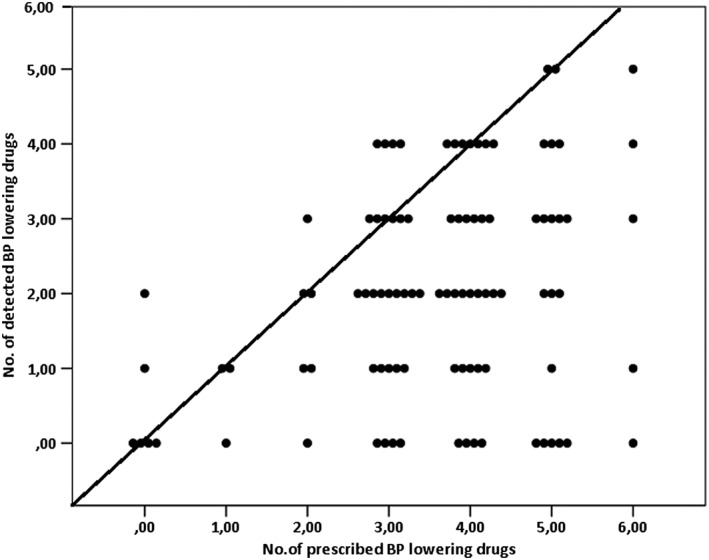
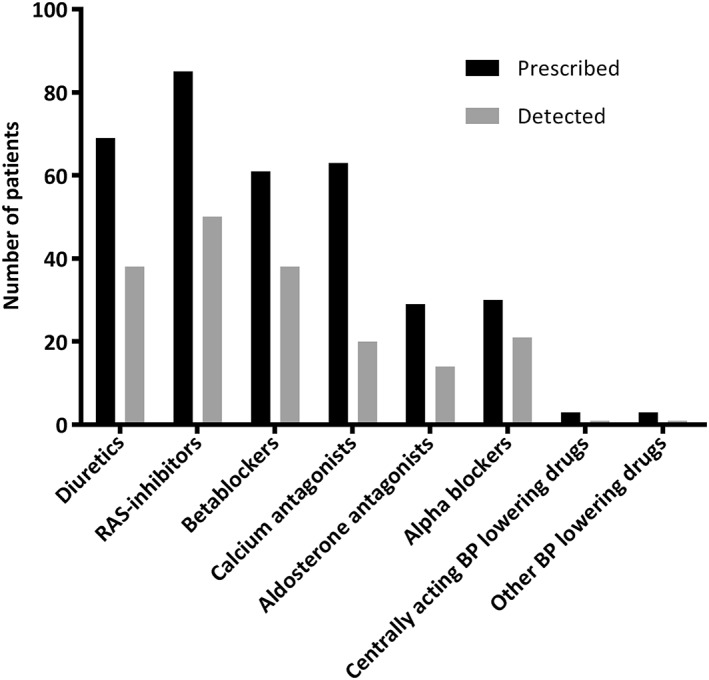
Results: Ninety-eight baseline and 83 6-month samples were available for analysis. Sixty-eight percent [95% confidence interval (CI) 59-78%] of the patients was nonadherent (n = 67). For every onw pill more prescribed, 0.785 [95%CI 0.529-0.891] prescribed pill was less detected in blood. A decrease of one pill in adherence between baseline and 6 months was associated with a significant rise in office systolic BP of 4 (95%CI 0.230-8.932) mmHg.
Conclusion: Objective measurement of BP lowering drugs in serum, as a tool to assess adherence, showed that nonadherence was very common in patients with apparent resistant hypertension. Furthermore, the assessment results were related to (changes in) blood pressure. Our findings provide direct and objective methodology to help the physician to understand and to improve the condition of apparent resistant hypertension.
Keywords: adherence; randomized controlled trial; resistant hypertension.
© 2017 The British Pharmacological Society.
Figures

References
-
- Falaschetti E, Mindell J, Knott C, Poulter N. Hypertension management in England: a serial cross‐sectional study from 1994 to 2011. Lancet 2014; 383: 1912–1919. - PubMed
-
- Pereira M, Lunet N, Azevedo A, Barros H. Differences in prevalence, awareness, treatment and control of hypertension between developing and developed countries. J Hypertens 2009; 27: 963–975. - PubMed
-
- Forouzanfar MH, Liu P, Roth GA, Ng M, Biryukov S, Marczak L, et al Global burden of hypertension and systolic blood pressure of at least 110 to 115 mm Hg, 1990‐2015. JAMA 2017; 317: 165–182. - PubMed
-
- de Jager RL, de Beus E, Beeftink MM, Sanders MF, Vonken EJ, Voskuil M, et al Impact of medication adherence on the effect of renal denervation. The SYMPATHY trial. Hypertension 2017; 69: 678–684. - PubMed
-
- Ettehad D, Emdin CA, Kiran A, Anderson SG, Callender T, Emberson J, et al Blood pressure lowering for prevention of cardiovascular disease and death: a systematic review and meta‐analysis. Lancet 2016; 387: 957–967. - PubMed
Publication types
MeSH terms
Substances
Supplementary concepts
LinkOut - more resources
Full Text Sources
Other Literature Sources
Medical