. 2017 Nov;11(11):1561-1578.
doi: 10.1002/1878-0261.12119. Epub 2017 Sep 13.

Novel landscape of HLA-G isoforms expressed in clear cell renal cell carcinoma patients

Affiliations

Novel landscape of HLA-G isoforms expressed in clear cell renal cell carcinoma patients

Diana Tronik-Le Roux et al. Mol Oncol. 2017 Nov.

Abstract

Immune checkpoints are powerful inhibitory molecules that promote tumor survival. Their blockade is now recognized as providing effective therapeutic benefit against cancer. Human leukocyte antigen G (HLA-G), a recently identified immune checkpoint, has been detected in many types of primary tumors and metastases, in malignant effusions as well as on tumor-infiltrating cells, particularly in patients with clear cell renal cell carcinoma (ccRCC). Here, in order to define a possible anticancer therapy, we used a molecular approach based on an unbiased strategy that combines transcriptome determination and immunohistochemical labeling, to analyze in-depth the HLA-G isoforms expressed in these tumors. We found that the expression of HLA-G is highly variable among tumors and distinct areas of the same tumor, testifying a marked inter- and intratumor heterogeneity. Moreover, our results generate an inventory of novel HLA-G isoforms which includes spliced forms that have an extended 5'-region and lack the transmembrane and alpha-1 domains. So far, these isoforms could not be detected by any method available and their assessment may improve the procedure by which tumors are analyzed. Collectively, our approach provides the first extensive portrait of HLA-G in ccRCC and reveals data that should prove suitable for the tailoring of future clinical applications.

Keywords: RNA sequencing; clear cell renal cell carcinoma; human leukocyte antigen G; immune checkpoints; isoforms; transcriptome.


Figures

Figure 1
Figure 1
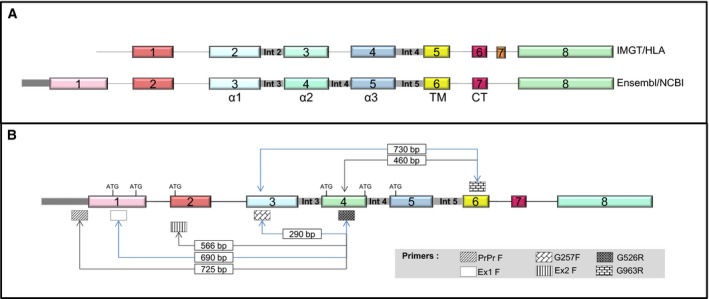
Schematic representation of the structure of the HLA‐G gene. (A) IMGT/HLA nomenclature (top) and Ensembl database (bottom). Numbers represent exons and the domains of the HLA‐G protein are shown underneath. TM, transmembrane; CT, cytoplasmic tail. (B) Localization of primers used for the different RT‐PCR strategies. Sizes, in bp, for specific amplicons and the translation initiation codons are indicated.
Figure 2
Figure 2
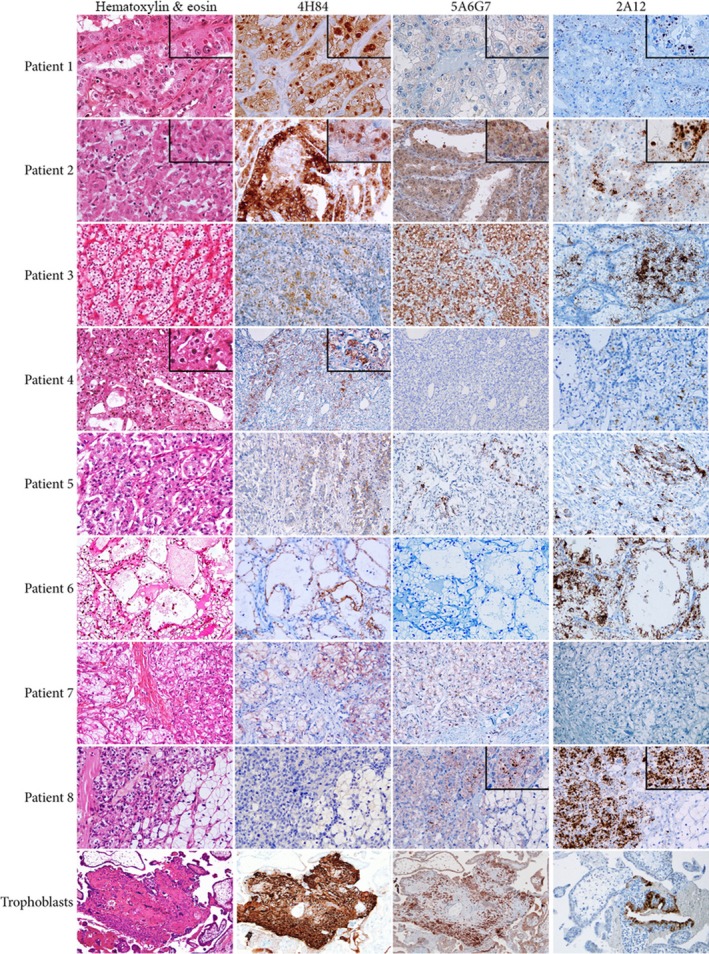
Differential morphologic and HLA‐G staining patterns of eight ccRCC included in this study. A trophoblastic tissue was used as positive control for immunohistochemical study (H&E and immunoperoxidase stains).
Figure 3
Figure 3
Expression of HLA‐G1 in ccRCC patients. RNA were subjected to RT‐PCR using the HLA‐G1‐specific primers G257F and G526R (upper panels) and ACTB primers as controls (lower panels). Lanes 1: adjacent nontumor region except for tumors of patients 6 and 8. Lanes 2, 3, and 4: different tumor areas. For patients 6 and 8, all regions shown correspond to tumor areas as partial nephrectomies were performed and adjacent tumor regions were not available. M: 100‐bp size marker.
Figure 4
Figure 4
Details of intron retention events found in HLA‐G transcripts. Only reads spanning intron–exon junctions have been considered. Reads corresponding exclusively to intron sequences were discarded.
Figure 5
Figure 5
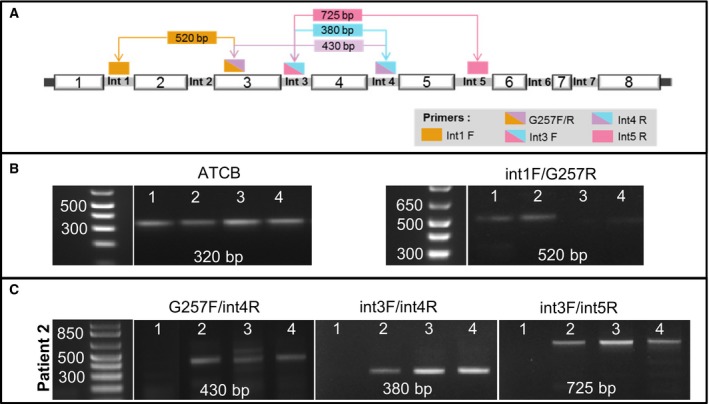
Molecular validation of main intron retention events. (A) Diagrammatic representation of the RT‐PCR strategy developed to amplify retained introns. (B) Results of the RT‐PCR analysis using actin primers as control for the absence of genomic DNA (left) and Int1 and G257R primers to detect the presence of intron 1 (right). The band of 523 bp reveals the absence of intron 2, which would produce a band of 649 bp (C) HLA‐G transcripts that retain only intron 4 (left panel) or HLA‐G transcripts that retain several introns simultaneously (middle and right panels).
Figure 6
Figure 6
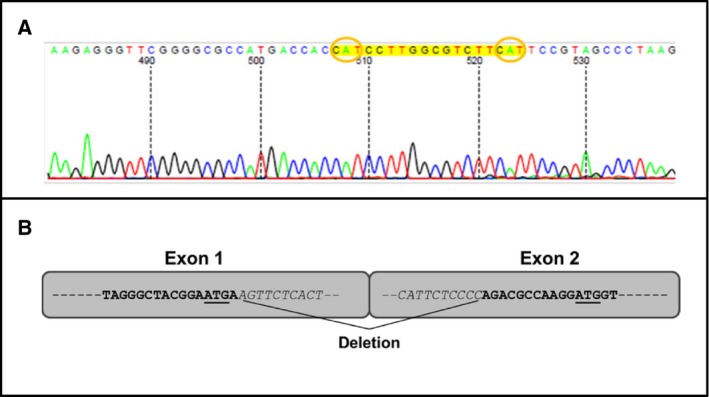
Identification of the 5′‐extended transcript HLA‐G1. (A) Details of the DNA sequence showing the reduced distance between the two ATGs. The sequencing was performed upward using the G526R primer. (B) Schematic representation of the 106‐bp deletion; the two ATGs are underlined.
Figure 7
Figure 7
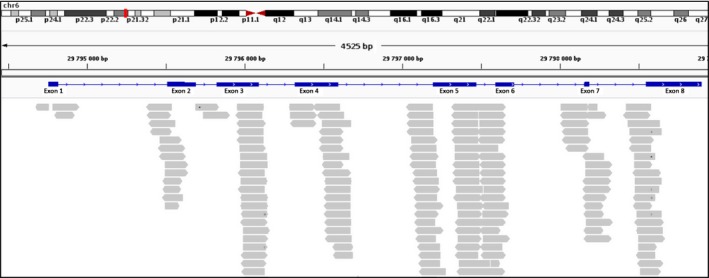
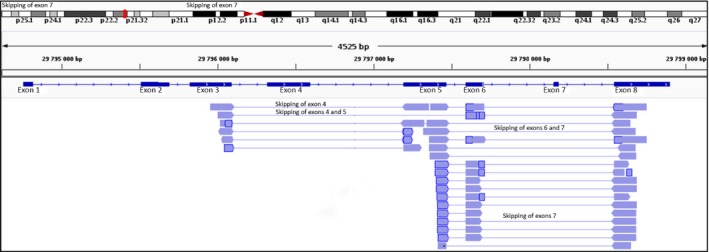
Mapping of RNAseq reads generated with tophat2 aligner showing main exon skipping events in HLA‐G (reads that did not show split mapping were hidden to improve readability).
Figure 8
Figure 8
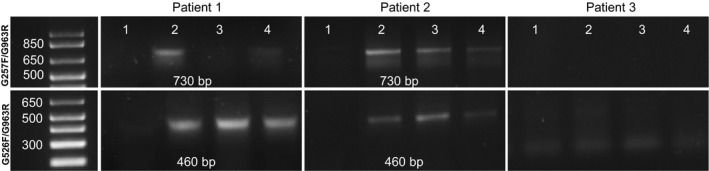
Expression of transcripts lacking exon 3 which encodes the alpha 1 domain and exon 6, the cytoplasmic domain. RT‐PCR amplification of RNA of tumors from patients 1, 2, and 3 with primers G257F/G963R and G526F/963R, respectively. Primer G257 is complementary to exon 3, G526 to exon 4, and G963 to exon 6. The cDNAs are the same as in Fig. 3, in which their integrity was shown by actin amplification.
Figure 9
Figure 9
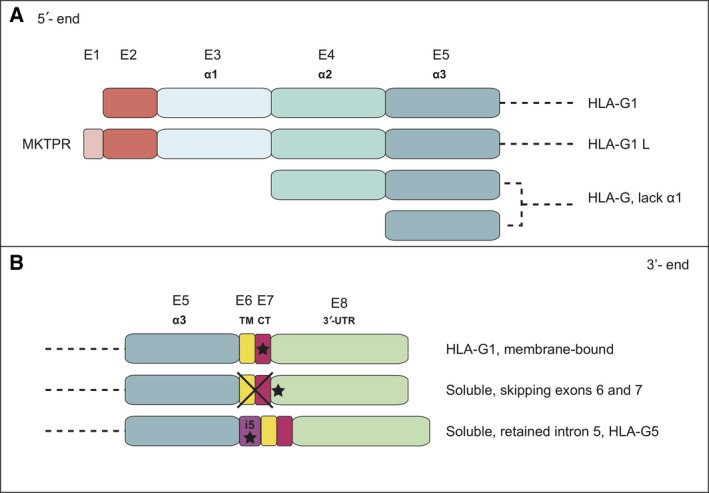
Diagrammatic representation of potentially expressed HLA‐G isoforms generated by alternative spliced transcripts. (A) N‐terminal ends including the additional five‐amino acid region of HLA‐G1L and the absence of the α1 domain that might yield isoforms containing the α2α3 domains or only the α3 domain. (B) Diagrammatic representation of isoforms with potentially different C‐terminal ends.

References

    1. Agaugue S, Carosella ED and Rouas‐Freiss N (2011) Role of HLA‐G in tumor escape through expansion of myeloid‐derived suppressor cells and cytokinic balance in favor of Th2 versus Th1/Th17. Blood 117, 7021–7031. - PubMed
    1. Aoubala M, Murray‐Zmijewski F, Khoury MP, Fernandes K, Perrier S, Bernard H, Prats AC, Lane DP and Bourdon JC (2011) p53 directly transactivates Delta133p53alpha, regulating cell fate outcome in response to DNA damage. Cell Death Differ 18, 248–258. - PMC - PubMed
    1. Braunschweig U, Barbosa‐Morais NL, Pan Q, Nachman EN, Alipanahi B, Gonatopoulos‐Pournatzis T, Frey B, Irimia M and Blencowe BJ (2014) Widespread intron retention in mammals functionally tunes transcriptomes. Genome Res 24, 1774–1786. - PMC - PubMed
    1. Brugarolas J (2014) Molecular genetics of clear‐cell renal cell carcinoma. J Clin Oncol 32, 1968–1976. - PMC - PubMed
    1. Buckley PT, Khaladkar M, Kim J and Eberwine J (2014) Cytoplasmic intron retention, function, splicing, and the sentinel RNA hypothesis. Wiley Interdiscip Rev RNA 5, 223–230. - PMC - PubMed

Publication types