Review
. 2012 Feb 9;5(2):258-277.
doi: 10.3390/ma5020258.

Ceramic Laser Materials

Affiliations
Review

Ceramic Laser Materials

Jasbinder Sanghera et al. Materials (Basel). .

Abstract

Ceramic laser materials have come a long way since the first demonstration of lasing in 1964. Improvements in powder synthesis and ceramic sintering as well as novel ideas have led to notable achievements. These include the first Nd:yttrium aluminum garnet (YAG) ceramic laser in 1995, breaking the 1 KW mark in 2002 and then the remarkable demonstration of more than 100 KW output power from a YAG ceramic laser system in 2009. Additional developments have included highly doped microchip lasers, ultrashort pulse lasers, novel materials such as sesquioxides, fluoride ceramic lasers, selenide ceramic lasers in the 2 to 3 μm region, composite ceramic lasers for better thermal management, and single crystal lasers derived from polycrystalline ceramics. This paper highlights some of these notable achievements.

Keywords: 100 KW; ceramic composites; ceramics; laser materials; microchip lasers; non-oxide ceramics; ultrashort pulse.


Figures

Figure 1
Figure 1
Thermal conductivity versus dopant concentration for crystals (Adapted from R. Gaume 2002 [4], P. Koopmann [6], F. Patel [7], A. Tunnermann [8] and T. Yamakasi [9]).
Figure 2
Figure 2
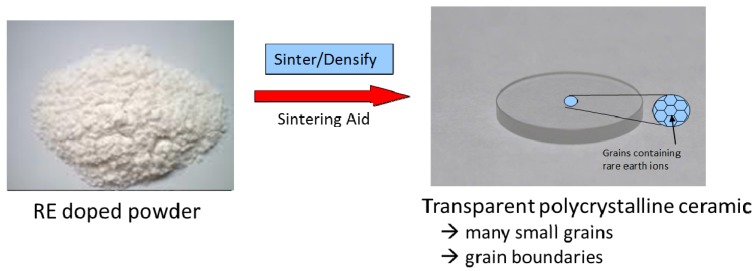
Ceramization process for converting powder into a transparent ceramic.
Figure 3
Figure 3
Practical fabrication of ceramics.
Figure 4
Figure 4
Transmission plot of the optically polished ceramics fabricated from our co-precipiated 10% Yb:Lu2O3 and commercial powders, respectively.
Figure 5
Figure 5
Demonstration of lower scattering loss in ceramic Nd:YAG (Quarles [12]).
Figure 6
Figure 6
Laser damage threshold for rare earth doped and undoped YAG ceramics compared with single crystal YAG (Adapted from Ueda et al. [17]).
Figure 7
Figure 7
Results of the first Nd:YAG ceramic laser (Adapted from [20]).
Figure 8
Figure 8
Results for first Nd:YAG laser to break 1 KW output power (Adapted from [22]).
Figure 9
Figure 9
Highly doped Yb:YAG ceramic lasers (Adapted from [23]).
Figure 10
Figure 10
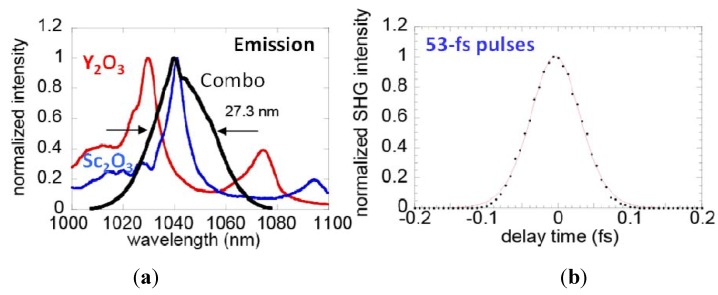
Combining a 2.5% Yb:Y2O3 ceramic behind a 1.8% Yb:Sc2O3 ceramic in a laser cavity to demonstrate (a) spectral broadening from nonlinear gain and (b) pulsed lasing with 53 fs pulses (Adapted from [25]).
Figure 11
Figure 11
Lasing results for 5%-Yb3+:0.65CaF2-0.35SrF2 ceramic compared with a single crystal (Adapted from [27]).
Figure 12
Figure 12
(a) The laser results for ceramic Cr2+:ZnSe made by hot pressing ceramics (HPC) and by chemical diffusion of CrSe into CVD ZnSe (CTD) (after [28]); and (b) a 15 W commercial source available from IPG [29].
Figure 13
Figure 13
Laser performance of various types of composite elements (Adapted from [30]).
Figure 14
Figure 14
(a) Graded laser ceramics showing distribution of Nd ions before and after sintering and (b) better thermal management during lasing (Adapted from [31]).
Figure 15
Figure 15
(a) Tape cast ceramic composite laser material and (b) laser result (Adapted from Messing [32]).
Figure 16
Figure 16
(a) Shows conversion of a ceramic into a single crystal by seeding a highly doped (3.6 at%) Nd:YAG with a single crystal YAG on either side and (b) the laser results highlighting improved slope efficiency for a single crystal produced from the ceramic, in this case containing 2.4 at% Nd (Adapted from Ikesue [30]).
Figure 17
Figure 17
Output power versus absorbed power for a 10% Yb:Lu2O3 ceramic laser using a 5% output coupler. Pumping was with a diode operating at 975 nm.
Figure 18
Figure 18
Thin disk laser using a 200 μm thick 9% Yb:YAG as the active medium and with a 1 mm thick undoped YAG cap (after [39]).
Figure 19
Figure 19
Different solid state laser configurations used for high power demonstrations: (a) heat capacity laser [41] (b) end-pumped slab laser [42] and (c) thinzag slab laser [43].
Figure 20
Figure 20
Large Nd:YAG ceramic laser slabs for the heat capacity laser (Adapted from [41]).
Figure 21
Figure 21
Evolution of laser output power versus year for YAG ceramics.

References

    1. Yamamoto R.M., Bhachu B.S., Cutter K.P., Fochs S.N., Letts S.A., Parks C.W., Rotter M.D., Soules T.F. Lawrence Livermore National Lab; Livermore, CA, USA: 2008. Lawrence Livermore National Lab Report No. 352959.
    1. Bishop B. Northrop Grumman scales new heights in electric laser power, achieves 100 kW from a solid-state laser. Globe Newswire. Mar 18, 2009. [(accessed on 26 December 2011)]. Available online: http://www.irconnect. com/noc/press/pages/news_releases html?d=161575.
    1. Bolz V., Peters A., Petermann K., Huber G. Growth of high-melting sesquioxides by the heat exchanger method. J. Cryst. Growth. 2002;237–239:879–883.
    1. Gaume R. Ph.D. Dissertation. Pierre & Marie Curie University; Paris, France: 2002. Relations Structures-Propriétés Dans les Lasers Solides de Puissance à L'ytterbium.
    1. Soules T. (Lawrence Livermore National Lab: Livermore, CA, USA). Personal communication.

LinkOut - more resources