Clinical Trial
. 2017 Oct 10;35(29):3338-3346.
doi: 10.1200/JCO.2017.73.9011. Epub 2017 Aug 17.

Phase I/II Trial of Labetuzumab Govitecan (Anti-CEACAM5/SN-38 Antibody-Drug Conjugate) in Patients With Refractory or Relapsing Metastatic Colorectal Cancer

Affiliations
Clinical Trial

Phase I/II Trial of Labetuzumab Govitecan (Anti-CEACAM5/SN-38 Antibody-Drug Conjugate) in Patients With Refractory or Relapsing Metastatic Colorectal Cancer

Efrat Dotan et al. J Clin Oncol. .

Abstract

Purpose The objectives were to evaluate dosing schedules of labetuzumab govitecan, an antibody-drug conjugate targeting carcinoembryonic antigen-related cell adhesion molecule 5 (CEACAM5) for tumor delivery of 7-ethyl-10-hydroxycamptothecin (SN-38), in an expanded phase II trial of patients with relapsed or refractory metastatic colorectal cancer. Patients and Methods Eligible patients with at least one prior irinotecan-containing therapy received labetuzumab govitecan once weekly at 8 and 10 mg/kg, or two times per week at 4 and 6 mg/km on weeks 1 and 2 of 3-week repeated cycles. End points were safety, response, pharmacokinetics, and immunogenicity. Results Eighty-six patients who had undergone a median of five prior therapies (range, one to 13) were each enrolled into one of the four cohorts. On the basis of Response Evaluation Criteria in Solid Tumors 1.1, 38% of these patients had a tumor as well as plasma carcinoembryonic antigen reduction from baseline after labetuzumab govitecan treatment; one patient achieved a partial response with a sustained response spanning > 2 years, whereas 42 patients had stable disease as the best overall response. Median progression-free survival and overall survival were 3.6 and 6.9 months, respectively. The major toxicities (grade ≥ 3) among all cohorts were neutropenia (16%), leukopenia (11%), anemia (9%), and diarrhea (7%). The antibody-drug conjugate's mean half-life was 16.5 hours for the four cohorts. Anti-drug/anti-antibody antibodies were not detected. The two once-weekly dose schedules, showing comparable toxicity and efficacy, were chosen for further study. Conclusion Monotherapy with labetuzumab govitecan demonstrated a manageable safety profile and therapeutic activity in heavily pretreated patients with metastatic colorectal cancer, all with prior irinotecan therapy. Further studies of labetuzumab govitecan treatment alone or in combination with other therapies in earlier settings are indicated.


Figures
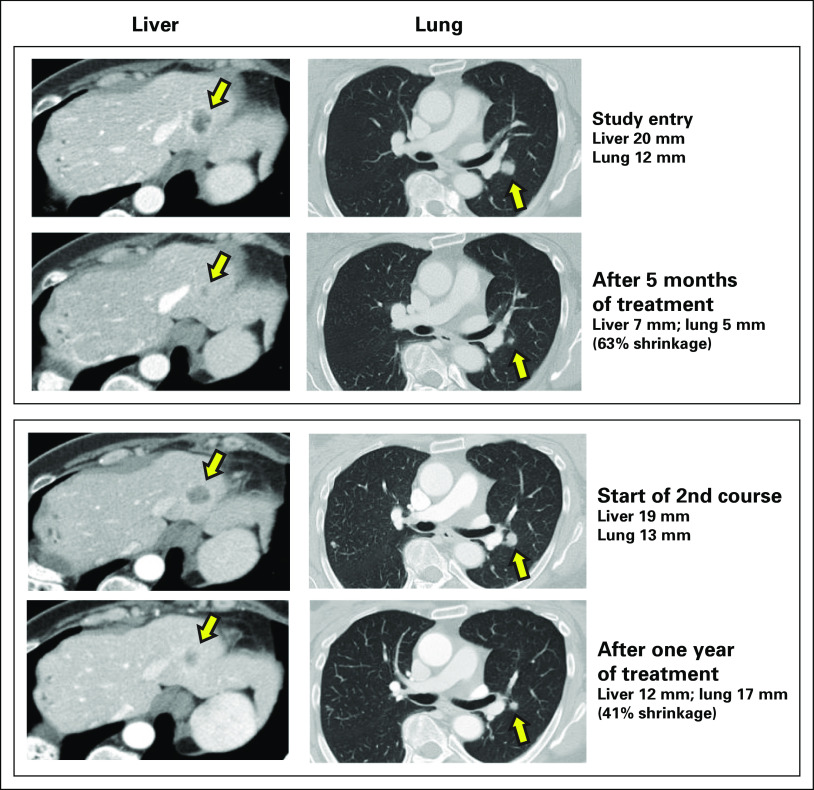
Fig 1.
Fig 1.
This 51-year-old woman was initially diagnosed with rectal adenocarcinoma, stage IIIb. After primary surgery, she received infusional fluorouracil, leucovorin, and oxaliplatin, capecitabine, and local radiation. Approximately 1.5 years later, she underwent a right hepatectomy for liver recurrence, followed by 12 cycles of fluorouracil, leucovorin, and irinotecan with bevacizumab. Her disease progressed approximately 1 year later and she entered the study with a plasma carcinoembryonic antigen (CEA) level of 21 ng/mL and multiple pulmonary and hepatic metastases, including two target lesions for Response Evaluation Criteria in Solid Tumors 1.1 response assessment: a 12-mm left perihilar lesion and a 20-mm lesion at the hepatic dome. She responded to treatment with 6 mg/kg twice-weekly labetuzumab govitecan with a 25% reduction of target lesions at first postbaseline assessment and with a partial response with a 46% reduction at 3 months, which was confirmed with a 63% reduction on subsequent assessment. After 13 months of treatment, there had been a 88% reduction of target lesions, including complete disappearance of the liver lesion, and the plasma CEA was reduced to 2.4 ng/mL. Because of the demands of the twice-weekly regimen over this period, she took a 3-month drug holiday, after which her disease returned with a plasma CEA level of 37.6 ng/mL, a 13-mm perihilar lesion, and a 19-mm hepatic dome lesion. She then resumed treatment, but at 8 mg/kg once-weekly, and again responded, with onset of a partial response at 4 months (41% reduction). One year after resuming treatment, her plasma CEA was 5.3 ng/mL and she continued to maintain 41% shrinkage, eventually progressing 6 months later. During the entire course of her treatment, which spanned 2.7 years and consisted of > 40 treatment cycles, no antilabetuzumab or anti–SN-38 antibodies were detected.
Fig 2.
Fig 2.
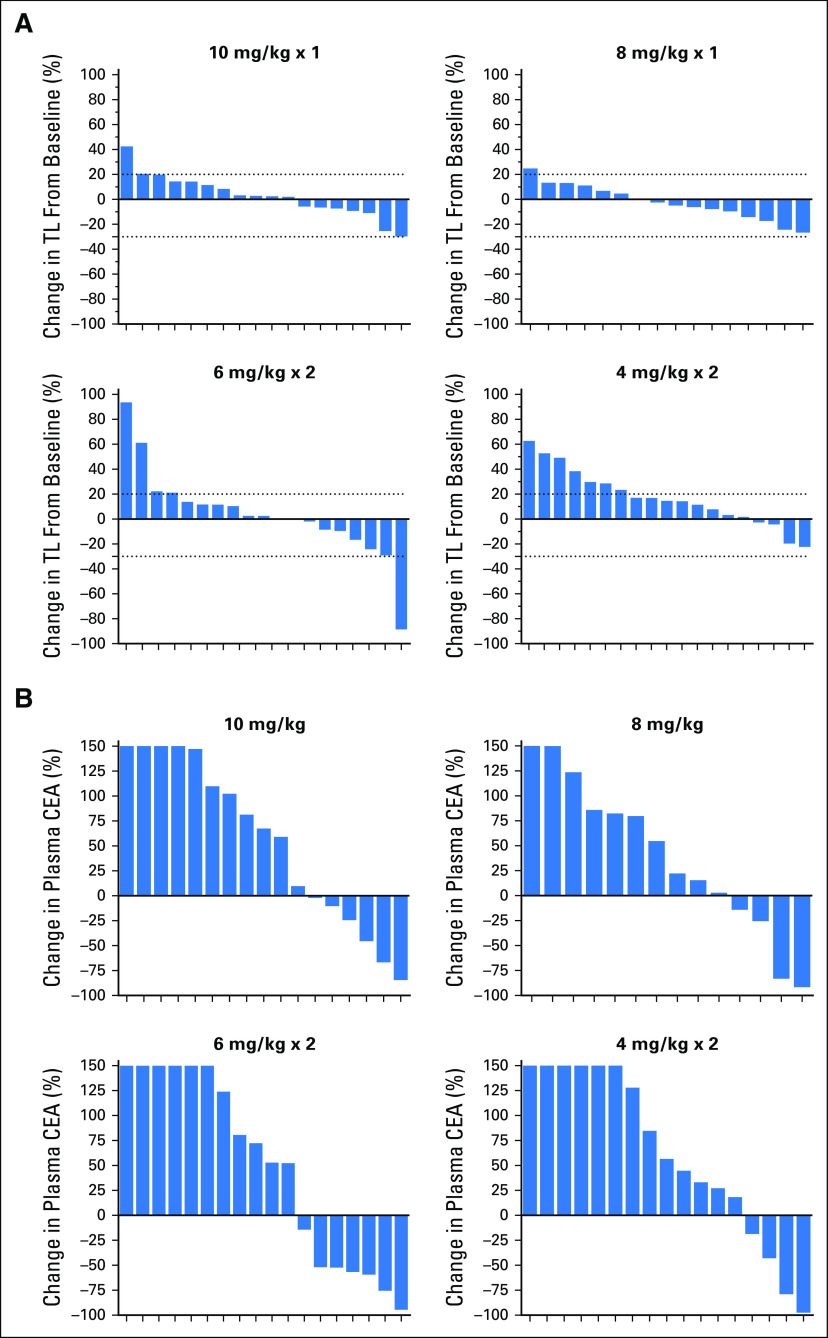
Waterfall plots for the four dose groups treated with labetuzumab govitecan once weekly at 8 or 10 mg/kg or twice weekly at 4 or 6 mg/kg. (A) Percent change from baseline of the sum of target lesion (TL) diameters at time of best response for patients with computed tomography–assessable responses. (B) Percent change in plasma carcinoembryonic antigen (CEA) levels from baseline to time of best response for patients with one or more postbaseline CEA values.
Fig 3.
Fig 3.
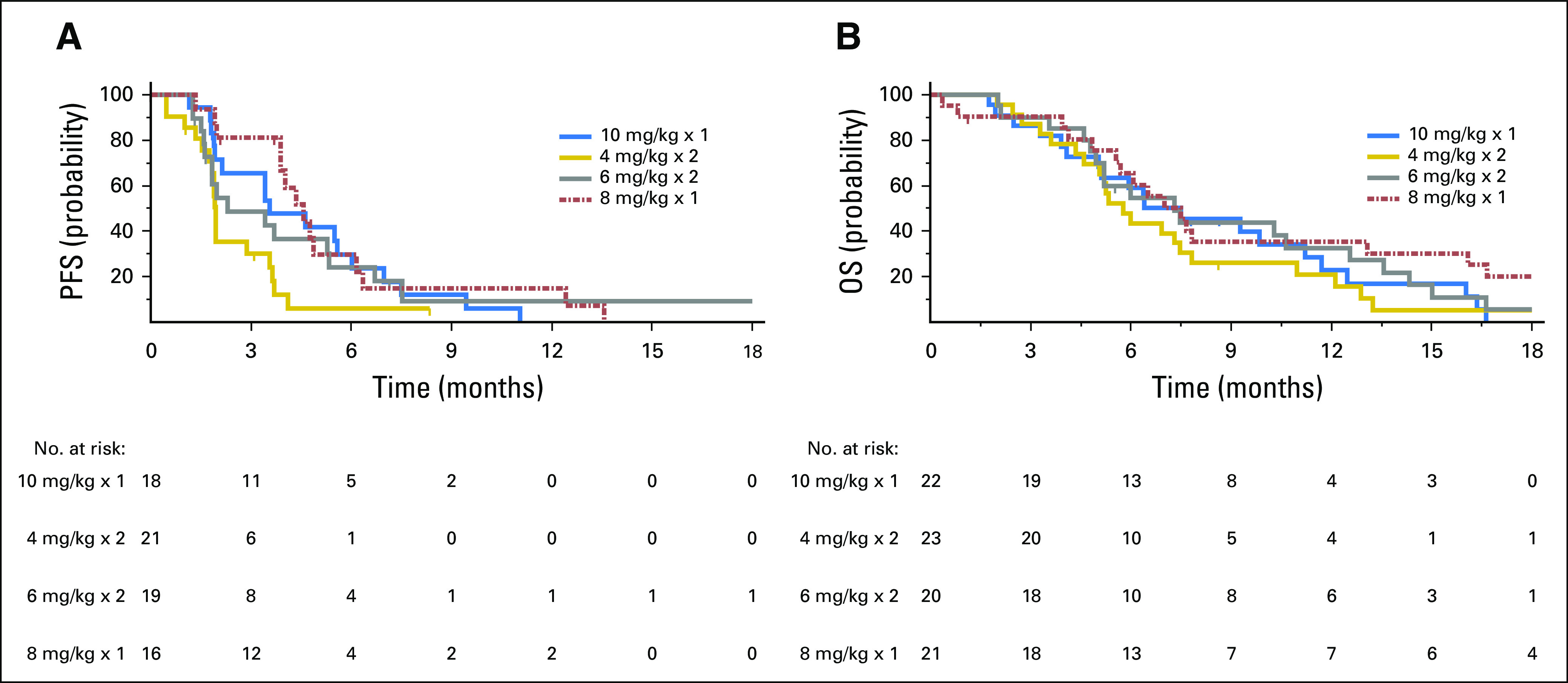
(A) Progression-free survival (PFS) and (B) overall survival (OS) in patients with refractory metastatic colorectal cancer treated with labetuzumab govitecan once weekly at 8 or 10 mg/kg or twice weekly at 4 or 6 mg/kg. Of the 86 patients, 72 continued on-study until progressive disease was documented radiologically at a tumor response assessment, whereas the other 21 patients discontinued study participation before radiologic confirmation of progression and were censored for PFS at the time of their most recent radiologic evaluation. Similarly, 78 of the 86 patients were observed until death, whereas eight patents were lost to follow-up and were censored for OS at last study evaluation.

References

    1. Siegel RL, Miller KD, Fedewa SA, et al: Colorectal cancer statistics, 2017. CA Cancer J Clin 67:177-193, 2017. - PubMed
    1. Siegel RL, Miller KD, Jemal A: Cancer Statistics, 2017. CA Cancer J Clin 67:7-30, 2017 - PubMed
    1. Van Cutsem E, Cervantes A, Nordlinger B, et al. : Metastatic colorectal cancer: ESMO Clinical Practice Guidelines for diagnosis, treatment and follow-up. Ann Oncol 25:iii1-iii9, 2014 - PubMed
    1. Bertocchi P, Aroldi F, Prochilo T, et al. : Chemotherapy rechallenge after regorafenib treatment in metastatic colorectal cancer: Still hope after the last hope? J Chemother 29:102-105, 2017 - PubMed
    1. doi: 10.2174/1568009617666170209095143. Nappi A, Berretta M, Romano C, et al: Metastatic colorectal cancer: Role of target therapies and future perspectives. Curr Cancer Drug Targets . [epub ahead of print on February 8, 2017] - DOI - PubMed

Publication types

MeSH terms