


Everolimus Is Associated With Less Weight Gain Than Tacrolimus 2 Years After Liver Transplantation: Results of a Randomized Multicenter Study
- PMID: 28817434
- PMCID: PMC5704647
- DOI: 10.1097/TP.0000000000001913
Everolimus Is Associated With Less Weight Gain Than Tacrolimus 2 Years After Liver Transplantation: Results of a Randomized Multicenter Study
Abstract
Background: Weight gain early after transplant is a risk factor for posttransplant metabolic syndrome (PTMS), cardiovascular events, and renal insufficiency. The impact of mammalian target of rapamycin inhibition on posttransplant weight gain and the development of PTMS components postliver transplantation were examined in a randomized, controlled study.
Methods: After a run-in period, patients (N = 719) were randomized at 30 ± 5 days posttransplant in a 1:1:1 ratio to 3 treatment groups: (i) everolimus (EVR) + reduced tacrolimus (TAC) (n = 245); (ii) TAC control (n = 243) or (iii) TAC elimination (n = 231). In this post hoc analysis, weight change at 12 and 24 months was compared between groups. Vital signs, lipids, and laboratory parameters at 12 and 24 months and rates of PTMS were assessed.
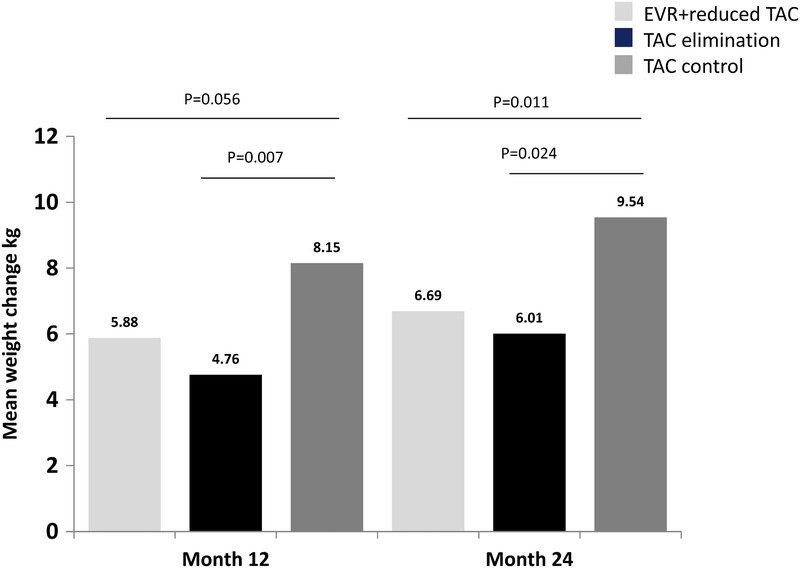
Results: Mean increase in weight from baseline was higher at month 12 in the TAC control arm (8.15 ± 9.27 kg) than in the EVR + reduced TAC (5.88 ± 12.60 kg, P = 0.056) and the TAC elimination arms (4.76 ± 9.94 kg, P = 0.007). At month 24, the TAC control arm displayed a significantly greater weight increase (9.54 ± 10.21 kg) than either the EVR + reduced TAC (6.69 ± 8.37 kg, P = 0.011) or the TAC elimination groups (6.01 ± 9.98 kg, P = 0.024). Rates of PTMS were similar for the EVR + reduced TAC (71.8%), TAC elimination (70.3%) and TAC control (67.4%) arms (P = NS).
Conclusions: EVR with reduced-exposure TAC attenuated weight gain at 1 and 2 years posttransplant compared with a standard TAC immunosuppression regimen. Rates of PTMS were comparable between EVR-containing and TAC control regimens.
Trial registration: ClinicalTrials.gov NCT00622869.
Conflict of interest statement
The authors declare no conflicts of interest.
Figures
References
-
- Everhart JE, Lombardero M, Lake JR, et al. Weight change and obesity after liver transplantation: incidence and risk factors. Liver Transpl Surg. 1998;4:285–296. - PubMed
-
- Wissing KM, Pipeleers L. Obesity, metabolic syndrome and diabetes mellitus after renal transplantation: prevention and treatment. Transplant Rev (Orlando). 2014;28:37–46. - PubMed
-
- Asfar S, Metrakos P, Fryer J, et al. An analysis of late deaths after liver transplantation. Transplantation. 1996;61:1377–1381. - PubMed
-
- Lentine KL, Costa SP, Weir MR, et al. Cardiac disease evaluation and management among kidney and liver transplantation candidates: a scientific statement from the American Heart Association and the American College of Cardiology Foundation. Circulation. 2012;126(5):617–663. - PubMed
Publication types
MeSH terms
Substances
Associated data
LinkOut - more resources
Full Text Sources
Other Literature Sources
Medical
Miscellaneous
