Review
doi: 10.1371/journal.pgen.1006842.
eCollection 2017 Aug.
Inhibition of mutagenic translesion synthesis: A possible strategy for improving chemotherapy?
Affiliations
- PMID: 28817566
- PMCID: PMC5560539
- DOI: 10.1371/journal.pgen.1006842
Item in Clipboard
Review
Inhibition of mutagenic translesion synthesis: A possible strategy for improving chemotherapy?
PLoS Genet.
.
No abstract available
Conflict of interest statement
The authors have declared that no competing interests exist.
Figures
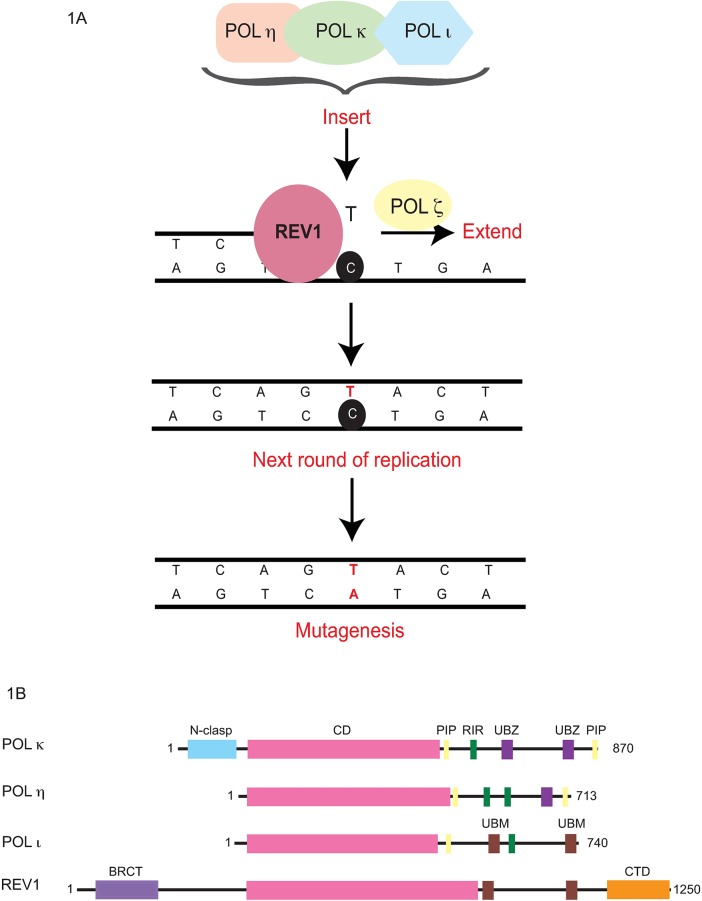
(A) Mechanism of the 2-step DNA damage bypass process. To bypass DNA damage, REV1 inserts deoxycytidine triphosphates across the damage or orchestrates the recruitment of the other polymerases, POL ι, POL κ, POL η, to replicate across the damage. Thereafter, POL ζ complex can help extend beyond the damage to enable re-initiation of undamaged DNA replication. If an incorrect nucleotide gets incorporated across the damage, this misincorporated nucleotide will lead to a mutation in the next round of replication. (B) A schematic representing the protein domains of the Y-family translesion synthesis (TLS) polymerases, REV1, POL ι, POL κ, POL η.
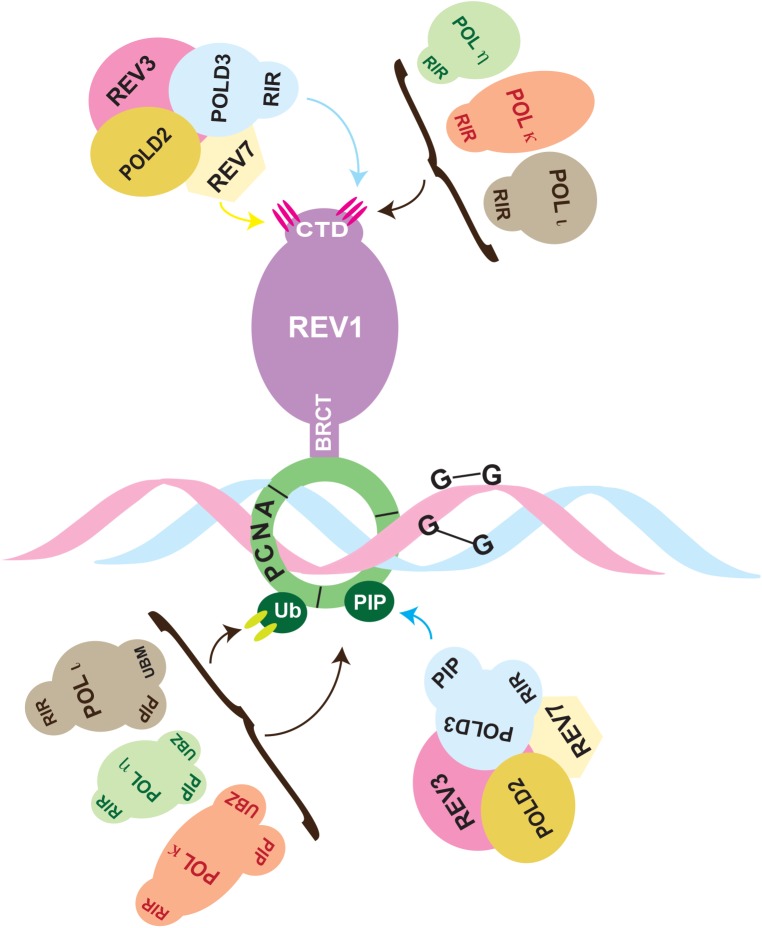
Two pathways are expected to facilitate TLS across DNA damage—the REV1 dependent and REV1 independent pathway. Majority of the DNA lesions are bypassed in a REV1 dependent fashion, which engages in protein-protein interactions with other TLS polymerases via its C-terminus. REV1 interacts with the REV1-interacting-region (RIR)-containing residues of POL ι, POL κ, POL η to enable insertion of nucleotides across the damage. And REV1 also interacts via key residues with REV7 of the POL ζ complex to facilitate extension beyond the insertion step. REV1 also binds to POLD3 subunit of the POL ζ complex to enable the key switch from the “insertion” to the “extension” step. In the REV1 independent pathway, the RIR-containing polymerases, POL ι, POL κ, POL η, by interacting with the proliferating cell nuclear antigen (PCNA) interacting protein (PIP) and ubiquitin-binding motif (UBM)/ ubiquitin-binding zinc finger (UBZ) domains of PCNA, can also enable TLS at the damaged site. Likewise, the POL ζ complex also interacts with the PIP box of PCNA to access the DNA and enable TLS.
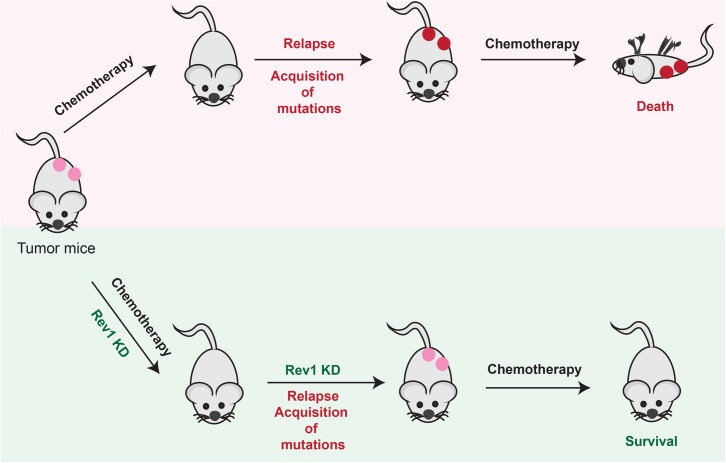
In a tumor mouse model, administration of chemotherapy reduces tumor formation by killing the generally chemoresensitive tumor cells. However, many of the tumors that relapse are resistant to further killing from chemotherapeutic treatment, thereby reducing survival of the mice. In contrast, mice harboring relapsed tumors in which REV1 has been knocked down remain sensitive to chemotherapy, whereby their survival is prolonged.
References
-
- Zahreddine H, Borden KLB. Mechanisms and insights into drug resistance in cancer. Front Pharmacol. 2013;4 doi: 10.3389/fphar.2013.00028 - DOI - PMC - PubMed
-
- Neesse A, Michl P, Frese KK, Feig C, Cook N, Jacobetz MA, et al. Stromal biology and therapy in pancreatic cancer. Gut. 2011;60(6):861–8. doi: 10.1136/gut.2010.226092 . - DOI - PubMed
-
- Knobel PA, Marti TM. Translesion DNA synthesis in the context of cancer research. Cancer Cell Int. 2011;11:39 doi: 10.1186/1475-2867-11-39 ; PubMed Central PMCID: PMCPMC3224763. - DOI - PMC - PubMed
-
- Zhang X, Chen Q, Chen J, He C, Mao J, Dai Y, et al. Association of polymorphisms in translesion synthesis genes with prognosis of advanced non-small-cell lung cancer patients treated with platinum-based chemotherapy. J Surg Oncol. 2016;113(1):17–23. doi: 10.1002/jso.24103 . - DOI - PubMed
-
- Wang H, Wu W, Wang HW, Wang S, Chen Y, Zhang X, et al. Analysis of specialized DNA polymerases expression in human gliomas: association with prognostic significance. Neuro Oncol. 2010;12(7):679–86. doi: 10.1093/neuonc/nop074 ; PubMed Central PMCID: PMCPMC2940659. - DOI - PMC - PubMed
Publication types
MeSH terms
Substances
Grants and funding
LinkOut - more resources
Full Text Sources
Other Literature Sources