


MALDI-TOF MS identification of Anopheles gambiae Giles blood meal crushed on Whatman filter papers
- PMID: 28817629
- PMCID: PMC5560667
- DOI: 10.1371/journal.pone.0183238
MALDI-TOF MS identification of Anopheles gambiae Giles blood meal crushed on Whatman filter papers
Abstract
Background: Identification of the source of mosquito blood meals is an important component for disease control and surveillance. Recently, matrix-assisted laser desorption/ionization time-of-flight mass spectrometry (MALDI-TOF MS) profiling has emerged as an effective tool for mosquito blood meal identification, using the abdomens of freshly engorged mosquitoes. In the field, mosquito abdomens are crushed on Whatman filter papers to determine the host feeding patterns by identifying the origin of their blood meals. The aim of this study was to test whether crushing engorged mosquito abdomens on Whatman filter papers was compatible with MALDI-TOF MS for mosquito blood meal identification. Both laboratory reared and field collected mosquitoes were tested.
Material and methods: Sixty Anopheles gambiae Giles were experimentally engorged on the blood of six distinct vertebrate hosts (human, sheep, rabbit, dog, chicken and rat). The engorged mosquito abdomens were crushed on Whatman filter papers for MALDI-TOF MS analysis. 150 Whatman filter papers, with mosquitoes engorged on cow and goat blood, were preserved. A total of 77 engorged mosquito abdomens collected in the Comoros Islands and crushed on Whatman filter papers were tested with MALDI-TOF MS.
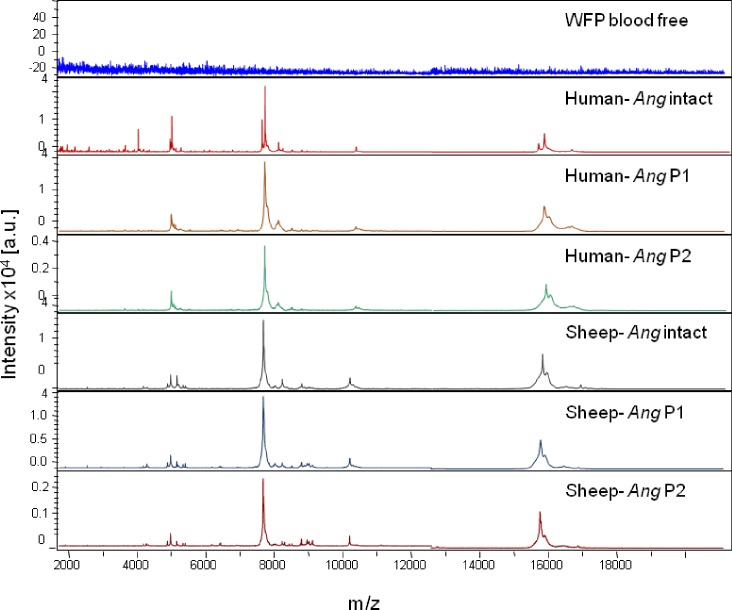
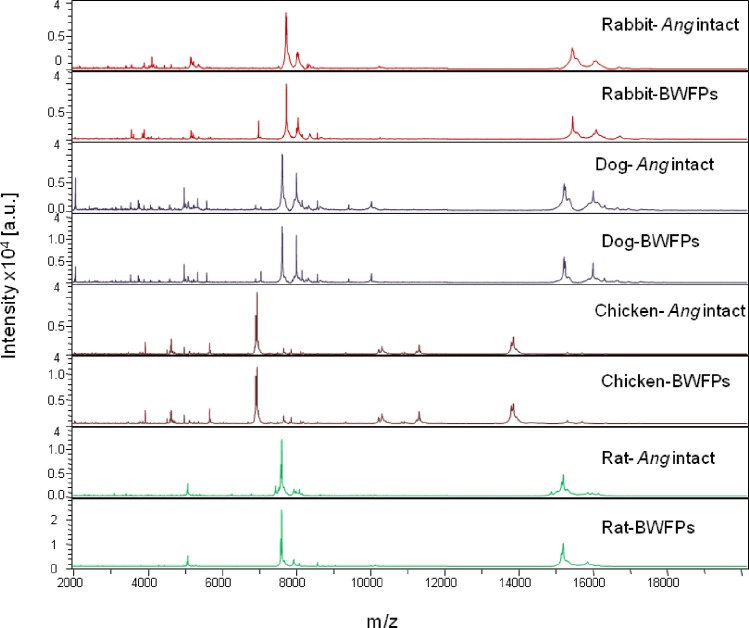
Results: The MS profiles generated from mosquito engorged abdomens crushed on Whatman filter papers exhibited high reproducibility according to the original host blood. The blood meal host was correctly identified from mosquito abdomens crushed on Whatman filter papers by MALDI-TOF MS. The MS spectra obtained after storage were stable regardless of the room temperature and whether or not they were frozen. The MS profiles were reproducible for up to three months. For the Comoros samples, 70/77 quality MS spectra were obtained and matched with human blood spectra. This was confirmed by molecular tools.
Conclusion: The results demonstrated that MALDI-TOF MS could identify mosquito blood meals from Whatman filter papers collected in the field during entomological surveys. The application of MALDI-TOF MS has proved to be rapid and successful, making it a new and efficient tool for mosquito-borne disease surveillance.
Conflict of interest statement
Figures

References
-
- World Health Organization (2015) World malaria report 2015. Geneva.
-
- Divis PC, Shokoples SE, Singh B, Yanow SK (2010) A TaqMan real-time PCR assay for the detection and quantitation of Plasmodium knowlesi. Malar J 9: 344 1475-2875-9-344 [pii]; doi: 10.1186/1475-2875-9-344 - DOI - PMC - PubMed
-
- Parola P (2013) The return of the big three killers. Clin Microbiol Infect 19: 887–888. doi: 10.1111/1469-0691.12331 S1198-743X(14)62972-4 [pii]. - DOI - PubMed
-
- Kelly-Hope LA, McKenzie FE (2009) The multiplicity of malaria transmission: a review of entomological inoculation rate measurements and methods across sub-Saharan Africa. Malar J 8: 19 1475-2875-8-19 [pii]; doi: 10.1186/1475-2875-8-19 - DOI - PMC - PubMed
-
- Mukabana WR, Takken W, Knols BG (2002) Analysis of arthropod bloodmeals using molecular genetic markers. Trends Parasitol 18: 505–509. S1471492202023644 [pii]. - PubMed
MeSH terms
LinkOut - more resources
Full Text Sources
Other Literature Sources
