. 2017 Oct;175(2):802-815.
doi: 10.1104/pp.17.00082. Epub 2017 Aug 17.

The Chickpea Early Flowering 1 (Efl1) Locus Is an Ortholog of Arabidopsis ELF3

Affiliations

The Chickpea Early Flowering 1 (Efl1) Locus Is an Ortholog of Arabidopsis ELF3

Stephen Ridge et al. Plant Physiol. 2017 Oct.

Abstract

In climates that experience short growing seasons due to drought, heat, or end-of-season frost, early flowering is a highly desirable trait for chickpea (Cicer arietinum). In this study, we mapped, sequenced, and characterized Early flowering3 (Efl3), an ortholog of Arabidopsis (Arabidopsis thaliana) EARLY FLOWERING3 (ELF3) that confers early flowering in chickpea. In a recombinant inbred line population derived from a cross between CDC Frontier and ICCV 96029, this gene was mapped to the site of a quantitative trait locus on Ca5 that explained 59% of flowering time variation under short days. Sequencing of ELF3 in ICCV 96029 revealed an 11-bp deletion in the first exon that was predicted to result in a premature stop codon. The effect of this mutation was tested by transgenic complementation in the Arabidopsis elf3-1 mutant, with the CDC Frontier form of CaELF3a partially complementing elf3-1 while the ICCV 96029 form had no effect on flowering time. While induction of FLOWERING LOCUS T homologs was very early in ICCV 96029, an analysis of circadian clock function failed to show any clear loss of rhythm in the expression of clock genes in ICCV 96029 grown under continuous light, suggesting redundancy with other ELF3 homologs or possibly an alternative mode of action for this gene in chickpea. The 11-bp deletion was associated with early flowering in global chickpea germplasm but was not widely distributed, indicating that this mutation arose relatively recently.


Figures

Figure 1.
Figure 1.
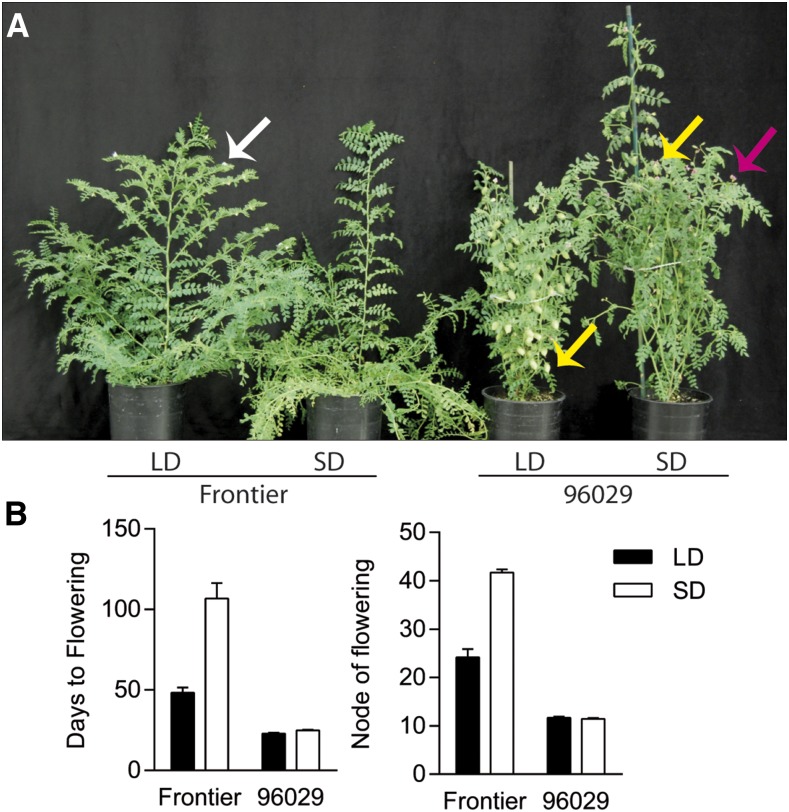
ICCV 96029 is early flowering and shows reduced responsiveness to photoperiod compared with CDC Frontier. A, Comparison of CDC Frontier and ICCV 96029 phenotypes for plants grown under LD and SD. LD-grown CDC Frontier has initiated flowers (white arrow), while SD-grown CDC Frontier is vegetative. LD-grown ICCV 96029 has set strong seed and is beginning to dry off; SD-grown ICCV 96029 has produced weak pods and continues to flower (purple arrow). Pods are indicated by yellow arrows. Plants are 63 d from sowing. B, Effects of photoperiod on flowering behavior in CDC Frontier and ICCV 96029 plants. Values represent means ± se for n = 6 to 9 replicates.
Figure 2.
Figure 2.
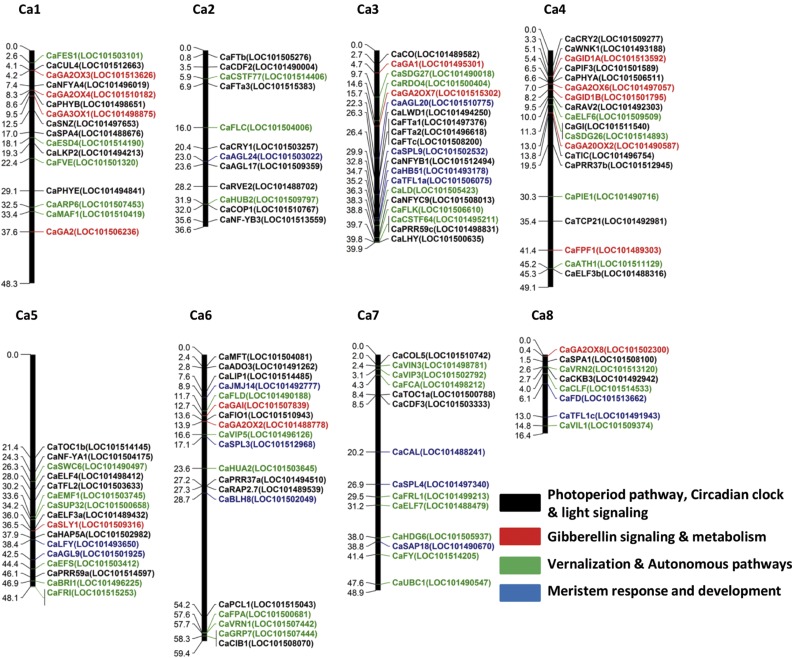
Physical maps of chickpea flowering time candidate genes. Chromosomes are represented as thick vertical lines with candidate gene positions indicated in Mb. Gene positions are based on the CDC Frontier genome assembly (ASM33114 version 1). A complete list of the 138 flowering time genes with their corresponding symbols and National Center for Biotechnology Information (NCBI) accession numbers can be found in Supplemental Data Set S2. Colors denote putative roles in the following pathways: black, photoperiod, circadian clock, and light signaling; red, GA signaling and metabolism; green, vernalization and autonomous pathways; blue, meristem response and development.
Figure 3.
Figure 3.
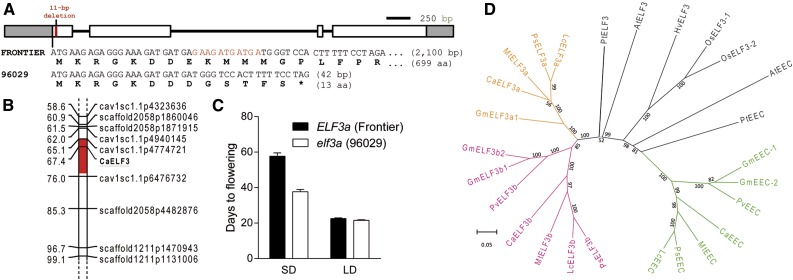
ICCV 96029 carries an 11-bp deletion in an ELF3 homolog. A, Diagram of the chickpea ELF3a gene showing the location of the 11-bp deletion in the first exon of ICCV 96029 (red line). Exons are shown as boxes, with coding sequences in white and untranslated regions in gray. Nucleotides are shown commencing from the start codon, with the 11-bp polymorphism displayed in red. The premature stop codon in ICCV 96029 is indicated by the asterisk, and CDS and protein lengths of the two variants are indicated. aa, Amino acids. B, Location of the QTL controlling SD flowering on Ca5 in the CDC Frontier × ICCV 96029 mapping population CPR-01 (F8). The one-log of the odds confidence intervals around the QTL peak are indicated by red shading, with units in centimorgans. Marker sequences are provided in Supplemental Data Set S1. C, DTF in the CPR-01 mapping population under LD and SD conditions for plants carrying the CDC Frontier and ICCV 96029 forms of CaELF3a. Values represent means ± se for n = 35 (ELF3a) and n = 53 (elf3a). D, Phylogram of ELF3-like genes across several families. ELF3a, ELF3b, and EEC legume clades are indicated in pink, orange, and green, respectively. Bootstrap values obtained from 1,000 replicate trees are shown as percentages above each branch. Branches with bootstrap values less than 50% have been collapsed. The protein sequence alignment used to generate this phylogram is provided in Supplemental Data Set S4 along with accession numbers for each sequence. At, Arabidopsis thaliana; Ca, Cicer arietinum; Gm, Glycine max; Hv, Hordeum vulgare; Lc, Lens culinaris; Mt, Medicago truncatula; Os, Oryza sativa; Ps, Pisum sativum; Pt, Populus trichocarpa; Pv, Phaseolus vulgaris.
Figure 4.
Figure 4.
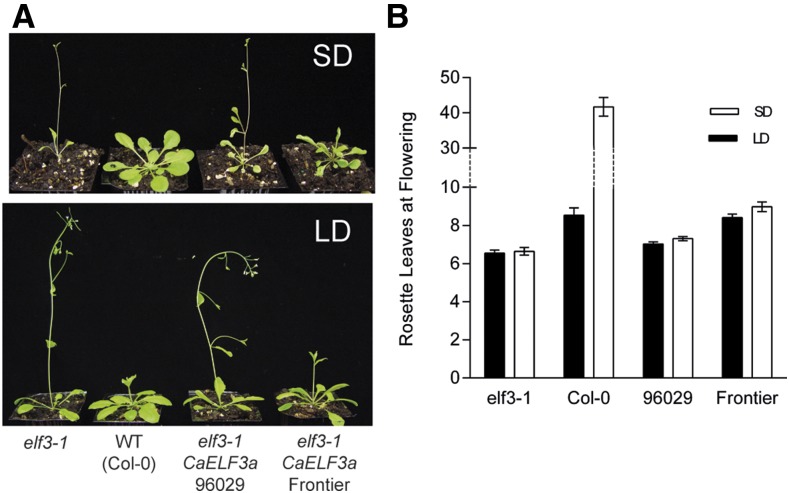
The 11-bp deletion in CaELF3a affects the function of the protein in Arabidopsis. A, Degrees of complementation of flowering phenotypes of the wild-type (WT) Columbia-0 (Col-0) Arabidopsis elf3-1 mutant by CDC Frontier but not the ICCV 96029 form of 35S:CaELF3a under both 8-h SD and 16-h LD conditions. B, Rosette leaf number at flowering for the elf3-1 mutant, the wild type, and transgenic Arabidopsis lines grown under LD and SD. Because Columbia-0 wild-type lines were extremely late flowering under SD, a discontinuous y axis indicated with broken lines was used to enable the visualization of flowering time differences in other lines. For LD conditions, values represent means ± se for n = 91 and n = 66 for CDC Frontier and ICCV 96029, respectively. For SD conditions, values represent means ± se for n = 85 and n = 71 for CDC Frontier and ICCV 96029, respectively. For each photoperiod/transgene combination, eight to 11 independent transgenic lines were analyzed. Data are derived from T2 plants homozygous for the transgene. Control (wild type/elf3-1) values represent means ± se for n = 10 to 14.
Figure 5.
Figure 5.
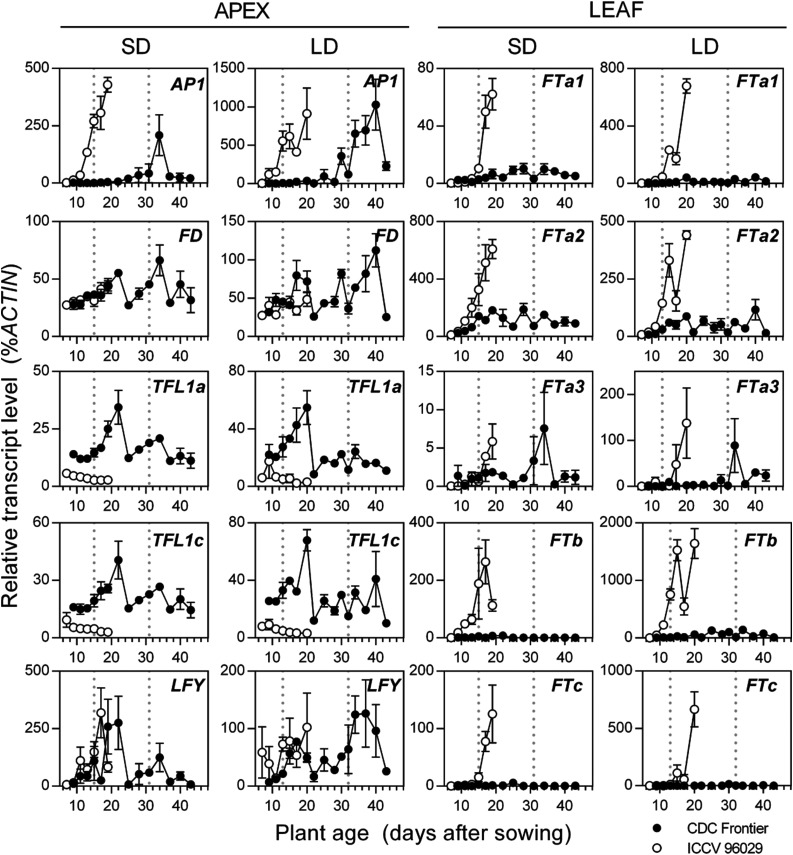
The caelf3a mutation is associated with misregulation of flowering genes. Gene expression is shown in CDC Frontier and ICCV 96029 during development under LD and SD conditions. Relative transcript levels were determined in the second-uppermost fully expanded leaf for members of the FT family or dissected shoot apices for meristem identity genes. Values represent means ± se for n = 2 to 3 biological replicates, each consisting of pooled material from two plants. Developing floral buds were first visible in CDC Frontier at 31 and 32 d after sowing in SD and LD, respectively, and in ICCV 96029 at 15 and 13 d after sowing in SD and LD, respectively (broken lines).
Figure 6.
Figure 6.
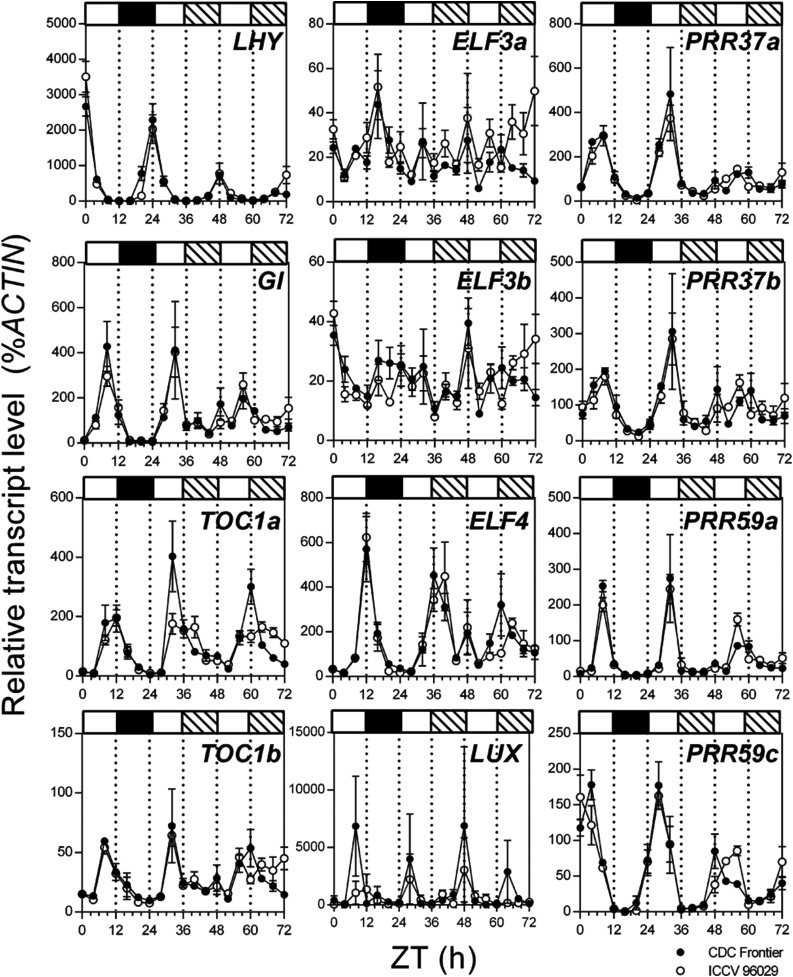
Rhythmic expression of circadian clock genes under LL are not affected by the caelf3a mutation. Plants were grown in growth chambers under a 12-h light/dark cycle at 22°C. Zeitgeber time (ZT) refers to the time since lights on of the last full entraining cycle, with ZT0 at 17 d after sowing. From ZT0, transcript levels were determined every 4 h in the uppermost fully expanded leaf of CDC Frontier and ICCV 96029 plants. At ZT24, plants were transferred to LL at 400 µmol m−2 s−1. Mean values ± se are shown for n = 2 to 3 biological replicates, each consisting of pooled material from two plants. Day and night periods are indicated by white and black bars, respectively, above the graphs, with subjective night periods during LL indicated by hatched bars.
Figure 7.
Figure 7.
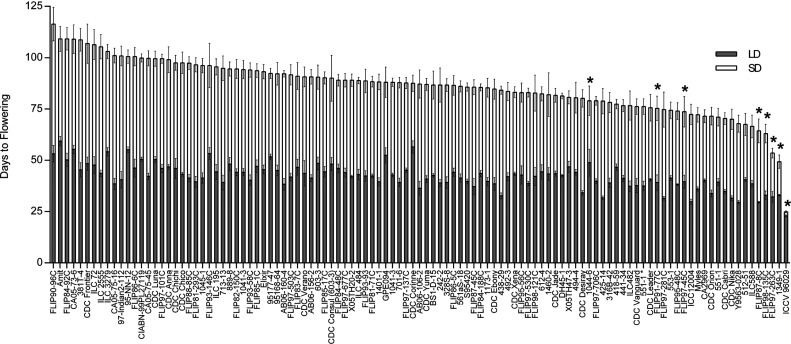
The caelf3a mutation is associated with earlier flowering under SD in global chickpea germplasm in a survey of photoperiodic flowering in chickpea. Plants were grown in chambers under LD (16-h) and SD (10-h) photoperiod conditions for 12 h at 22°C and 12 h at 16°C. The eight lines carrying the 11-bp deletion in CaELF3a are indicated by asterisks. A full list of accessions carrying the 11-bp deletion in CaELF3a is provided in Supplemental Data Set S5. Values represent means ± se, n = 6.

References

    1. Abbo S, Berger J, Turner NC (2003) Evolution of cultivated chickpea: four bottlenecks limit diversity and constrain adaptation. Funct Plant Biol 30: 1081–1087 - PubMed
    1. Abbo S, Lev-Yadun S, Galwey N (2002) Vernalization response of wild chickpea. New Phytol 154: 695–701 - PubMed
    1. Abbo S, Redden RJ, Yadav SS (2007) Utilization of wild relatives. In Yadav SS, Redden RJ, Chen W, Sharma B, eds, Chickpea Breeding and Management. CABI, Wallingford, UK, pp 338–354
    1. Ali L, Deokar A, Caballo C, Tar’an B, Gil J, Chen W, Millan T, Rubio J (2016) Fine mapping for double podding gene in chickpea. Theor Appl Genet 129: 77–86 - PubMed
    1. Alvarez MA, Tranquilli G, Lewis S, Kippes N, Dubcovsky J (2016) Genetic and physical mapping of the earliness per se locus Eps-A (m) 1 in Triticum monococcum identifies EARLY FLOWERING 3 (ELF3) as a candidate gene. Funct Integr Genomics 16: 365–382 - PMC - PubMed

LinkOut - more resources