doi: 10.3324/haematol.2017.167882.
Epub 2017 Aug 17.
Erythropoietin stimulates murine and human fibroblast growth factor-23, revealing novel roles for bone and bone marrow
Affiliations
- PMID: 28818868
- PMCID: PMC5664401
- DOI: 10.3324/haematol.2017.167882
Item in Clipboard
Erythropoietin stimulates murine and human fibroblast growth factor-23, revealing novel roles for bone and bone marrow
Haematologica.
2017 Nov.
No abstract available
Figures
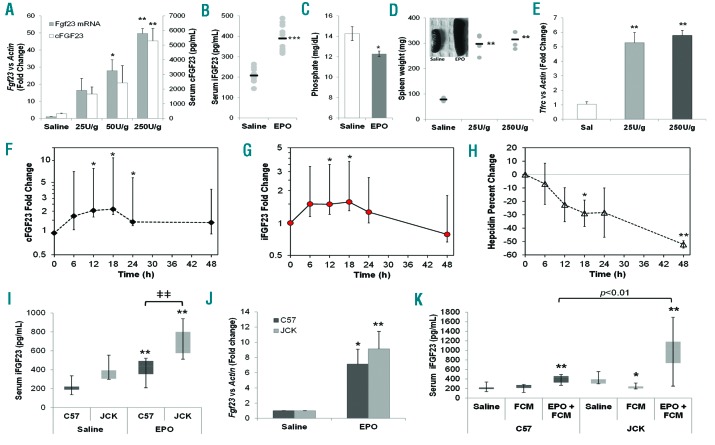
Erythropoietin (EPO) is a stimulator of FGF23. (A) Injections of EPO (50–250 U/g/d of body weight) over a 3-day time course dose-dependently increased serum cFGF23 as well as whole intact femur Fgf23 mRNA (*P<0.05, **P<0.01 vs. saline controls). (B) Serum iFGF23, measured with the Quidel rodent specific ELISA, was significantly elevated following EPO delivery (125 U/g/d body weight; ***P<0.001), (C) which correlated with a significant decrease in serum phosphate (*P<0.05). Markers of EPO activity, including (D) spleen weight and (E) whole bone TfRc mRNA, were increased in EPO-injected mice (n=3–8 mice at each time point; **P<0.01). (F) Serum cFGF23 levels progressively increased in 4 anemic patients treated with EPO, with a significant elevation over baseline levels observed at the 12–24 hour (h) time points (P<0.05). (G) Serum iFGF23, measured with the Quidel human-specific ELISA, mirrored cFGF23, with significant increases observed 12 and 18 h post injection. (H) After receiving EPO, serum hepcidin was significantly decreased in these subjects, indicative of normal EPO function. (I) Jck and C57 mice were injected with either saline or 125 U/g EPO. EPO treatment increased iFGF23 in C57 and Jck mice, with Jck iFGF23 concentrations significantly higher versus C57 mice; n=6 mice per group; **P<0.01 versus saline treatment of the same genotype, ǂǂP<0.01 versus C57 same treatment. (J) EPO treatment increased whole bone Fgf23 mRNA in C57 and in Jck mice (*P<0.02 and **P<0.01 compared to saline treatment of the same genotype). (I) Jck and C57 mice were injected with either ferric carboxymaltose (FCM) alone or in combination with EPO (EPO+FCM) during the 3-day regimen. FCM alone reduced serum iFGF23 in the Jck mice, whereas FCM+EPO increased iFGF23 in both genotypes, with higher iFGF23 concentrations observed in the Jck mice compared to C57 (n=6 mice per group; *P<0.05 and **P<0.01 vs. saline treatment of the same genotype).
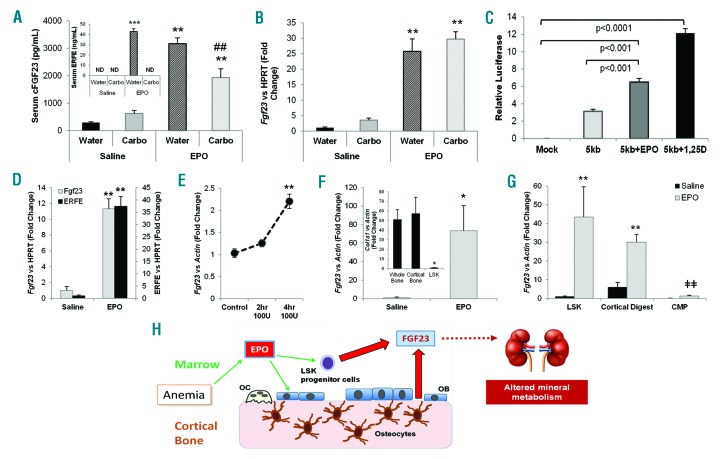
Marrow-derived FGF23 contributes to the response to erythropoietin (EPO). (A) Marrow ablation in wild-type mice using carboplatin (‘Carbo’) completely blocked the induction of ERFE in response to EPO (inset; ND: not detected). Although serum cFGF23 was induced in all groups treated with EPO, marrow ablation reduced these levels by approximately 40%. (B) Fgf23 mRNA, normalized to Hprt, was induced in cortical bone flushed of marrow in all groups treated with EPO (n=5–6; **P<0.01 vs. same pre-treatment + Saline; #P<0.05 and ##P<0.01 vs. water ablation control+same post-treatment). (C) A -5kb Fgf23 promoter fragment responded positively to EPO treatment versus the promoter fragment alone or mock transfected ROS17/2.8 osteoblastic cells. 1,25D treatment served as the positive control (n=3 replicates per treatment). (D) Flushed bone marrow RNA from mice treated with EPO showed a significant increase in Fgf23 and Erfe mRNA levels (normalized to Hprt) compared to flushed bone marrow from saline-injected mice (n=4 mice per group; **P<0.001). (E) Isolated bone marrow cells were cultured ex vivo and treated with 100 U/mL of EPO for 4 h, showing a significant increase in Fgf23 mRNA expression (**P<0.01). (F) An enriched population of Lineage− cells was isolated from flushed bone marrow using a hematopoietic progenitor separation kit. Treatment of wild-type C57 mice with EPO resulted in a significant increase of Fgf23 mRNA expression compared to that of saline-treated mice (n=4 replicates, pools from at least 2 mice; P<0.05). Col1a1 mRNA, a marker of osteoblasts, was significantly reduced in this enriched population compared to wild-type whole bone and wild-type cortical bone flushed of marrow to show a lack of osteoblasts within this preparation (inset; *P<0.05 vs. whole bone and cortical bone). (G) Marrow from C57 control mice injected with saline or EPO were stained and co-sorted with flow cytometry for LSK and CMP cell populations while the cortical bone was collagenase digested. The sorted LSK cells significantly induced Fgf23 mRNA in response to EPO (n=4 pools from 2–3 mice; **P<0.01). Cortical digested cells also showed a significant Fgf23 mRNA induction with EPO treatment (**P<0.01), whereas the CMP cells were at the limit of detection and remained significantly lower compared to the LSK and cortical digested cells (ǂǂP<0.01 vs. LSK and cortical digests treated with EPO). Data represented as mean+standard error of mean (SEM). (H) Our data demonstrate that EPO can induce FGF23 production in osteoblasts/osteocytes and hematopoietic progenitors, with excess FGF23 potentially leading to altered renal mineral metabolism and other pathogenic actions.
References
-
- Hsu CY, McCulloch CE, Curhan GC. Epidemiology of anemia associated with chronic renal insufficiency among adults in the United States: results from the Third National Health and Nutrition Examination Survey. J Am Soc Nephrol. 2002;13(2):504–510. - PubMed
-
- Fliser D, Kollerits B, Neyer U, et al. Fibroblast growth factor 23 (FGF23) predicts progression of chronic kidney disease: the Mild to Moderate Kidney Disease (MMKD) Study. J Am Soc Nephrol. 2007;18(9):2600–2608. - PubMed
-
- McCullough PA, Barnhart HX, Inrig JK, et al. Cardiovascular toxicity of epoetinalfa in patients with chronic kidney disease. Am J Nephrol. 2013;37(6):549–558. - PubMed
Publication types
MeSH terms
Substances
Grants and funding
- F32 AR065389/AR/NIAMS NIH HHS/United States
- T32 HL007910/HL/NHLBI NIH HHS/United States
- R21 AR067330/AR/NIAMS NIH HHS/United States
- R01 DK095784/DK/NIDDK NIH HHS/United States
- K08 DK111980/DK/NIDDK NIH HHS/United States
- L40 DK106813/DK/NIDDK NIH HHS/United States
- R01 AR065403/AR/NIAMS NIH HHS/United States
- R01 DK107309/DK/NIDDK NIH HHS/United States
- UL1 TR001881/TR/NCATS NIH HHS/United States
- P30 DK090948/DK/NIDDK NIH HHS/United States
- R21 AR059278/AR/NIAMS NIH HHS/United States
- UL1 TR000124/TR/NCATS NIH HHS/United States
- P30 CA082709/CA/NCI NIH HHS/United States
- R01 DK063934/DK/NIDDK NIH HHS/United States
- R01 DK065029/DK/NIDDK NIH HHS/United States
- K12 HD034610/HD/NICHD NIH HHS/United States
LinkOut - more resources
Full Text Sources
Other Literature Sources
Medical