. 2017 Aug 17;7(1):8655.
doi: 10.1038/s41598-017-09277-z.

Biology, physiology and gene expression of grasshopper Oedaleus asiaticus exposed to diet stress from plant secondary compounds

Affiliations

Biology, physiology and gene expression of grasshopper Oedaleus asiaticus exposed to diet stress from plant secondary compounds

Xunbing Huang et al. Sci Rep. .

Abstract

We studied the role of plant primary and secondary metabolites in mediating plant-insect interactions by conducting a no-choice single-plant species field experiment to compare the suitability, enzyme activities, and gene expression of Oedaleus asiaticus grasshoppers feeding on four host and non-host plants with different chemical traits. O. asiaticus growth showed a positive relationship to food nutrition content and a negative relationship to secondary compounds content. Grasshopper amylase, chymotrypsin, and lipase activities were positively related to food starch, crude protein, and lipid content, respectively. Activity of cytochrome P450s, glutathione-S-transferase, and carboxylesterase were positively related to levels of secondary plant compounds. Gene expression of UDP-glucuronosyltransferase 2C1, cytochrome P450 6K1 were also positively related to secondary compounds content in the diet. Grasshoppers feeding on Artemisia frigida, a species with low nutrient content and a high level of secondary compounds, had reduced growth and digestive enzyme activity. They also had higher detoxification enzyme activity and gene expression compared to grasshoppers feeding on the grasses Cleistogenes squarrosa, Leymus chinensis, or Stipa krylovii. These results illustrated Oedaleus asiaticus adaptive responses to diet stress resulting from toxic chemicals, and support the hypothesis that nutritious food benefits insect growth, but plant secondary compounds are detrimental for insect growth.


Conflict of interest statement

The authors declare that they have no competing interests.

Figures
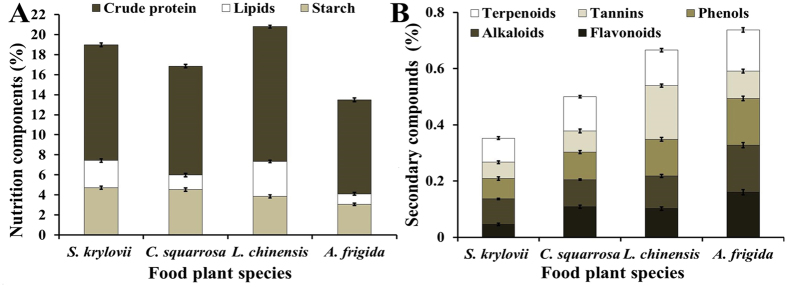
Figure 1
Figure 1
(A) Percentage nutrition components (crude protein, lipid, starch) and (B) secondary compounds (terpenoids, tannins, phenols, alkaloids, flavonoids) content (±SD, %) of the plant species C. squarrosa, L. chinensis, S. krylovii, and A. frigida, respectively.
Figure 2
Figure 2
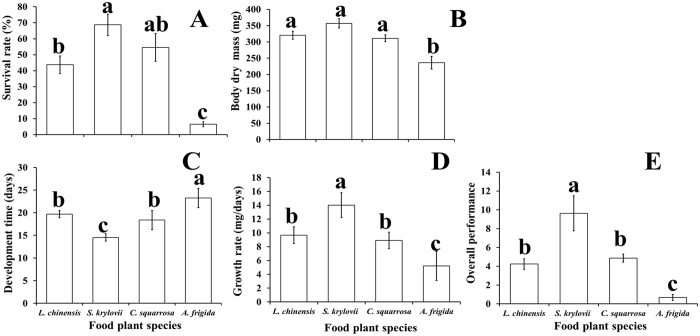
(A) O. asiaticus mean % survival rate from fourth instar to adult ± SD, (B) mean dry mass (mg ± SD) of adults, (C) mean developmental time (days ± SD) from fourth instar to adult, (D) growth rate (mg/day ± SD) and (E) overall performance (±SD) when fed on either L. chinensis, S. krylovii, C. squarrosa, or A. frigida, respectively. Bars marked by different lowercase letters are significantly different based on Turkey’s HSD analysis at P < 0.05.
Figure 3
Figure 3
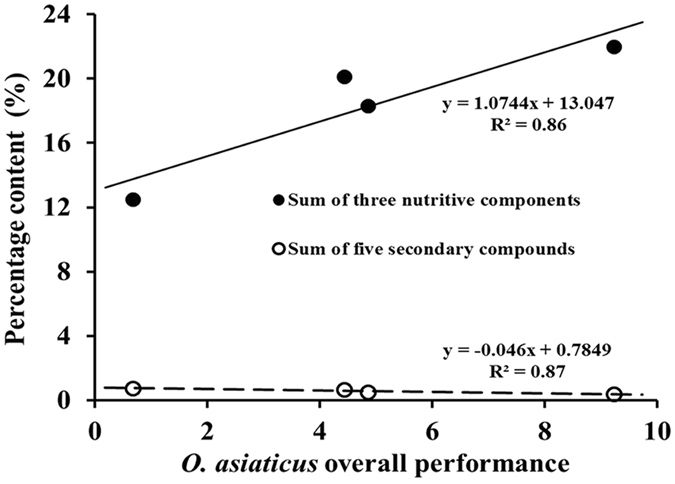
Linear relationship of O. asiaticus mean overall performance with the sum of three nutritive components (crude protein, lipid, starch) and five secondary compounds (alkaloids, flavonoids, phenols, tannins, terpenoids), respectively.
Figure 4
Figure 4
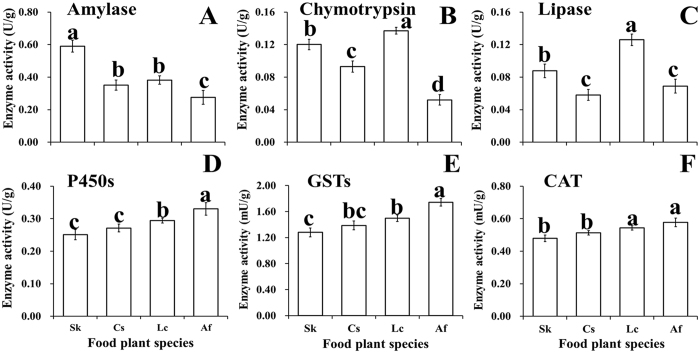
The activity (±SD) of the main digestive (amylase, chymotrypsin, lipase) and detoxification (P450s: cytochrome P450s, GSTs: glutathione-S-transferase, CAT: carboxylesterase) enzymes for O. asiaticus when fed on L. chinensis (Lc), S. krylovii (Sk), C. squarrosa (Cs), and A. frigida (Af). Bars marked by different lowercase letters are significantly different based on Turkey’s HSD analysis at P < 0.05.
Figure 5
Figure 5
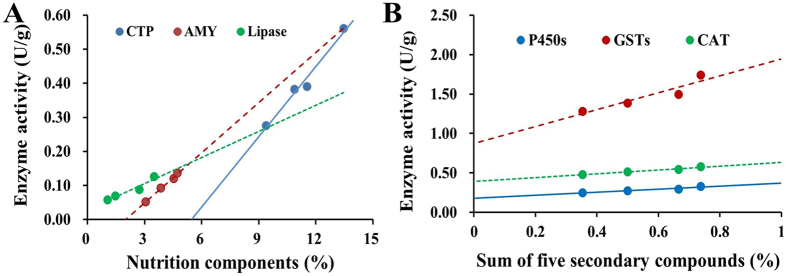
Linear relations between O. asiaticus mean enzyme activity and food plant chemical traits. (A) Relationship between mean chymotrypsin (CTP, U/g) activity and mean crude protein content, mean amylase (AMY, U/g) activity and mean starch content, mean lipase activity (U/g) and mean lipid content. (B) Relationship between cytochrome P450s (P450s, U/g), glutathione-S-transferase (GSTs, mU/g), carboxylesterase (CAT, mU/g) mean activities with the sum of five secondary compounds (%).
Figure 6
Figure 6
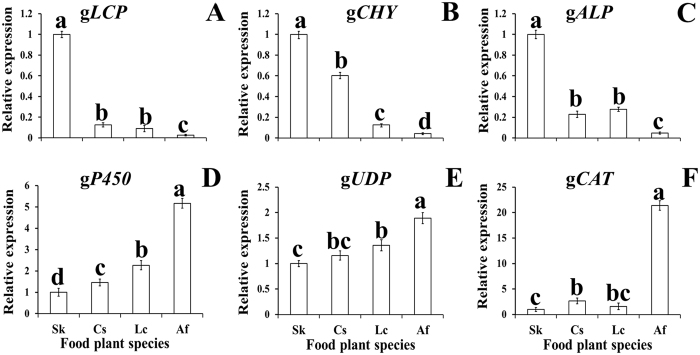
Relative expression (±SD) of six candidate genes for O. asiaticus feeding on S. krylovii (Sk), L. chinensis (Lc), C. squarrosa (Cs), and A. frigida (Af). Different lower case letters indicate a significant difference among the four treatments at P = 0.05. Key: gLCP: Cuticle protein 6; gCHY: TPA_exp: chymotrypsin 2; gALP: alpha-glucosidase; gUDP: UDP-glucuronosyltransferase 2C1; gP450: cytochrome P450 6K1; gCAT: carboxylesterase.

References

    1. Gatehouse JA. Plant resistance towards insect herbivores: a dynamic interaction. New Phytol. 2002;156:145–169. doi: 10.1046/j.1469-8137.2002.00519.x. - DOI - PubMed
    1. Wu JQ, Baldwin IT. New insights into plant responses to the attack from insect herbivores. Annu. Rev. Genet. 2010;44 doi: 10.1146/annurev-genet-102209-163500. - DOI - PubMed
    1. Giri AP, et al. Molecular interactions between the specialist herbivore Manduca sexta (Lepidoptera, Sphingidae) and its natural host Nicotiana attenuata. VII. Changes in the plant’s proteome. Plant Physiol. 2007;142:1621–1641. doi: 10.1104/pp.106.088781. - DOI - PMC - PubMed
    1. Dicke M, Baldwin IT. The evolutionary context for herbivore-induced plant volatiles: beyond the ‘cry for help’. Trends Plant Sci. 2010;15:167–175. doi: 10.1016/j.tplants.2009.12.002. - DOI - PubMed
    1. Raubenheimer D, Simpson SJ. Nutrient balancing in grasshoppers: behavioural and physiological correlates of dietary breadth. J. Exp. Biol. 2004;206:1669–1681. doi: 10.1242/jeb.00336. - DOI - PubMed

Publication types

LinkOut - more resources