


Patient satisfaction and acceptance of spherical equivalent spectacles correction wear in rural India
- PMID: 28820160
- PMCID: PMC5598185
- DOI: 10.4103/ijo.IJO_819_16
Patient satisfaction and acceptance of spherical equivalent spectacles correction wear in rural India
Abstract
Purpose: The aim of this study was to explore the possibilities of acceptance of a ready-to-dispense spherical equivalent (SE) of spherocylindrical (SC) correction spectacles in rural India.
Methods: Snellen visual acuity with SE power of refracted SC lenses was prospectively collected from all individuals visiting vision centers in Phase 1 (vision correction accuracy) of the study conducted in two South Indian districts. The satisfaction level was recorded by asking one standard question. The SE spectacles were dispensed in vision centers of one district in Phase 2 (SE acceptance) with a suggestion to return, if unsatisfied, for free exchange of spectacles within a month of dispensing.
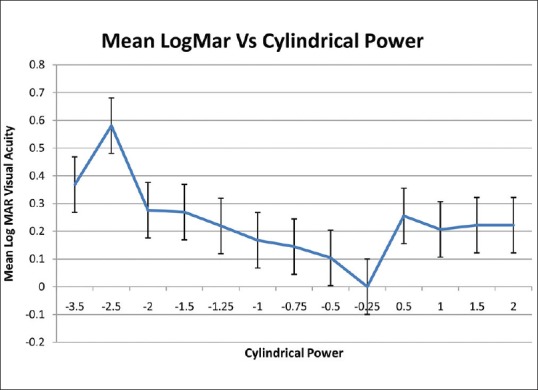
Results: In Phase 1, 929 of 3529 patients were refracted and it was found that 320 patients and one eye of one patient (641 eyes) had astigmatism. The average age was 41 (±16; range: 7-84) years. There was no reduction of visual acuity in SE of 0.25 Dcyl (100% satisfaction) and progressive decrease in satisfaction to 43%, 26%, and 19% with SE correction of 0.50, 0.75, and 1.00 Dcyl, respectively. In Phase 2, 988 of 6168 patients needed refraction and 240 had astigmatism. A total of 103 patients (206 eyes) accepted SE equivalent spectacles. No client returned for the free exchange of spectacles.
Conclusion: Dispensing SE power up to 1 Dcyl in ready - made spectacles could be considered in remote rural populations in resource-poor economic conditions.
Conflict of interest statement
There are no conflicts of interest.
Figures
Similar articles
-
Visual function after correction of distance refractive error with ready-made and custom spectacles: a randomized clinical trial.Ophthalmology. 2012 Oct;119(10):2014-20. doi: 10.1016/j.ophtha.2012.03.051. Epub 2012 Jun 15. Ophthalmology. 2012. PMID: 22705346 Clinical Trial.
-
Used glasses versus ready-made spectacles for the treatment of refractive error.Ophthalmic Surg Lasers Imaging. 2012 May-Jun;43(3):235-40. doi: 10.3928/15428877-20120223-02. Epub 2012 Mar 1. Ophthalmic Surg Lasers Imaging. 2012. PMID: 22373170
-
Spectacle Wear Among Children in a School-Based Program for Ready-Made vs Custom-Made Spectacles in India: A Randomized Clinical Trial.JAMA Ophthalmol. 2017 Jun 1;135(6):527-533. doi: 10.1001/jamaophthalmol.2017.0641. JAMA Ophthalmol. 2017. PMID: 28426857 Free PMC article. Clinical Trial.
-
Spectacle non-tolerance in clinical practice - a systematic review with meta-analysis.Ophthalmic Physiol Opt. 2021 May;41(3):610-622. doi: 10.1111/opo.12796. Epub 2021 Mar 9. Ophthalmic Physiol Opt. 2021. PMID: 33751648
-
Self-adjustable glasses in the developing world.Clin Ophthalmol. 2014 Feb 17;8:405-13. doi: 10.2147/OPTH.S46057. eCollection 2014. Clin Ophthalmol. 2014. PMID: 24570581 Free PMC article. Review.
Cited by
-
Approaches for delivery of refractive and optical care services in community and primary care settings.Cochrane Database Syst Rev. 2024 May 29;5(5):CD016043. doi: 10.1002/14651858.CD016043. Cochrane Database Syst Rev. 2024. PMID: 38808577 Free PMC article.
-
Prevalence of refractive error among Dongarias and use of Folding Phoropter (FoFo) as a field device enabling implementation research in this indigenous community. Tribal Odisha Eye Disease Study (TOES) Report # 13.PLoS One. 2023 May 11;18(5):e0284790. doi: 10.1371/journal.pone.0284790. eCollection 2023. PLoS One. 2023. PMID: 37167346 Free PMC article.
References
-
- Bourne RR, Stevens GA, White RA, Smith JL, Flaxman SR, Price H, et al. Causes of vision loss worldwide, 1990-2010: A systematic analysis. Lancet Glob Health. 2013;1:e339–49. - PubMed
-
- Jonas JB, George R, Asokan R, Flaxman SR, Keeffe J, Leasher J, et al. Prevalence and causes of vision loss in Central and South Asia: 1990-2010. Br J Ophthalmol. 2014;98:592–8. - PubMed
Publication types
MeSH terms
LinkOut - more resources
Full Text Sources
Other Literature Sources
Medical
