Review
. 2017 Aug 18;17(8):1901.
doi: 10.3390/s17081901.

Surface-Enhanced Raman Scattering in Molecular Junctions

Affiliations
Review

Surface-Enhanced Raman Scattering in Molecular Junctions

Madoka Iwane et al. Sensors (Basel). .

Abstract

Surface-enhanced Raman scattering (SERS) is a surface-sensitive vibrational spectroscopy that allows Raman spectroscopy on a single molecular scale. Here, we present a review of SERS from molecular junctions, in which a single molecule or molecules are made to have contact from the top to the bottom of metal surfaces. The molecular junctions are nice platforms for SERS as well as transport measurement. Electronic characterization based on the transport measurements of molecular junctions has been extensively studied for the development of miniaturized electronic devices. Simultaneous SERS and transport measurement of the molecular junctions allow both structural (geometrical) and electronic information on the single molecule scale. The improvement of SERS measurement on molecular junctions open the door toward new nanoscience and nanotechnology in molecular electronics.

Keywords: electron transport; molecular electronics; single-molecular junction; surface-enhanced Raman scattering.


Conflict of interest statement

The authors declare no conflicts of interest.

Figures

Figure 1
Figure 1
(a) The experimental setup for surface-enhanced Raman scattering (SERS) of molecular junctions fabricated with a mechanically controllable break junction (MCBJ); (b) SERS of 1,4-benzenedithiol (BDT) molecular junctions with different gap widths. The gap width was (A) 0.8 nm, (B) 0.6 nm, and (C) 0.4 nm. (λex: 632.8 nm) [30].
Figure 2
Figure 2
(a) Schematic view of the fishing-mode tip-enhanced Raman scattering (FM-TERS) for simultaneous measurement of conductance and TERS for single-molecular junctions; (b) Time course of conductance for the Au scanning tunneling microscopy tip/4,4′-bipyridine/Au (111) system; (c) TERS spectra corresponding to the ON and OFF states. (λex: 632.8 nm, laser intensity: 5 mW) [33].
Figure 3
Figure 3
(a) Scanning electron microscope (SEM) image of the sample; (b) Map of the substrate Si 520 cm−1 peak; (c) Map of the p-mercaptoaniline (pMA) SERS signal of 1590 cm−1 (a1 symmetry mode); (d) Waterfall plot of SERS and conductance for a pMA molecular junction (λex: 785 nm, laser intensity: 0.5 mW) [34].
Figure 4
Figure 4
(a) Sample Raman spectra of the three-ring oligophenylene vinylene (OPV3) molecular junction. The full scale of the anti-Stokes and Stokes signal are 235 counts and 10,000 counts, respectively; (b) Effective temperature of the molecular junction as a function of bias voltage: 1317 cm−1 (red) and 1625 cm−1 (blue) [35].
Figure 5
Figure 5
SERS intensity as a function of the conductance of the BPY molecular junction. The arrow indicates the conductance regime of BPY single-molecular junction [37]. The hollow and solid squares correspond to the molecular junctions showing the totally symmetric a mode and the non-totally symmetric b mode in SERS, respectively.
Figure 6
Figure 6
(a) Two types of SERS spectra of the BPY single-molecular junctions (λex: 785 nm, laser intensity: 0.5 mW); (b) Time evolution of the Raman intensity of the b1 mode and b2 mode, and the conductance of the BPY single-molecular junction; (c) Time course of the Raman shift of the ring breathing mode around 1050 cm−1 and the conductance of the BPY single-molecular junction [37].
Figure 7
Figure 7
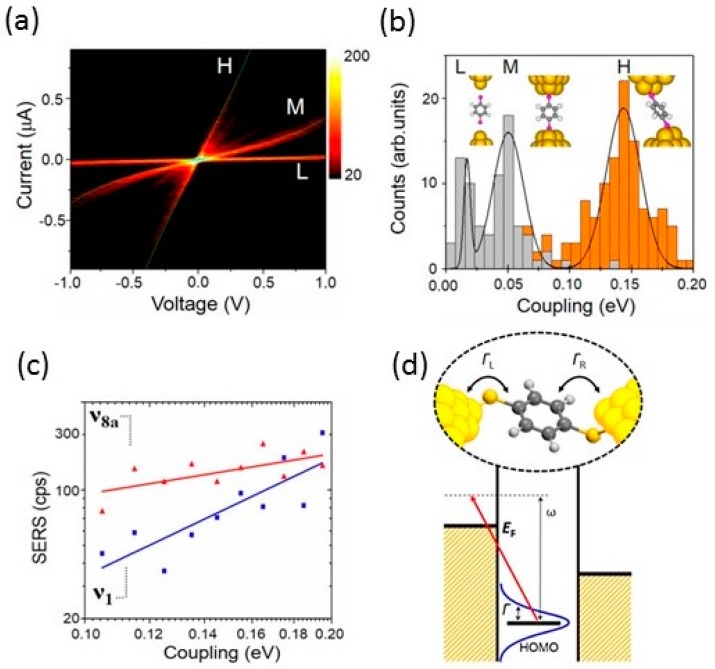
(a) Bidimensional IV histogram summarizing the individual IV response of single-molecule BDT junctions; (b) Statistical distribution of Γ. Orange counts correspond to ν8a-active samples; (c) Correlation between the average intensity of the SERS signal (ν1 and ν8 modes) as a function of Γ on a log—log plot; (d) Photo-induced charge transfer transition from HOMO to metal unoccupied state. The discrete molecular level is broadened by Γ [42].
Figure 8
Figure 8
(a) Example of SERS of the C60 molecular junction fabricated with the electron migration technique. Inset: SEM image of the electrode. Surrounding figures illustrate vibrational modes; (b) SERS of the C60 molecular junction as a function of the bias voltage; (c) Raman shift as a function of the bias voltage for a particular mode: 1258 cm−1 [46].
Figure 9
Figure 9
(a) The bias voltage dependence on TERS of BPY molecular junction featuring the ν8a band (1610 cm−1); (b) The schematic of the BPY single-molecular junction at a low and high bias-voltage (λex: 632.8 nm, laser intensity: 5 mW) [33].
Figure 10
Figure 10
(a) Schematic view of squeezable break junction setup for conductance measurement of the molecular junction; (b) Conductance histograms of the 2,7-diaminofluorene molecular junction measured without (black curve) and with (red colored area) continuous wave illumination (wavelength: 781 nm, power: 10 mW). Inset: Examples of the conductance traces of the 2,7-diaminofluorene molecular junctions without (black) and with (red) laser illumination [47].

References

    1. Aviram A., Ratner M.A. Molecular rectifiers. Chem. Phys. Lett. 1974;29:277–283. doi: 10.1016/0009-2614(74)85031-1. - DOI
    1. Metzger R.M., Chen B., Höpfner U., Lakshmikantham M.V., Vuillaume D., Kawai T., Wu X., Tachibana H., Hughes T.V., Sakurai H., et al. Unimolecular Electrical Rectification in Hexadecylquinolinium Tricyanoquinodimethanide. J. Am. Chem. Soc. 1997;119:10455–10466. doi: 10.1021/ja971811e. - DOI
    1. Song H., Kim Y., Jang Y.H., Jeong H., Reed M.A., Lee T. Observation of molecular orbital gating. Nature. 2009;462:1039–1043. doi: 10.1038/nature08639. - DOI - PubMed
    1. Kiguchi M., Ohto T., Fujii S., Sugiyasu K., Nakajima S., Takeuchi M., Nakamura H. Single Molecular Resistive Switch Obtained via Sliding Multiple Anchoring Points and Varying Effective Wire Length. J. Am. Chem. Soc. 2014;136:7327–7332. doi: 10.1021/ja413104g. - DOI - PubMed
    1. Su T.A., Li H., Steigerwald M.L., Venkataraman L., Nuckolls C. Stereoelectronic switching in single-molecule junctions. Nat. Chem. 2015;7:215–220. doi: 10.1038/nchem.2180. - DOI - PubMed