. 2017 Oct;97(4):1170-1179.
doi: 10.4269/ajtmh.16-0955. Epub 2017 Aug 18.

The Impact of Introducing Malaria Rapid Diagnostic Tests on Fever Case Management: A Synthesis of Ten Studies from the ACT Consortium

Affiliations

The Impact of Introducing Malaria Rapid Diagnostic Tests on Fever Case Management: A Synthesis of Ten Studies from the ACT Consortium

Katia J Bruxvoort et al. Am J Trop Med Hyg. 2017 Oct.

Abstract

Since 2010, the World Health Organization has been recommending that all suspected cases of malaria be confirmed with parasite-based diagnosis before treatment. These guidelines represent a paradigm shift away from presumptive antimalarial treatment of fever. Malaria rapid diagnostic tests (mRDTs) are central to implementing this policy, intended to target artemisinin-based combination therapies (ACT) to patients with confirmed malaria and to improve management of patients with nonmalarial fevers. The ACT Consortium conducted ten linked studies, eight in sub-Saharan Africa and two in Afghanistan, to evaluate the impact of mRDT introduction on case management across settings that vary in malaria endemicity and healthcare provider type. This synthesis includes 562,368 outpatient encounters (study size range 2,400-432,513). mRDTs were associated with significantly lower ACT prescription (range 8-69% versus 20-100%). Prescribing did not always adhere to malaria test results; in several settings, ACTs were prescribed to more than 30% of test-negative patients or to fewer than 80% of test-positive patients. Either an antimalarial or an antibiotic was prescribed for more than 75% of patients across most settings; lower antimalarial prescription for malaria test-negative patients was partly offset by higher antibiotic prescription. Symptomatic management with antipyretics alone was prescribed for fewer than 25% of patients across all scenarios. In community health worker and private retailer settings, mRDTs increased referral of patients to other providers. This synthesis provides an overview of shifts in case management that may be expected with mRDT introduction and highlights areas of focus to improve design and implementation of future case management programs.


Figures

Figure 1.
Figure 1.
Patients in scenarios without and with malaria rapid diagnostic test (mRDT) interventions that were tested with any malaria diagnostic test at the provider of (A) all patients, (B) patients under age five years, and (C) patients ages five years and older. Afgh1 and Ghan1 studies individually randomized patients to malaria diagnostic method and are not included in this analysis. Some settings had more than one mRDT intervention scenario, which are graphed separately using the color and symbol for the setting. These include Cam1/a and Cam1/b (two intervention scenarios each), Nige1 (three intervention scenarios), and Tanz2 (three intervention scenarios). See Table 1. Scenarios with denominators fewer than 50 patients in Figure 2B are Afgh2/a without mRDT interventions and Afgh2/b both with and without mRDT interventions.
Figure 2.
Figure 2.
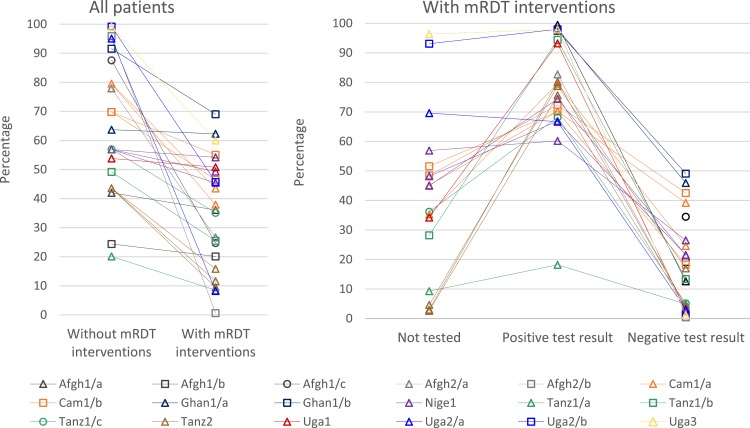
Patients prescribed an artemisinin-based combination therapy (ACT) of all patients in scenarios without and with malaria rapid diagnostic test (mRDT) interventions and by test result for all patients in scenarios with mRDT interventions. Graphs depict the percentage of patients prescribed ACT except for: Afgh1 and Afgh2, where all antimalarials are included to account for Plasmodium vivax treatment; and Nige1 without mRDT interventions only, where ACT or sulfadoxine-pyrimethamine (SP) are included to reflect treatment practices at the time of data collection. Scenarios with denominators fewer than 10 patients are not graphed, resulting in some points without adjoining lines: Afgh2/a and Afgh2/b in the “Not tested” column and Afgh1/b, Afgh1/c, and Afgh2/b in the “Positive test result” column. Afgh1 and Ghan1 studies individually randomized patients to malaria diagnostic method; data are not included in the “Not tested” column because all patients in mRDT intervention scenarios were tested. Some settings had more than one mRDT intervention scenario, which are graphed separately using the color and symbol for the setting. These include Cam1/a and Cam1/b (two intervention scenarios each), Nige1 (three intervention scenarios), and Tanz2 (three intervention scenarios). See Table 1. The following scenarios with denominators fewer than 50 patients are included: Uga2 in the “Not tested” column, and Cam1/a (R1), Tanz1/b, and Uga2/a in the “Positive test result” column. All other scenarios had larger denominators.
Figure 3.
Figure 3.
Patients prescribed an antibacterial of all patients in scenarios without and with malaria rapid diagnostic test (mRDT) interventions and by test result for all patients in scenarios with mRDT interventions. Some settings had more than one mRDT intervention scenario, which are graphed separately using the color and symbol for the setting. These include Cam1/a and Cam1/b (two intervention scenarios each), Nige1 (three intervention scenarios), and Tanz2 (three intervention scenarios). See Table 1. Community health workers in Uga2 were not permitted to prescribe antibacterials medications, so this study is not included in figure 3. Afgh1 and Ghan1 studies individually randomized patients to malaria diagnostic method; data are not included in the “Not tested” column because all patients in scenarios with mRDT interventions were tested. Scenarios with denominators fewer than 10 patients are not graphed, resulting in some points without adjoining lines: Afgh2/a and Afgh2/b in the “Not tested” column, and Afgh1/b, Afgh1/c, and Afgh2/b in the “Positive test result” column. The following scenarios with denominators fewer than 50 patients are included: Cam1/a (R1) and Tanz1/b in the “Positive test result” column. All other scenarios had larger denominators.
Figure 4.
Figure 4.
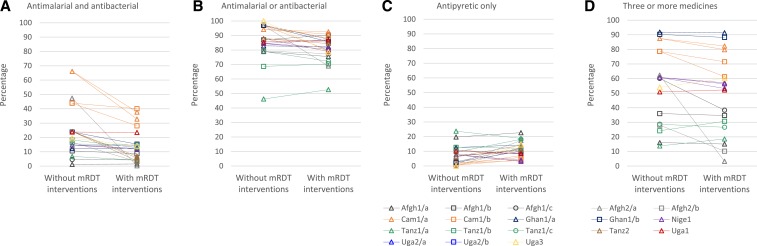
Patients in scenarios without and with malaria rapid diagnostic test (mRDT) interventions prescribed (A) an antimalarial and an antibacterial, (B) an antimalarial or an antibacterial, (C) an antipyretic without an antimalarial or an antibacterial, and (D) three or more medicines. Some settings had more than one mRDT intervention scenario, which are graphed separately using the color and symbol for the setting. These include Cam1/a and Cam1/b (two intervention scenarios each); Nige1 (three intervention scenarios) and Tanz2 (three intervention scenarios). See Table 1. Community health workers in Uga2 were not permitted to prescribe antibacterials medications, so this study is not included in figure 4. Tanz2 did not record data on all medications prescribed, so this study is not included in (D).
Figure 5.
Figure 5.
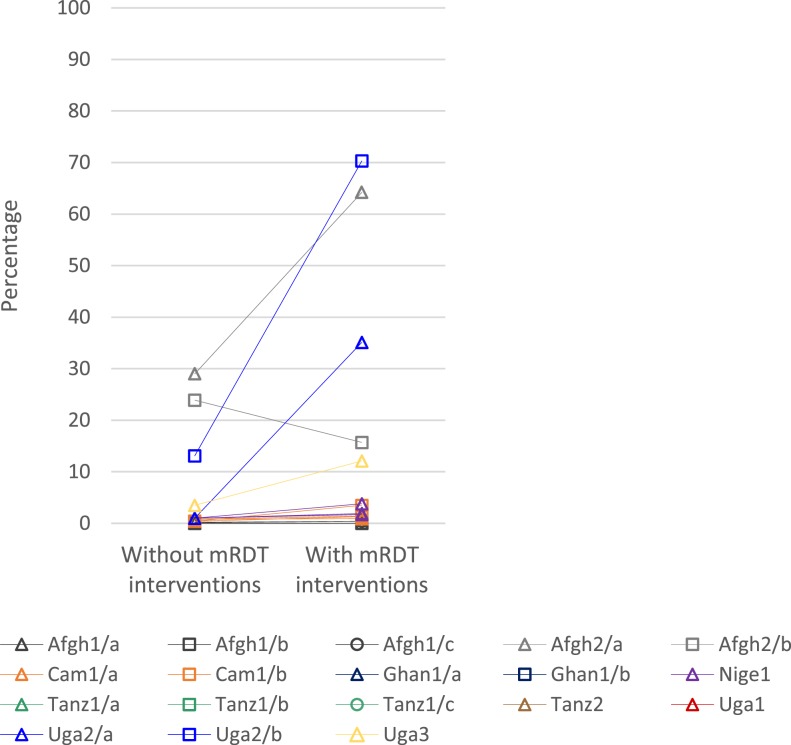
Patients in scenarios without and with malaria rapid diagnostic test (mRDT) interventions that were referred to another care provider or health facility. Ghan1, Tanz1, Tanz2, and Uga1 did not record data on referral. Case management was performed by community health workers in Afgh2 and Uga2, private drug store retailers in Uga3, and both public and private health facilities in Nige1. All other studies were conducted in public health facilities.

References

    1. Whitty CJ, Chandler C, Ansah E, Leslie T, Staedke SG, 2008. Deployment of ACT antimalarials for treatment of malaria: challenges and opportunities. Malar J 7 (Suppl 1): S7. - PMC - PubMed
    1. World Health Organization , 2011. Universal Access to Malaria Diagnostic Testing: An Operational Manual. Geneva, Switzerland: World Health Organization.
    1. World Health Organization , 2010. Guidelines for the Treatment of Malaria. 2nd edition. Geneva, Switzerland: World Health Organization.
    1. Mabey D, Peeling RW, Ustianowski A, Perkins MD, 2004. Diagnostics for the developing world. Nat Rev Microbiol 2: 231–240. - PubMed
    1. UNITAID , 2016. Malaria Diagnostics Landscape Update. Geneva, Switzerland: World Health Organization for the UNITAID Secretariat.