


Methodological factors affecting joint moments estimation in clinical gait analysis: a systematic review
- PMID: 28821242
- PMCID: PMC5563001
- DOI: 10.1186/s12938-017-0396-x
Methodological factors affecting joint moments estimation in clinical gait analysis: a systematic review
Abstract
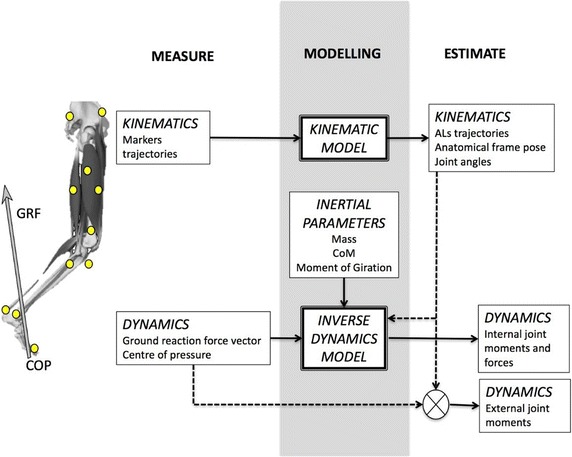
Quantitative gait analysis can provide a description of joint kinematics and dynamics, and it is recognized as a clinically useful tool for functional assessment, diagnosis and intervention planning. Clinically interpretable parameters are estimated from quantitative measures (i.e. ground reaction forces, skin marker trajectories, etc.) through biomechanical modelling. In particular, the estimation of joint moments during motion is grounded on several modelling assumptions: (1) body segmental and joint kinematics is derived from the trajectories of markers and by modelling the human body as a kinematic chain; (2) joint resultant (net) loads are, usually, derived from force plate measurements through a model of segmental dynamics. Therefore, both measurement errors and modelling assumptions can affect the results, to an extent that also depends on the characteristics of the motor task analysed (i.e. gait speed). Errors affecting the trajectories of joint centres, the orientation of joint functional axes, the joint angular velocities, the accuracy of inertial parameters and force measurements (concurring to the definition of the dynamic model), can weigh differently in the estimation of clinically interpretable joint moments. Numerous studies addressed all these methodological aspects separately, but a critical analysis of how these aspects may affect the clinical interpretation of joint dynamics is still missing. This article aims at filling this gap through a systematic review of the literature, conducted on Web of Science, Scopus and PubMed. The final objective is hence to provide clear take-home messages to guide laboratories in the estimation of joint moments for the clinical practice.
Keywords: Dynamics; Error propagation; Gait analysis methodology; Inverse dynamics approach; Joint moments; Kinematics; Reliability; Reproducibility; Sensitivity; Stereophotogrammetry.
Figures
References
-
- Fantozzi S, Garofalo P, Cuti AG, Stagni R. 3D joint moments in transfemoral and transtibial amputees: when is the “ground reaction vector technique” an alternative to inverse dynamics? J Mech Med Biol. 2012;12:1250061. doi: 10.1142/S0219519412004983. - DOI
-
- Winter DA. Three dimensional kinematics and kinetics. Biomech. Mot. Control Hum. Mov. 2009. p. 176–99.
-
- Zatsiorsky VM. Joint torques and forces: the inverse problem of dynamics. Kinet Hum Motion. 2002;2:365–454.
-
- Vaughan CL. Are joint torques the Holy Grail of human gait analysis? Hum Mov Sci. 1996;15:423–443. doi: 10.1016/0167-9457(96)00009-7. - DOI
Publication types
MeSH terms
LinkOut - more resources
Full Text Sources
Other Literature Sources
Miscellaneous
