


Down-regulation of the tumour suppressor κ-opioid receptor predicts poor prognosis in hepatocellular carcinoma patients
- PMID: 28821282
- PMCID: PMC5562986
- DOI: 10.1186/s12885-017-3541-9
Down-regulation of the tumour suppressor κ-opioid receptor predicts poor prognosis in hepatocellular carcinoma patients
Abstract
Background: Opioid receptors have become increasingly implicated in cancer progression and long-term patient outcomes. However, the expression and significance of the κ-opioid receptor (KOR) in hepatocellular carcinoma (HCC) remain unclear.
Methods: In this study, KOR mRNA expression was analysed by real-time quantitative PCR in 64 pairs of HCC tumour tissues and adjacent non-tumour tissues, and KOR protein expression was analysed by immunohistochemistry in 174 HCC patients. We investigated the correlation between KOR expression and clinicopathological parameters to illustrate the potential prognostic significance of KOR expression in HCC.
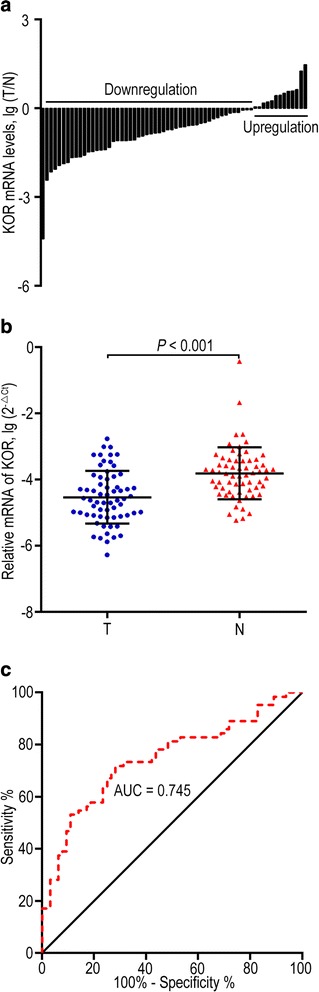
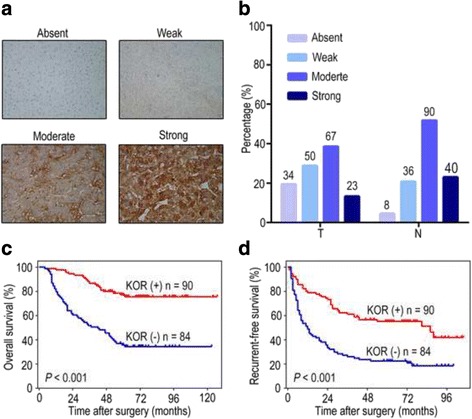
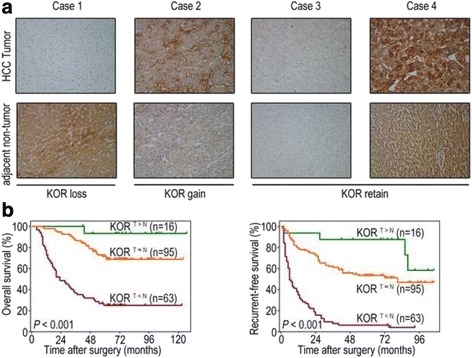
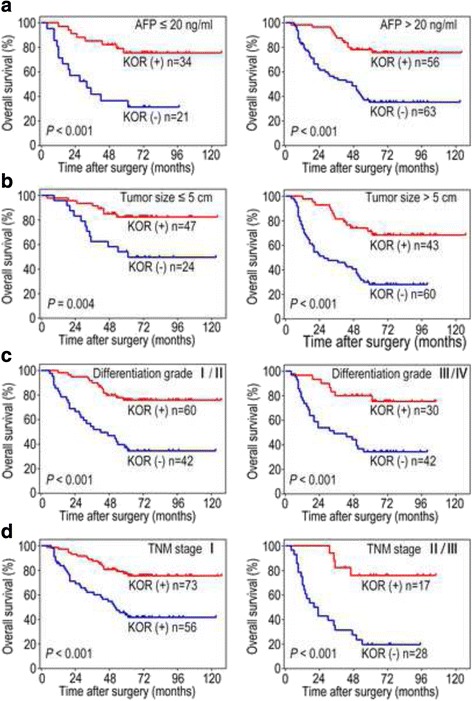
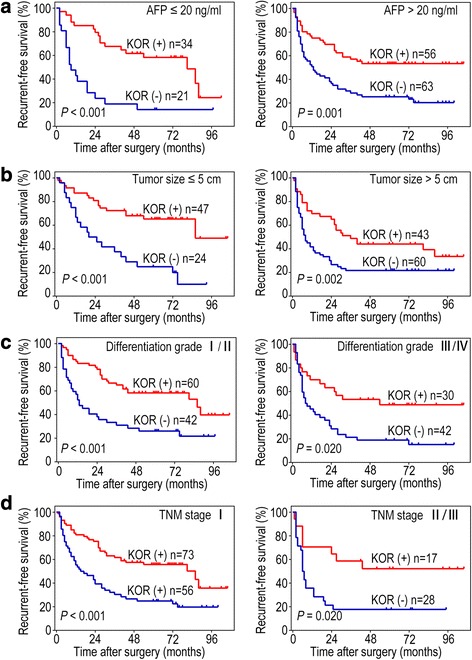
Results: KOR mRNA expression was significantly down-regulated in 79.69% (51 of 64) of the HCC tumour samples, and KOR expression in tumour tissue was significantly lower than that in adjacent non-tumour tissues (P < 0.001). ROC curve analysis showed that KOR mRNA expression yielded AUC of 0.745, for the detection of HCC patients. Low KOR mRNA expression in HCC was correlated with aggressive clinicopathological parameters, such as tumour size (P = 0.015), differentiation grade (P = 0.011), and TNM stage (P = 0.021). Moreover, down-regulation of KOR protein expression in HCC tissues was detected in 174 HCC patients. Similarly, negative KOR protein expression was significantly correlated with aggressive clinicopathological features, such as tumour size (P = 0.002), vascular invasion (P = 0.003), differentiation grade (P = 0.026), and TNM stage (P = 0.030). Furthermore, Kaplan-Meier survival analysis demonstrated that down-regulation of KOR in HCC indicated poor prognosis. KOR deficiency (KORT < N) was correlated to a shorter survival rate and an increased recurrence (both P < 0.001). In univariate and multivariate survival analyses, KOR was identified as a promising independent risk factor for both overall survival (OS, both P < 0.001) and recurrence-free survival (RFS, both P < 0.001).
Conclusions: Down-regulation of KOR in HCC tumour tissues has a strong association with poor prognosis and KOR might be a potential tumour suppressor.
Keywords: Hepatocellular carcinoma; Prognosis; Tumour suppressor; κ-opioid receptor.
Conflict of interest statement
Ethics approval and consent to participate
This study was approved by Committee for Ethical Review of Research at Sun Yat-sen University Cancer Center. All patients were informed of the analyses and provided written consent for the use of existing tissue samples in the present study. For those survival data were followed up via outpatient visit, written informed consents were obtained. Part of the survival data were obtained thorough telephone follow-up, the written informed consent could not be available due to the long journey from their resident to our hospital. Under these conditions, only verbal informed consents were obtained from these subjects or their legal guardians.
Consent for publication
Not applicable.
Competing interests
The authors declare that they have no competing interests.
Publisher’s Note
Springer Nature remains neutral with regard to jurisdictional claims in published maps and institutional affiliations.
Figures
References
MeSH terms
Substances
LinkOut - more resources
Full Text Sources
Other Literature Sources
Medical
