. 2017 Aug 18;7(1):8777.
doi: 10.1038/s41598-017-09138-9.

Isolation, characterization and toxicological potential of Alternaria-mycotoxins (TeA, AOH and AME) in different Alternaria species from various regions of India

Affiliations

Isolation, characterization and toxicological potential of Alternaria-mycotoxins (TeA, AOH and AME) in different Alternaria species from various regions of India

Mukesh Meena et al. Sci Rep. .

Abstract

Alternaria species produce various sorts of toxic metabolites during their active growth and causes severe diseases in many plants by limiting their productivity. These toxic metabolites incorporate various mycotoxins comprising of dibenzo-α-pyrone and some tetramic acid derivatives. In this study, we have screened out total 48 isolates of Alternaria from different plants belonging to different locations in India, on the basis of their pathogenic nature. Pathogenicity testing of these 48 strains on susceptible tomato variety (CO-3) showed 27.08% of the strains were highly pathogenic, 35.41% moderately pathogenic and 37.5% were less pathogenic. Phylogenetic analysis showed the presence of at least eight evolutionary cluster of the pathogen. Toxins (TeA, AOH and AME) were isolated, purified on the basis of column chromatography and TLC, and further confirmed by the HPLC-UV chromatograms using standards. The final detection of toxins was done by the LC-MS/MS analysis by their mass/charge ratio. The present study develops an approach to classify the toxicogenic effect of each of the individual mycotoxins on tomato plant and focuses their differential susceptibility to develop disease symptoms. This study represents the report of the natural occurrence and distribution of Alternaria toxins in various plants from India.


Conflict of interest statement

The authors declare that they have no competing interests.

Figures

Figure 1
Figure 1
Morphological characteristics, growth pattern, colony morphology and microscopic examination of three potent toxic isolates of Alternaria species collected from different regions in India. All the Alternaria isolated were grown on PDA culture media and incubated at 28 °C for 12 h light/dark photoperiod. The pictures of the colonies were taken at 6th day after incubation of pathogen. Note: The names of the Alternaria isolates were given as abbreviation of the different plants from which they were isolated (details described in Table 1).
Figure 2
Figure 2
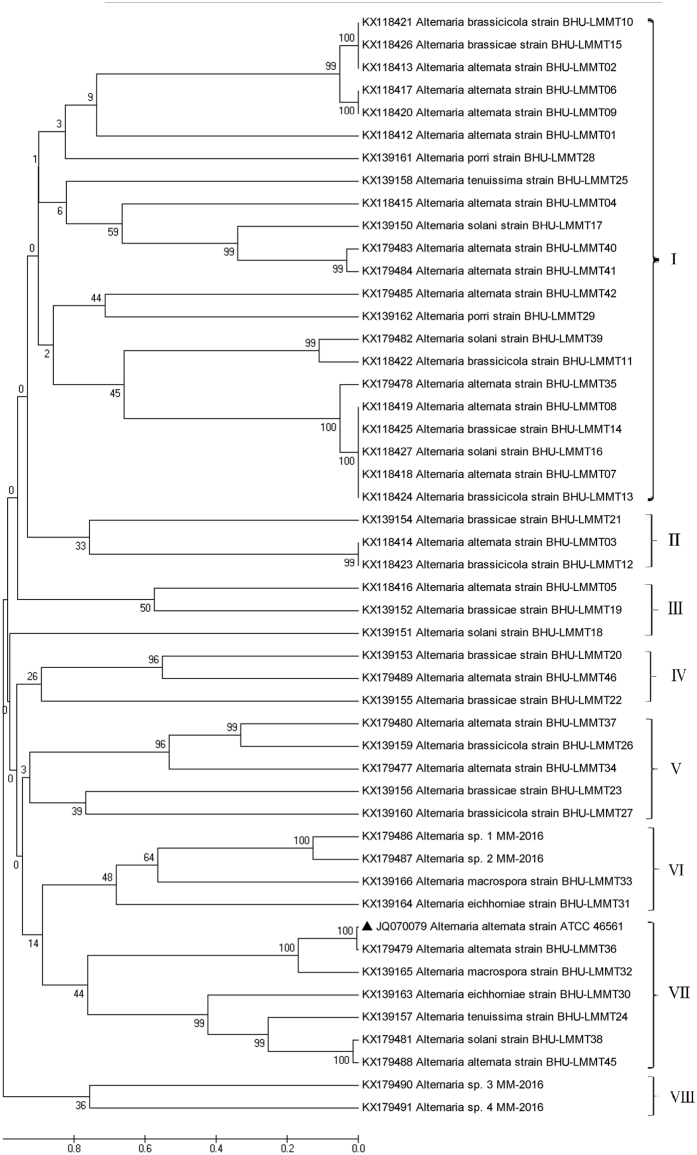
Phylogenetic relationship based on 18S rDNA sequences of different isolated Alternaria species. DNA sequences from the NCBI nucleotide database were aligned using the Clustal W program in MEGA 5.0, and constructed using the Neighbour-Joining method with 500 bootstrap replicates. The scale bar indicates the number of differences in nucleotide substitutions per sequences.
Figure 3
Figure 3
TLC analysis of different metabolites of Alternaria displaying different spots on TLC plates. (A) showing the spots of alternariol monomethyl ether (AME), (B) showing the spots of alternariol (AOH), and (C) showing the spots of tenuazonic acid (TeA), on the basis of their Rf values. The standards of these toxins were also run on similar plates for comparisons of the Rf values. The spots were visualized by spraying ferric chloride (FeCl3)  solution or under UV-light.
Figure 4
Figure 4
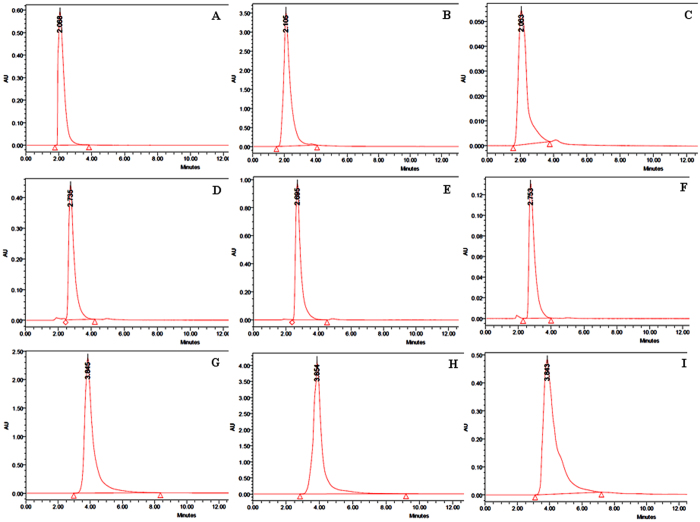
HPLC chromatogram representing the differential concentrations (maximum and minimum level) reported from toxigenic isolates of Alternaria. (A) standard chromatogram for TeA, (B) maximum conc. of TeA as recorded form isolate TM 4, (C) minimum conc. of TeA as recorded from isolate PE 1, (D) standard chromatogram for AOH, (E) maximum conc. of AOH from isolate TM 4, (F) maximum conc. of AOH from isolate ON 1, (G) standard chromatogram for AME, (H) maximum conc. of AME from isolate TM 4, and  (I) minimum conc. of AME from BJ 6. Note: The names of the Alternaria isolates were given as abbreviation of the different plants from which they were isolated (details described in Table 1).
Figure 5
Figure 5
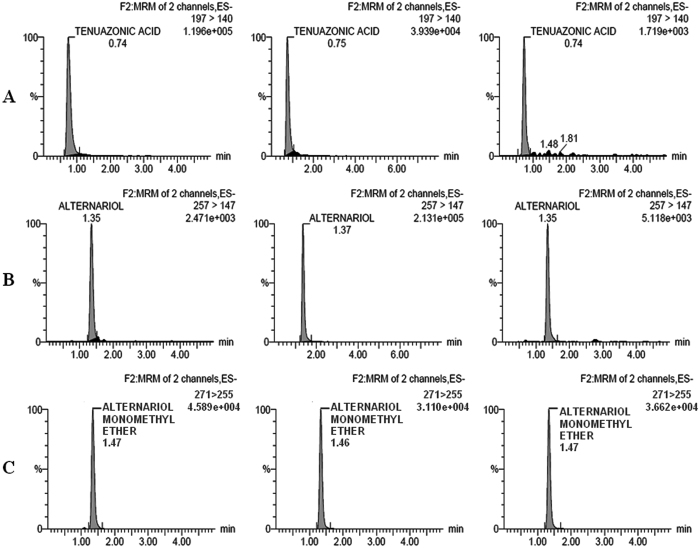
LC-MS/MS analysis (using the Accucore RP-MS 100 × 3, ACQ-TQD, QBP 1152) of TeA, AOH and AME in different isolates of Alternaria species which showed higher amount of these toxins. (A) Chromatograms of TeA, Collision energies for TeA (20 eV) and multiple reaction monitoring (MRM) transitions (ES+198/125 and ES−197/140). (B) Chromatograms of AOH, Collision energies for AOH (30 eV) and multiple reaction monitoring (MRM) transitions (ES+259/185 and ES−257/147). (C) Chromatograms of AME, Collision energies for AME (32 eV) and multiple reaction monitoring (MRM) transitions (ES+271/255 and ES−271/228).
Figure 6
Figure 6
Graphical representation of different mycotoxins (TeA, AOH and AME) and their varying concentrations from 48 selected pathogenic isolates of Alternaria. Results are expressed in mean of three replicates and vertical bars show the ± SD of the mean.
Figure 7
Figure 7
Comparision of toxic potency of TeA, AOH and AME on leaves of tomato plants. (A) Necrotic spots (diseased area) developed after 2, 4 and 6 days of mycotoxins inoculum treatment. (B) Graphical representation of percent diseased area (necrotic regions) and days after treatment of mycotoxins (results are expressed in mean of three replicates and vertical bars show the ± SD of the mean). Note: The arrows indicate the necrotic symptoms of diseased area.
Figure 8
Figure 8
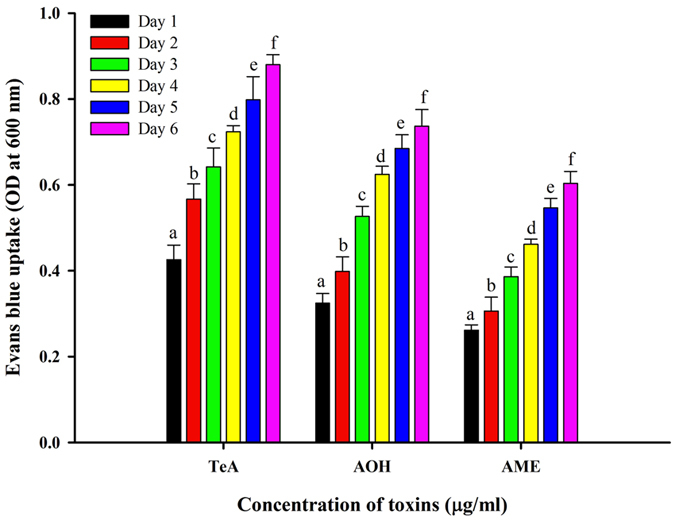
Cell death assay by uptake of Evans blue stain in the leaves of tomato plant treated with Alternaria toxins (AME, AOH and TeA) at different days intervals. The results are expressed as mean of three replicates and the vertical bars showed the ± SD of the mean. Different letters indicate that the values are significantly different from each other (P ≤ 0.05).

References

    1. Garg A, Singh S. Alternaria species in aerospora of vegetable and fruit market at Agra and their mycotoxigenic potential. Asian J. Agric. Life Sci. 2016;1:4–7.
    1. Meena M, et al. Comparative evaluation of biochemical changes in tomato (Lycopersicon esculentum Mill.) infected by Alternaria alternata and its toxic metabolites (TeA, AOH, and AME) Front. Plant Sci. 2016;7 - PMC - PubMed
    1. Ostry V. Alternaria mycotoxins: An overview of chemical characterization, producers, toxicity, analysis and occurrence in foodstuffs. World Mycotoxin J. 2008;1:175–188. doi: 10.3920/WMJ2008.x013. - DOI
    1. Lou J, Fu L, Peng Y, Zhou L. Metabolites from Alternaria fungi and their bioactivities. Molecules. 2013;18:5891–5935. doi: 10.3390/molecules18055891. - DOI - PMC - PubMed
    1. Logrieco A, Moretti A, Solfrizzo M. Alternaria toxins and plant diseases: An overview of origin and occurrence. World Mycotoxin J. 2009;2:129–140. doi: 10.3920/WMJ2009.1145. - DOI

Publication types

LinkOut - more resources