


Global yellow fever vaccination coverage from 1970 to 2016: an adjusted retrospective analysis
- PMID: 28822780
- PMCID: PMC5666204
- DOI: 10.1016/S1473-3099(17)30419-X
Global yellow fever vaccination coverage from 1970 to 2016: an adjusted retrospective analysis
Abstract
Background: Substantial outbreaks of yellow fever in Angola and Brazil in the past 2 years, combined with global shortages in vaccine stockpiles, highlight a pressing need to assess present control strategies. The aims of this study were to estimate global yellow fever vaccination coverage from 1970 through to 2016 at high spatial resolution and to calculate the number of individuals still requiring vaccination to reach population coverage thresholds for outbreak prevention.
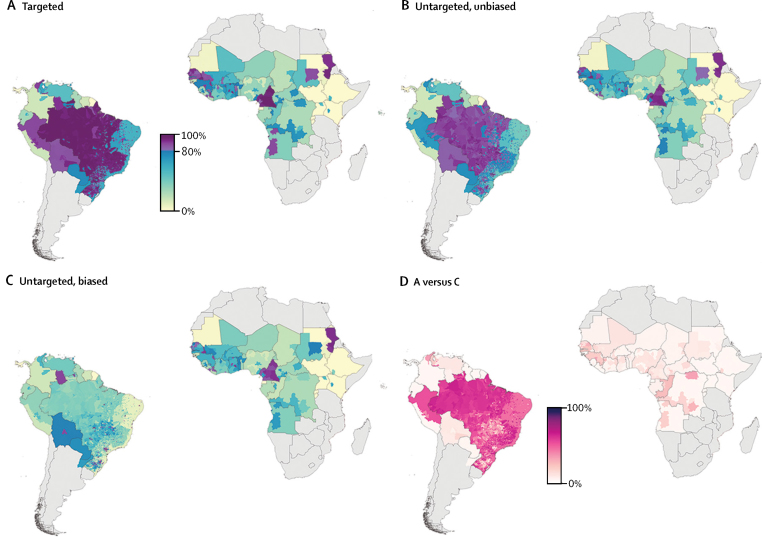
Methods: For this adjusted retrospective analysis, we compiled data from a range of sources (eg, WHO reports and health-service-provider registeries) reporting on yellow fever vaccination activities between May 1, 1939, and Oct 29, 2016. To account for uncertainty in how vaccine campaigns were targeted, we calculated three population coverage values to encompass alternative scenarios. We combined these data with demographic information and tracked vaccination coverage through time to estimate the proportion of the population who had ever received a yellow fever vaccine for each second level administrative division across countries at risk of yellow fever virus transmission from 1970 to 2016.
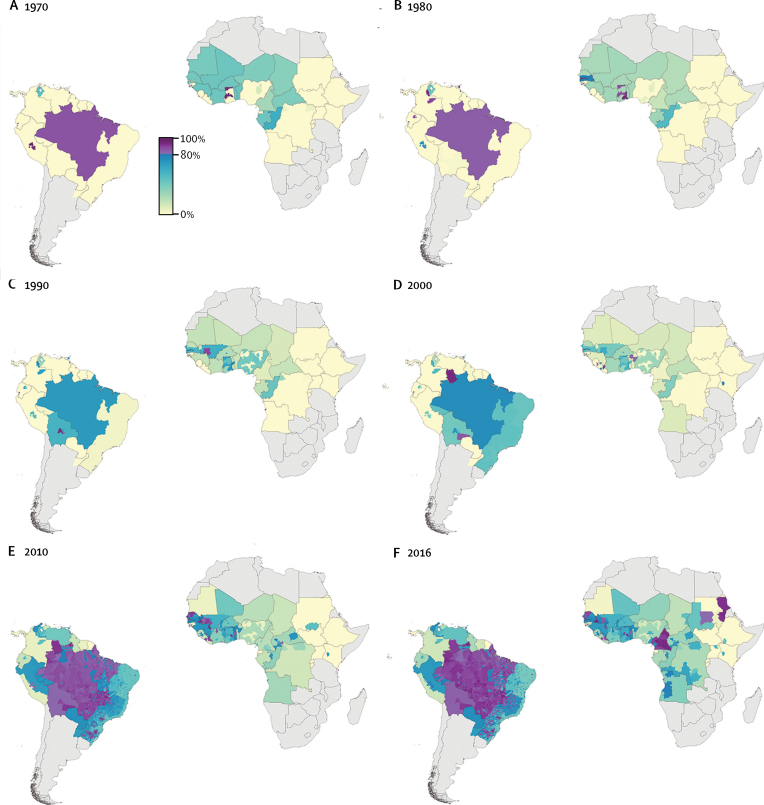
Findings: Overall, substantial increases in vaccine coverage have occurred since 1970, but notable gaps still exist in contemporary coverage within yellow fever risk zones. We estimate that between 393·7 million and 472·9 million people still require vaccination in areas at risk of yellow fever virus transmission to achieve the 80% population coverage threshold recommended by WHO; this represents between 43% and 52% of the population within yellow fever risk zones, compared with between 66% and 76% of the population who would have required vaccination in 1970.
Interpretation: Our results highlight important gaps in yellow fever vaccination coverage, can contribute to improved quantification of outbreak risk, and help to guide planning of future vaccination efforts and emergency stockpiling.
Funding: The Rhodes Trust, Bill & Melinda Gates Foundation, the Wellcome Trust, the National Library of Medicine of the National Institutes of Health, the European Union's Horizon 2020 research and innovation programme.
Copyright © 2017 The Author(s). Published by Elsevier Ltd. This is an Open Access article under the CC BY 4.0 license. Published by Elsevier Ltd.. All rights reserved.
Figures

Comment in
-
Yellow fever vaccination: estimating coverage.Lancet Infect Dis. 2017 Nov;17(11):1109-1111. doi: 10.1016/S1473-3099(17)30494-2. Epub 2017 Aug 16. Lancet Infect Dis. 2017. PMID: 28822782 No abstract available.
-
Yellow fever vaccination coverage in French Guiana.Lancet Infect Dis. 2018 Jan;18(1):28. doi: 10.1016/S1473-3099(17)30701-6. Epub 2017 Dec 20. Lancet Infect Dis. 2018. PMID: 29303736 No abstract available.
References
-
- Paules CI, Fauci AS. Yellow fever—once again on the radar screen in the Americas. N Engl J Med. 2017;376:1397–1399. - PubMed
-
- WHO Vaccines and vaccination against yellow fever. WHO position paper—June 2013. Wkly Epidemiol Rec. 2013;88:269–284. - PubMed
-
- Barrett ADT, Higgs S. Yellow fever: a disease that has yet to be conquered. Annu Rev Entomol. 2007;S2:209–229. - PubMed
-
- WHO Eliminate yellow fever epidemics (EYE): a global strategy, 2017–2026. Wkly Epidemiol Rec. 2017;16:193–204. - PubMed
Publication types
MeSH terms
Substances
Grants and funding
LinkOut - more resources
Full Text Sources
Other Literature Sources
Medical
Miscellaneous
