Effect of corn grain particle size on ruminal fermentation and blood metabolites of Holstein steers fed total mixed ration
- PMID: 28823129
- PMCID: PMC5756927
- DOI: 10.5713/ajas.17.0069
Effect of corn grain particle size on ruminal fermentation and blood metabolites of Holstein steers fed total mixed ration
Abstract
Objective: This study was conducted to investigate the effect of corn grain particle size on ruminant fermentation and blood metabolites in Holstein steers fed total mixed ration (TMR) as a basal diet to explain fundamental data of corn grain for cattle in Korea.
Methods: Four ruminally cannulated Holstein steers (body weight 592±29.9 kg) fed TMR as a basal diet were housed individually in an auto temperature and humidity modulated chamber (24°C and 60% for 22 h/d). Treatments in a 4×4 Latin square design were TMR only (control), TMR with whole corn grain (WC), coarsely ground corn grain (CC), and finely ground corn grain (FC), respectively. The corn feeds substituted for 20% energy intake of TMR intake. To measure the ruminal pH, ammonia N, and volatile fatty acids (VFA), ruminal digesta was sampled through ruminal cannula at 1 h intervals after the morning feeding to determine ruminal fermentation characteristics. Blood was sampled via the jugular vein after the ruminal digesta sampling.
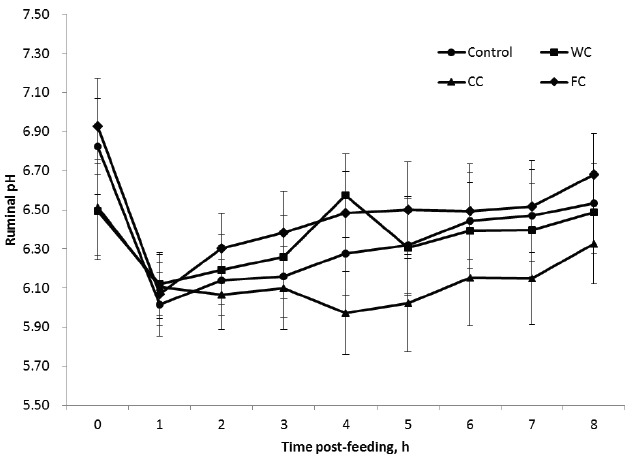
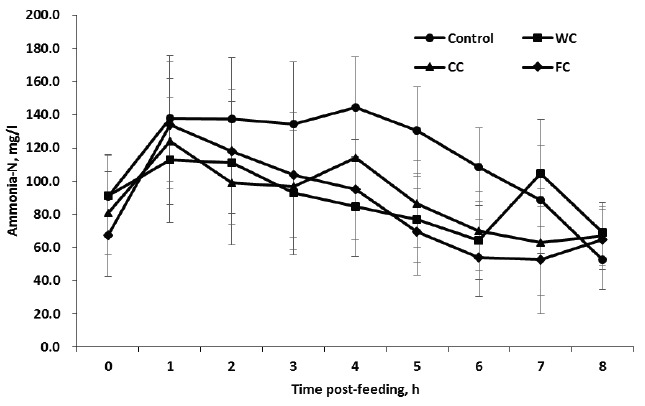
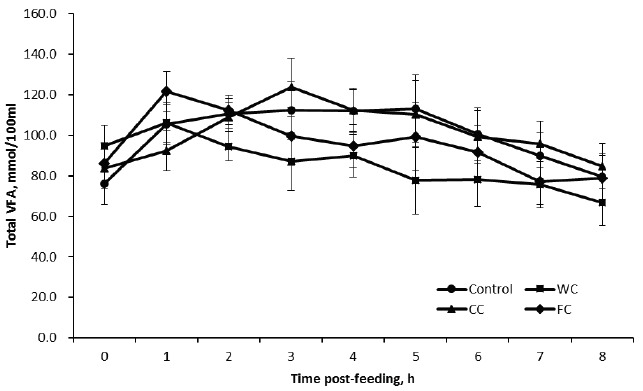
Results: There was no difference in dry matter (DM) intake between different corn particle size because the DM intake was restricted to 1.66% of body weight. Different corn particle size did not change mean ammonia N and total VFA concentrations whereas lower (p<0.05) ruminal pH and a ratio of acetate to propionate, and higher (p<0.05) propionate concentration were noted when the steers consumed CC compared with WC and FC. Concentration of blood metabolites were not affected by different particle size of corn grain except for blood triglyceride concentration, which was significantly (p<0.05) increased by FC.
Conclusion: Results indicate that feeding CC may increase feed digestion in the rumen, whereas the FC group seemed to obtain inadequate corn retention time for microbial degradation in the rumen.
Keywords: Corn Grain; Holstein Steer; Particle Size; Ruminal Fermentation.
Conflict of interest statement
We certify that there is no conflict of interest with any financial organization regarding the material discussed in the manuscript.
Figures
References
-
- Lee SY, Kim WY, Ko JY, Ha JK. Effects of corn processing on in vitro and in situ digestion of corn grain in Holstein steers. Asian-Australas J Anim Sci. 2002;15:851–8.
-
- Owens FN, Secrist DS, Hill WJ, Gill DR. The effect of grain source and grain processing on performance of feedlot cattle: A review. J Anim Sci. 1997;78:369–75. - PubMed
-
- Wondra KJ, Hancock JD, Behnke KC, Hines RH, Stark CR. Effects of particle size and pelleting on growth performance, nutrient digestibility, and stomach morphology in finishing pigs. J Anim Sci. 1995;73:757–63. - PubMed
-
- Theurer CB. Grain processing effects on starch utilization by ruminants. J Anim Sci. 1986;63:1649–62. - PubMed
-
- Koenig KM, Beauchemin KA, Rode LM. Effect of grain processing and silage on microbial protein synthesis and nutrient digestibility in beef cattle fed barley-based diets. J Anim Sci. 2003;81:1057–67. - PubMed
LinkOut - more resources
Full Text Sources
Other Literature Sources