


Disconnectivity between Dorsal Raphe Nucleus and Posterior Cingulate Cortex in Later Life Depression
- PMID: 28824410
- PMCID: PMC5539218
- DOI: 10.3389/fnagi.2017.00236
Disconnectivity between Dorsal Raphe Nucleus and Posterior Cingulate Cortex in Later Life Depression
Abstract
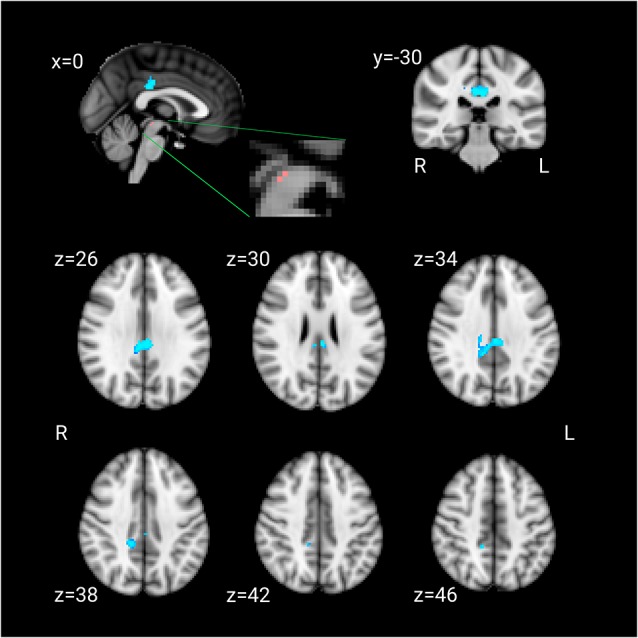
The dorsal raphe nucleus (DRN) has been repeatedly implicated as having a significant relationship with depression, along with its serotoninergic innervation. However, functional connectivity of the DRN in depression is not well understood. The current study aimed to isolate functional connectivity of the DRN distinct in later life depression (LLD) compared to a healthy age-matched population. Resting state functional magnetic resonance imaging (rsfMRI) data from 95 participants (33 LLD and 62 healthy) were collected to examine functional connectivity from the DRN to the whole brain in voxel-wise fashion. The posterior cingulate cortex (PCC) bilaterally showed significantly smaller connectivity in the LLD group than the control group. The DRN to PCC connectivity did not show any association with the depressive status. The findings implicate that the LLD involves disruption of serotoninergic input to the PCC, which has been suggested to be a part of the reduced default mode network in depression.
Keywords: depression; dorsal raphe nucleus; geriatric psychiatry; magnetic resonance imaging; neuroimaging.
Figures
References
-
- American Psychiatric Association (2000). Diagnostic and Statistical Manual of Mental Disorders. Fourth Edition, Text Revision (DSM-IV-TR). Washington, DC: American Psychiatric Association.
LinkOut - more resources
Full Text Sources
Other Literature Sources
