. 2017 Aug 3:8:1456.
doi: 10.3389/fmicb.2017.01456. eCollection 2017.

A Systems Biology Approach Reveals Differences in the Dynamics of Colonization and Degradation of Grass vs. Hay by Rumen Microbes with Minor Effects of Vitamin E Supplementation

Affiliations

A Systems Biology Approach Reveals Differences in the Dynamics of Colonization and Degradation of Grass vs. Hay by Rumen Microbes with Minor Effects of Vitamin E Supplementation

Alejandro Belanche et al. Front Microbiol. .

Abstract

Increasing the efficiency of utilization of fresh and preserved forage is a key target for ruminant science. Vitamin E is often used as additive to improve product quality but its impact of the rumen function is unknown. This study investigated the successional microbial colonization of ryegrass (GRA) vs. ryegrass hay (HAY) in presence of zero or 50 IU/d supplementary vitamin E, using a rumen simulation technique. A holistic approach was used to link the dynamics of feed degradation with the structure of the liquid-associated (LAB) and solid-associated bacteria (SAB). Results showed that forage colonization by SAB was a tri-phasic process highly affected by the forage conservation method: Early colonization (0-2 h after feeding) by rumen microbes was 2× faster for GRA than HAY diets and dominated by Lactobacillus and Prevotella which promoted increased levels of lactate (+56%) and ammonia (+18%). HAY diets had lower DM degradation (-72%) during this interval being Streptococcus particularly abundant. During secondary colonization (4-8 h) the SAB community increased in size and decreased in diversity as the secondary colonizers took over (Pseudobutyrivibrio) promoting the biggest differences in the metabolomics profile between diets. Secondary colonization was 3× slower for HAY vs. GRA diets, but this delay was compensated by a greater bacterial diversity (+197 OTUs) and network complexity resulting in similar feed degradations. Tertiary colonization (>8 h) consisted of a slowdown in the colonization process and simplification of the bacterial network. This slowdown was less evident for HAY diets which had higher levels of tertiary colonizers (Butyrivibrio and Ruminococcus) and may explain the higher DM degradation (+52%) during this interval. The LAB community was particularly active during the early fermentation of GRA and during the late fermentation for HAY diets indicating that the availability of nutrients in the liquid phase reflects the dynamics of feed degradation. Vitamin E supplementation had minor effects but promoted a simplification of the LAB community and a slight acceleration in the SAB colonization sequence which could explain the higher DM degradation during the secondary colonization. Our findings suggest that when possible, grass should be fed instead of hay, in order to accelerate feed utilization by rumen microbes.

Keywords: colonization; grass; hay; plant degradation; rumen fermentation; rumen microbiome; vitamin E.


Figures
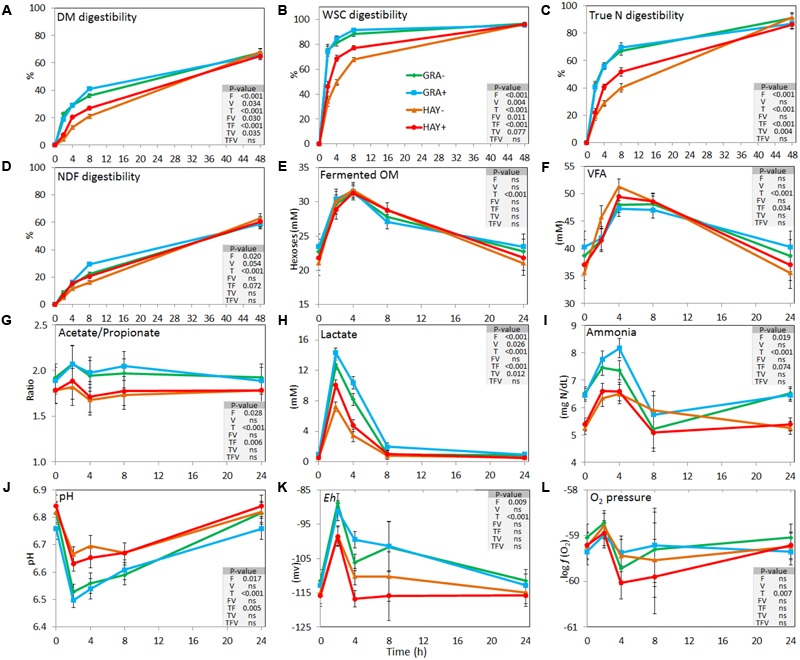
FIGURE 1
FIGURE 1
Effect of the type of forage and vitamin E supplementation on the dynamics of feed degradation (A–D) and fermentation pattern (E–L) in the Rusitec system. Error bars indicate the standard error of the mean and P-values are depicted for the effect of forage type (F), vitamin E supplementation (V), time points (T) and their interactions (n = 4).
FIGURE 2
FIGURE 2
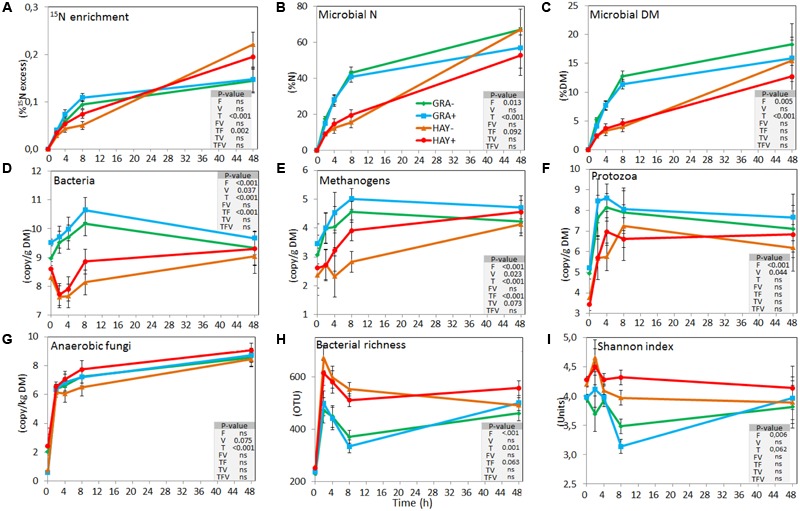
Effect of the type of forage and vitamin E supplementation on the dynamics of plant colonization by rumen microbes based on 15N labeling (A–C), on the concentration of different microbial groups determined by qPCR (D–G) and on the bacterial diversity indexes based on NGS (H,I) in the Rusitec system. Error bars indicate the standard error of the mean and P-values are depicted for the effect of forage type (F), vitamin E supplementation (V), time points (T) and their interactions (n = 4).
FIGURE 3
FIGURE 3
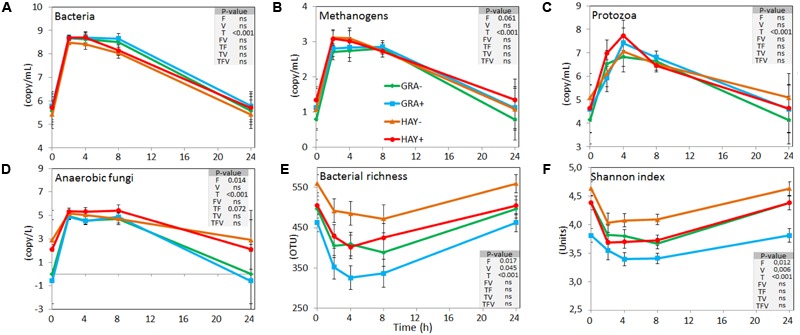
Effect of the type of forage and vitamin E supplementation on the dynamics of the liquid associated rumen microbes based on the concentration of different microbial groups determined by qPCR (A–D) and on the bacterial diversity indexes based on NGS (E,F) in the Rusitec system. Error bars indicate the standard error of the mean and P-values are depicted for the effect of forage type (F), vitamin E supplementation (V), time points (T) and their interactions (n = 4).
FIGURE 4
FIGURE 4
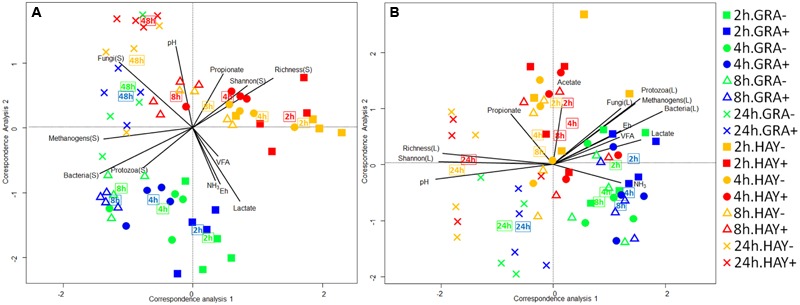
Canonical correspondence analysis illustrating the effect of grass (GRA), grass hay (HAY) and vitamin E supplementation (-,+) on the relationship of the structure of the bacterial community associated with the plant residue (A) or the liquid phase (B) with the rumen fermentation parameters in the Rusitec system. Lines show the direction and lengths are proportional to the correlations (P < 0.05). Centroid is indicated for each treatment.
FIGURE 5
FIGURE 5
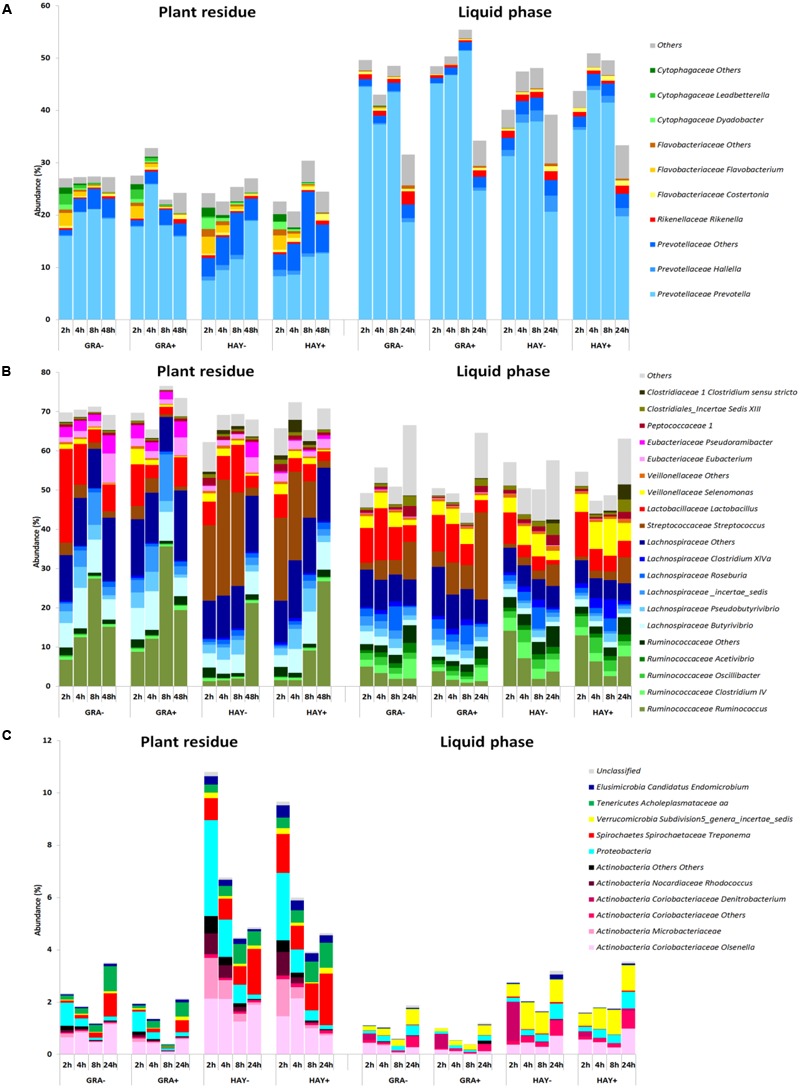
Abundance of the main bacterial genera in the phylum Bacteroidetes (A), Firmicutes (B) and minor phyla (C) in the plant residue and liquid phase to describe the effect of grass (GRA), grass hay (HAY) and vitamin E supplementation (-,+) on the dynamics of plant colonization and utilization in the Rusitec system (n = 4).
FIGURE 6
FIGURE 6
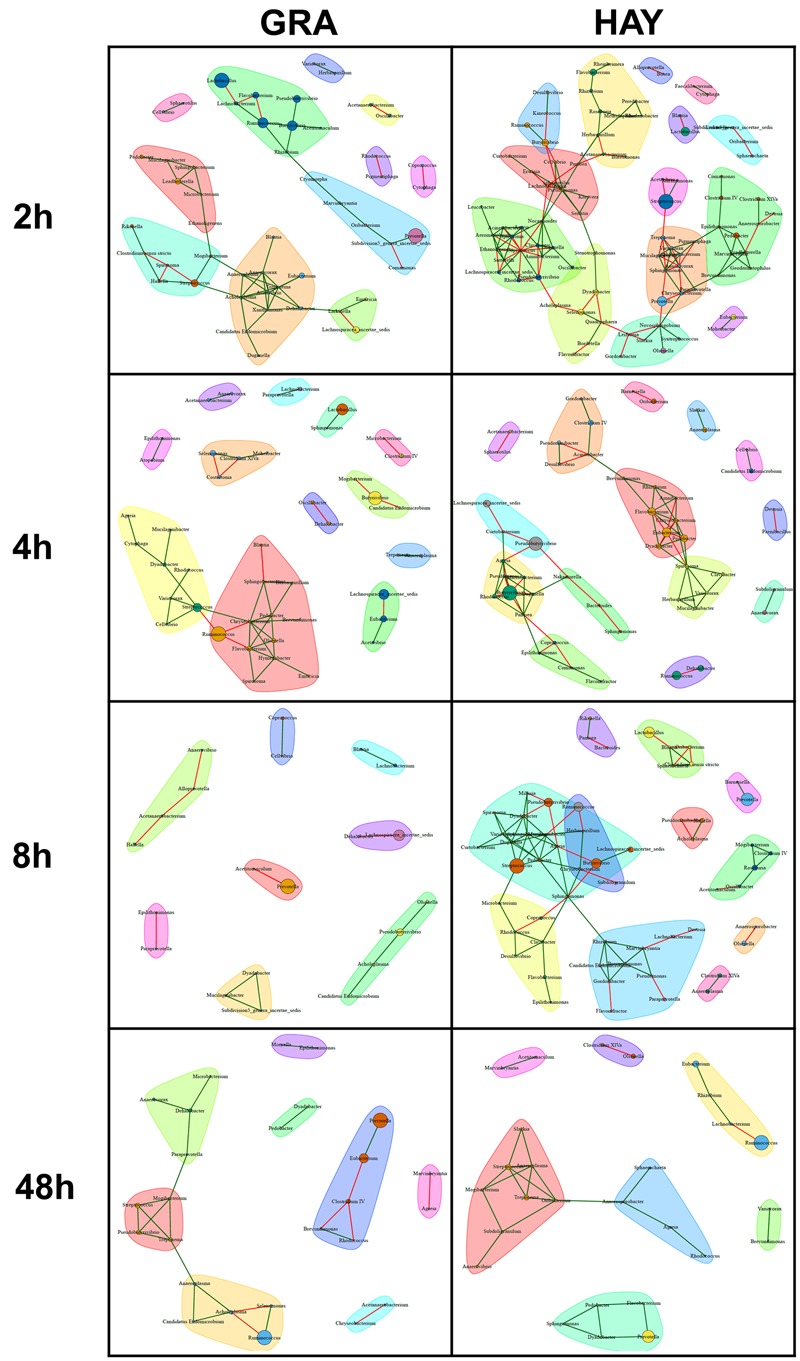
Bacterial networks illustrating the effect of grass (GRA) and grass hay (HAY) on the relationships between the different bacterial genera in the plant residue in the Rusitec system. Edges represent positive (green) and negative (red) correlation coefficients between genera (r > 0.7 and adjusted P < 0.05).
FIGURE 7
FIGURE 7
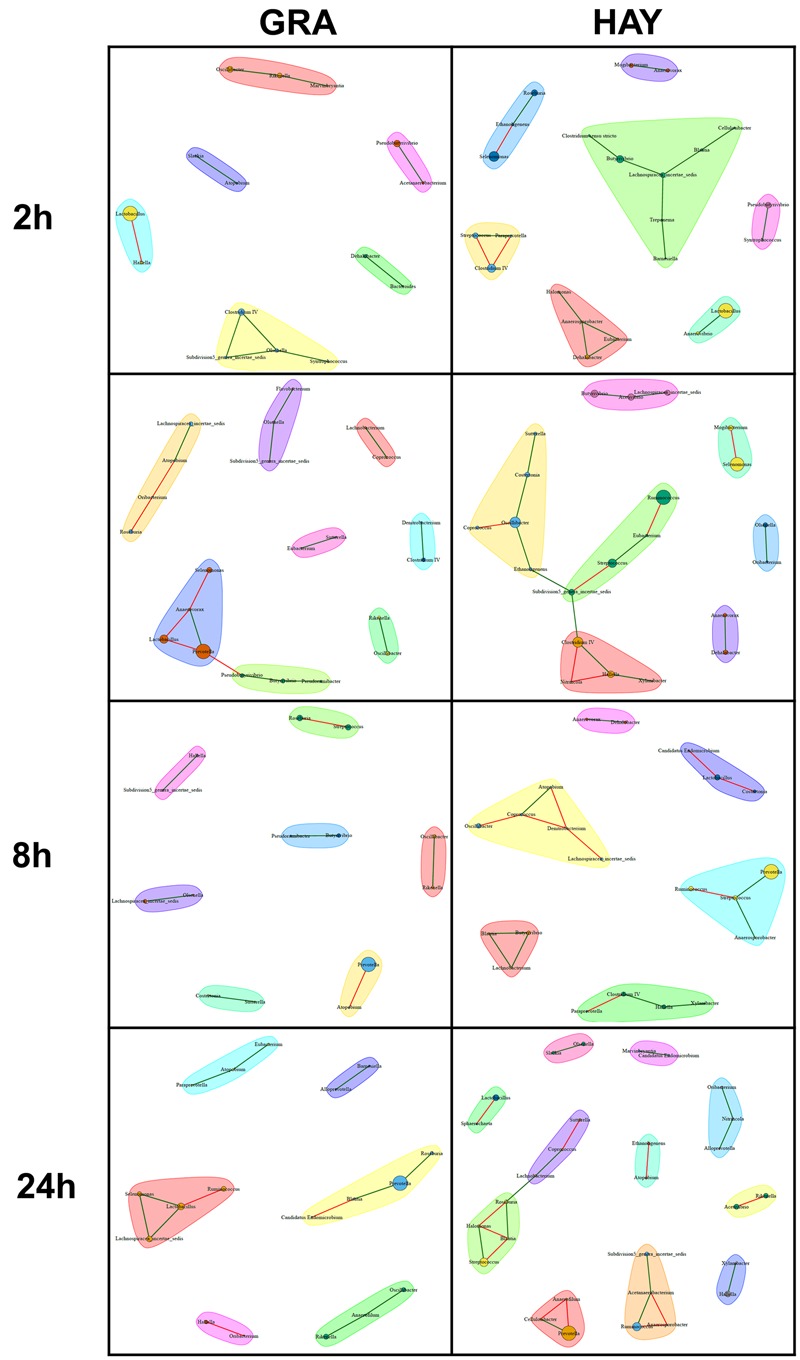
Bacterial networks illustrating the effect of grass (GRA) and grass hay (HAY) on the relationships between the different bacterial genera in the liquid phase in the Rusitec system. Edges represent positive (green) and negative (red) correlation coefficients between genera (r > 0.7 and adjusted P < 0.05).
FIGURE 8
FIGURE 8
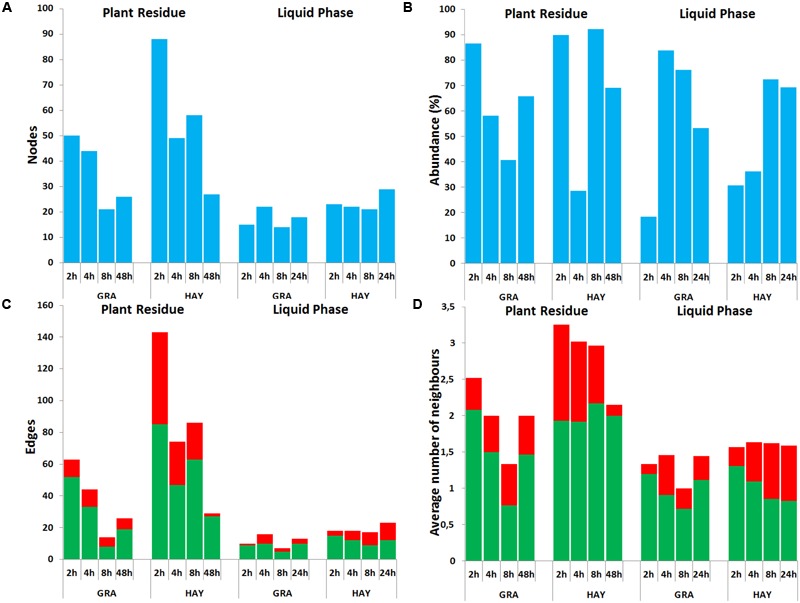
Bacterial network data describing the effect of type of forage on the dynamics of plant colonization in terms of number of nodes (A), abundance (B), number edges (C) and average number of neighbors (D) in the Rusitec system. Network was generated based on those genera which were positively (green) or negatively (red) correlated (r > 0.7 and adjusted-P < 0.05).
FIGURE 9
FIGURE 9
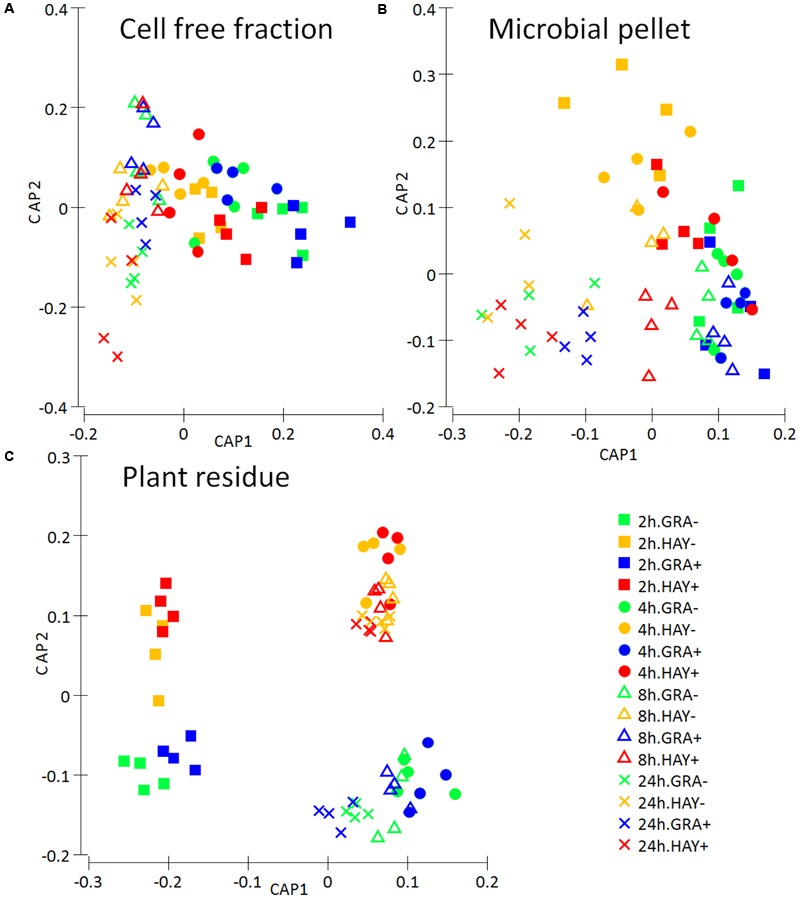
Metabolite fingerprinting based on FTIR spectroscopy depicting the effect of the type of forage and vitamin E supplementation on the dynamics the rumen interactome in the Rusitec system: a cell free fraction (A), a microbial pellet recovered from the planktonic phase (B) and a plant residue including microorganism (C). Canonical Analysis of Principal Coordinate was performed based on Bray–Curtis dissimilarity.

References

    1. Akin D. (1989). Histological and physical factors affecting digestibility of forages. Agron. J. 81 17–25. 10.2134/agronj1989.00021962008100010004x - DOI
    1. Akin D., Rigsby L. (1987). Mixed fungal populations and lignocellulosic tissue degradation in the bovine rumen. Appl. Environ. Microbiol. 53 1987–1995. - PMC - PubMed
    1. Arnold R. N., Scheller K. K., Arp S. C., Williams S. N., Buege D. R., Schaefer D. M. (1992). Effect of long- or short-term feeding of alpha-tocopheryl acetate to Holstein and crossbred beef steers on performance, carcass characteristics, and beef color stability. J. Anim. Sci. 70 3055–3065. 10.2527/1992.70103055x - DOI - PubMed
    1. Belanche A., Jones E., Parveen I., Newbold C. J. (2016c). A metagenomics approach to evaluate the impact of dietary supplementation with Ascophyllum nodosum or Laminaria digitata on rumen function in rusitec fermenters. Front. Microbiol. 7:299 10.3389/fmicb.2016.00299 - DOI - PMC - PubMed
    1. Belanche A., Kingston-Smith A., Newbold C. J. (2016a). An integrated multi-omics approach reveals the effects of supplementing grass or grass hay with vitamin E on the rumen microbiome and its function. Front. Microbiol. 7:905 10.3389/fmicb.2016.00905 - DOI - PMC - PubMed

LinkOut - more resources