. 2017 Apr 10;8(2):129-140.
doi: 10.1007/s13167-017-0089-3. eCollection 2017 Jun.

Breast cancer and Flammer syndrome: any symptoms in common for prediction, prevention and personalised medical approach?

Affiliations

Breast cancer and Flammer syndrome: any symptoms in common for prediction, prevention and personalised medical approach?

Pavol Zubor et al. EPMA J. .

Abstract

An epidemic scale of the breast cancer (BC) prevalence is actually recognised as the reality of the early twenty-first century. Particularly alarming is that the sporadic BC (about 90% of all patients) creates currently unpredictable subpopulations in terms of disease predisposition, development and progression. Despite broad discussions run since years in BC area, no any plausible approach has been suggested so far to get the overall situation better controlled in the populations. Here, we present highly innovative concepts considering investigation of specific syndromes and symptoms underestimated till now in relationship with BC predisposition and development. Consequently, the purpose of our pilot project was to evaluate the prevalence of Flammer Syndrome (FS) in BC patient cohort. The results achieved here support the main hypothesis of the project clearly demonstrating the tendency of BC patients to the increased prevalence of FS symptoms compared to the disease-free individuals. Our study strongly indicates the relevance of FS symptoms for BC pathology such as feeling inadequately cold, deficient thermoregulation, altered sensitivity to different stimuli, potential dehydration, altered sleep patterns, tendency towards headache, migraine attacks and dizziness. Moreover, the symptoms' appearance is specifically linked to the individual BC subtypes. Potential mechanisms interconnecting FS with BC pathology are discussed.

Keywords: Breast cancer; Cardiovascular component; Drug sensitivity; Flammer syndrome; Pain; Patient stratification; Predictive preventive personalised medicine; Sense regulation; Systemic hypoxia; Thermoregulation.


Conflict of interest statement

Funding

This multicentred study has been supported by the following organisations:

  1. European Association for Predictive, Preventive and Personalised Medicine, EPMA, Brussels, Belgium

  2. Schwickert-Foundation, Switzerland

  3. Slovak Research and Development Agency (under the contract no. APVV-14-0815), the Scientific Grant Agency, Ministry of Education, Science and Research, Slovak Republic

  4. National Sustainability Program I (NPU I) Nr. LO1503, Ministry of Education Youth and Sports, Czech Republic and MH CZ-DRO (Faculty Hospital in Plzen-FNPl, 00669806).

Competing interests

The authors declare that they have no competing interests.

Figures
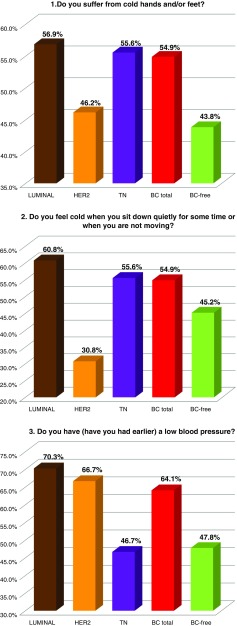
Fig. 1
Fig. 1
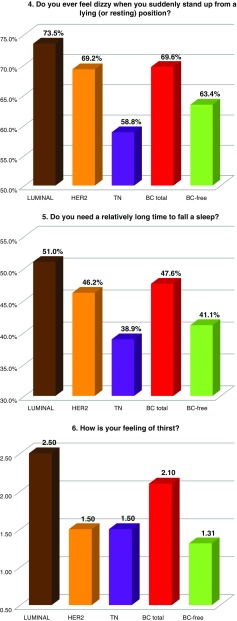
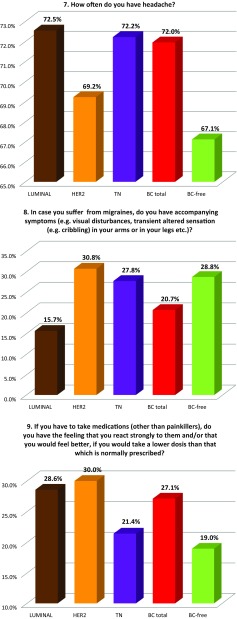
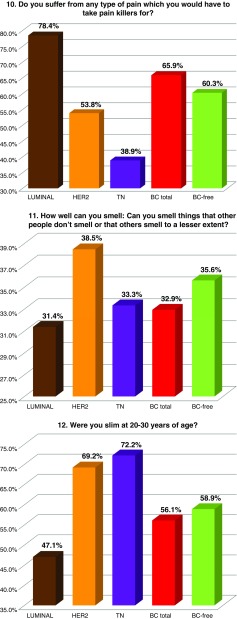
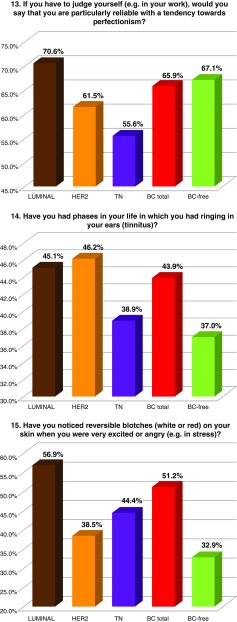
Evaluation of the prevalence of individual symptoms (1–15) of the “Flammer syndrome” phenotype in two groups of comparison: “breast cancer-diseased” (BC total) versus “breast cancer-free” (BC-free). Therein, the entire breast cancer patient pool (“BC total”) has been additionally analysed in subgroups stratified according to the individual BC subtypes as “LUMINAL”, “HER2” positive and TN (triple negative) breast cancer. For more details regarding the patient stratification, see the “Materials and methods” section. The prevalence in each individual group is presented by percentage of individuals who have responded to the corresponding question with “frequently” and “sometimes” pooled together. Responders answering with “I do not know” have been excluded from the overall numbers/calculations. Question-specific notes: Question 6—the ratio between “I do not feel thirsty and drink little” and “I feel much thirsty and drink a lot” has been calculated and expressed in X times; Question 12—answers “very slim” and “slim” have been pooled together and presented in %
Fig. 1
Fig. 1
Evaluation of the prevalence of individual symptoms (1–15) of the “Flammer syndrome” phenotype in two groups of comparison: “breast cancer-diseased” (BC total) versus “breast cancer-free” (BC-free). Therein, the entire breast cancer patient pool (“BC total”) has been additionally analysed in subgroups stratified according to the individual BC subtypes as “LUMINAL”, “HER2” positive and TN (triple negative) breast cancer. For more details regarding the patient stratification, see the “Materials and methods” section. The prevalence in each individual group is presented by percentage of individuals who have responded to the corresponding question with “frequently” and “sometimes” pooled together. Responders answering with “I do not know” have been excluded from the overall numbers/calculations. Question-specific notes: Question 6—the ratio between “I do not feel thirsty and drink little” and “I feel much thirsty and drink a lot” has been calculated and expressed in X times; Question 12—answers “very slim” and “slim” have been pooled together and presented in %
Fig. 1
Fig. 1
Evaluation of the prevalence of individual symptoms (1–15) of the “Flammer syndrome” phenotype in two groups of comparison: “breast cancer-diseased” (BC total) versus “breast cancer-free” (BC-free). Therein, the entire breast cancer patient pool (“BC total”) has been additionally analysed in subgroups stratified according to the individual BC subtypes as “LUMINAL”, “HER2” positive and TN (triple negative) breast cancer. For more details regarding the patient stratification, see the “Materials and methods” section. The prevalence in each individual group is presented by percentage of individuals who have responded to the corresponding question with “frequently” and “sometimes” pooled together. Responders answering with “I do not know” have been excluded from the overall numbers/calculations. Question-specific notes: Question 6—the ratio between “I do not feel thirsty and drink little” and “I feel much thirsty and drink a lot” has been calculated and expressed in X times; Question 12—answers “very slim” and “slim” have been pooled together and presented in %
Fig. 1
Fig. 1
Evaluation of the prevalence of individual symptoms (1–15) of the “Flammer syndrome” phenotype in two groups of comparison: “breast cancer-diseased” (BC total) versus “breast cancer-free” (BC-free). Therein, the entire breast cancer patient pool (“BC total”) has been additionally analysed in subgroups stratified according to the individual BC subtypes as “LUMINAL”, “HER2” positive and TN (triple negative) breast cancer. For more details regarding the patient stratification, see the “Materials and methods” section. The prevalence in each individual group is presented by percentage of individuals who have responded to the corresponding question with “frequently” and “sometimes” pooled together. Responders answering with “I do not know” have been excluded from the overall numbers/calculations. Question-specific notes: Question 6—the ratio between “I do not feel thirsty and drink little” and “I feel much thirsty and drink a lot” has been calculated and expressed in X times; Question 12—answers “very slim” and “slim” have been pooled together and presented in %
Fig. 1
Fig. 1
Evaluation of the prevalence of individual symptoms (1–15) of the “Flammer syndrome” phenotype in two groups of comparison: “breast cancer-diseased” (BC total) versus “breast cancer-free” (BC-free). Therein, the entire breast cancer patient pool (“BC total”) has been additionally analysed in subgroups stratified according to the individual BC subtypes as “LUMINAL”, “HER2” positive and TN (triple negative) breast cancer. For more details regarding the patient stratification, see the “Materials and methods” section. The prevalence in each individual group is presented by percentage of individuals who have responded to the corresponding question with “frequently” and “sometimes” pooled together. Responders answering with “I do not know” have been excluded from the overall numbers/calculations. Question-specific notes: Question 6—the ratio between “I do not feel thirsty and drink little” and “I feel much thirsty and drink a lot” has been calculated and expressed in X times; Question 12—answers “very slim” and “slim” have been pooled together and presented in %

References

    1. Golubnitschaja O, Debald M, Yeghiazaryan K, Kuhn W, Pešta M, Costigliola V, Grech G. Breast cancer epidemic in the early 21st century: evaluation of risk factors, cumulative questionnaires and recommendations for preventive measures. Tumor Biol. 2016;37(10):12941–12957. doi: 10.1007/s13277-016-5168-x. - DOI - PubMed
    1. Golubnitschaja O. Feeling cold and other underestimated symptoms in breast cancer: anecdotes or individual profiles for advanced patient stratification? EPMA J. 2017;8(1):17–22. doi:10.1007/s13167-017-0086-6. - PMC - PubMed
    1. Konieczka K, Ritch R, Traverso CE, Kim DM, Kook MS, Gallino A, et al. Flammer syndrome. EPMA J. 2014;5(1):11. doi: 10.1186/1878-5085-5-11. - DOI - PMC - PubMed
    1. Yeghiazaryan K, Flammer J, Orgül S, Wunderlich K, Golubnitschaja O. Vasospastic individuals demonstrate significant similarity to glaucoma patients as revealed by gene expression profiling in circulating leukocytes. Mol Vis. 2009;15:2339–2348. - PMC - PubMed
    1. Flammer J, Konieczka K, Flammer AJ. The primary vascular dysregulation syndrome: implications for eye diseases. EPMA J. 2013;4(1):14. doi: 10.1186/1878-5085-4-14. - DOI - PMC - PubMed

LinkOut - more resources