


Does the Flipped Classroom Improve Learning in Graduate Medical Education?
- PMID: 28824764
- PMCID: PMC5559246
- DOI: 10.4300/JGME-D-16-00817.1
Does the Flipped Classroom Improve Learning in Graduate Medical Education?
Abstract
Background: The flipped classroom model for didactic education has recently gained popularity in medical education; however, there is a paucity of performance data showing its effectiveness for knowledge gain in graduate medical education.
Objective: We assessed whether a flipped classroom module improves knowledge gain compared with a standard lecture.
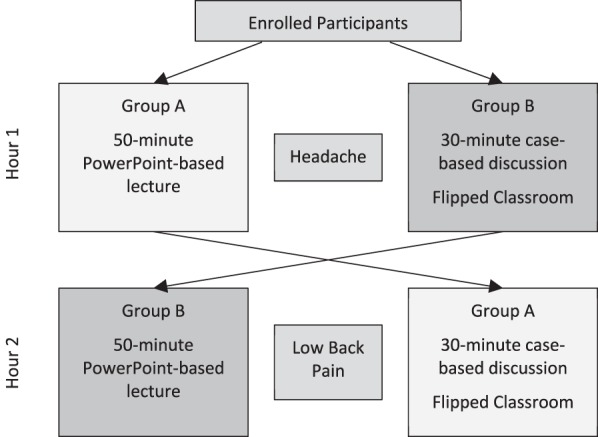
Methods: We conducted a randomized crossover study in 3 emergency medicine residency programs. Participants were randomized to receive a 50-minute lecture from an expert educator on one subject and a flipped classroom module on the other. The flipped classroom included a 20-minute at-home video and 30 minutes of in-class case discussion. The 2 subjects addressed were headache and acute low back pain. A pretest, immediate posttest, and 90-day retention test were given for each subject.
Results: Of 82 eligible residents, 73 completed both modules. For the low back pain module, mean test scores were not significantly different between the lecture and flipped classroom formats. For the headache module, there were significant differences in performance for a given test date between the flipped classroom and the lecture format. However, differences between groups were less than 1 of 10 examination items, making it difficult to assign educational importance to the differences.
Conclusions: In this crossover study comparing a single flipped classroom module with a standard lecture, we found mixed statistical results for performance measured by multiple-choice questions. As the differences were small, the flipped classroom and lecture were essentially equivalent.
Conflict of interest statement
Conflict of interest: Dr Jhun is a salaried content director for Hippo Education. Preliminary findings of this study were presented as an abstract poster presentation at the Society for Academic Emergency Medicine Annual Meeting, San Diego, California, May 15, 2015, and at the Western Regional Society for Academic Emergency Medicine, Tucson, Arizona, March 28, 2015.
References
-
- Prober CG, Heath C. . Lecture halls without lectures—a proposal for medical education. N Engl J Med. 2012; 366 18: 1657– 1659. - PubMed
-
- Mehta NB, Hull AL, Young JB, et al. Just imagine: new paradigms for medical education. Acad Med. 2013; 88: 1418– 1423. - PubMed
-
- McLaughlin JE, Roth MT, Glatt DM, et al. The flipped classroom: a course redesign to foster learning and engagement in a health professions school. Acad Med. 2014; 89 2: 236– 243. - PubMed
-
- Nematollahi S, St John PA, Adamas-Rappaport WJ. . Lessons learned with a flipped classroom. Med Educ. 2015; 49 11: 1143. - PubMed
-
- Morgan H, McLean K, Chapman C, et al. The flipped classroom for medical students. Clin Teach. 2015; 12 3: 155– 160. - PubMed
Publication types
MeSH terms
LinkOut - more resources
Full Text Sources
Other Literature Sources
Medical
Research Materials
