Cesarean Delivery with External Negative Pressure Dressing System: A Retrospective Cohort Study
- PMID: 28824992
- PMCID: PMC5553538
- DOI: 10.1055/s-0036-1585470
Cesarean Delivery with External Negative Pressure Dressing System: A Retrospective Cohort Study
Abstract
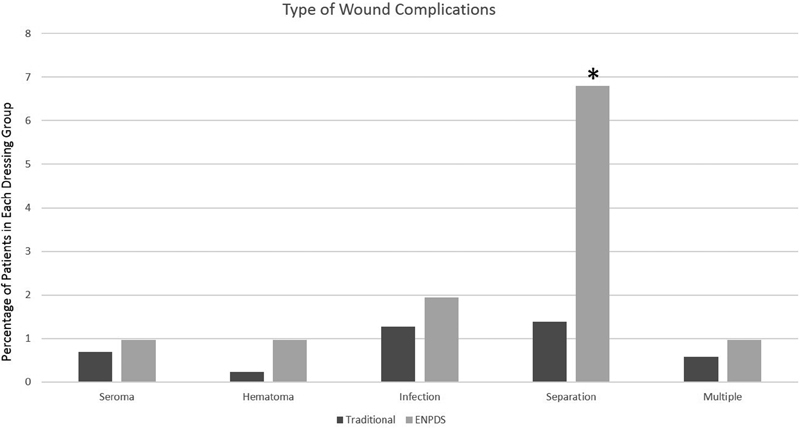
Objective To determine whether the use of external negative pressure dressing system (ENPDS) can reduce the incidence of wound complications after cesarean delivery (CD) compared with traditional dressings. Methods Retrospective review of all patients undergoing CD between November 2011 and March 2013. Information was collected on demographics, body mass index (BMI), duration of labor, pre- and postnatal infections, incision and dressing type, and postoperative course. Comparisons were made between traditional dressing and an external negative pressure dressing system. Results Of 970 patients included in the study, wound complications occurred in 50 patients (5.2%). Comparisons of ENPDS ( n = 103) and traditional dressing ( n = 867) groups revealed higher wound complications for ENPDS with odds ratio (OR) 3.37 and confidence interval (CI) 1.68 to 6.39. ENPDS was more commonly used in patients with BMI > 30 and preexisting diabetes. After controlling for BMI and pregestational diabetes in logistic regression analysis, ENPDS was equivalent to traditional dressing for risk of wound complications with an adjusted OR 2.76 (CI 0.97 to 7.84), with a trend toward more wound complications with ENPDS. Wound separation also tended to be more common in ENPDS group versus traditional dressing with an adjusted OR 2.66 (CI 0.87 to 8.12), although this result did not reach significance. Conclusion ENPDS is equivalent to traditional dressing for preventing wound complications after controlling for the higher-risk population selected for its use. In particular, wound separation appears to occur more frequently in women treated with ENPDS versus traditional dressing and should be regarded as a potential hazard of the system.
Keywords: cesarean delivery; cesarean section; negative pressure; wound therapy.
Conflict of interest statement
Figures
References
-
- Menaker F, Hamilton B E. Hyattsville, MD: National Center for Health Statistics; 2010. Recent Trends in Cesarean Delivery in the United States. NCHS Data Brief, no. 35. - PubMed
-
- Basha S L, Rochon M L, Quiñones J N, Coassolo K M, Rust O A, Smulian J C. Randomized controlled trial of wound complication rates of subcuticular suture vs staples for skin closure at cesarean delivery. Am J Obstet Gynecol. 2010;203(03):2850–2.85E10. - PubMed
-
- Alanis M C, Villers M S, Law T L, Steadman E M, Robinson C J. Complications of cesarean delivery in the massively obese parturient. Am J Obstet Gynecol. 2010;203(03):2710–2.71E9. - PubMed
-
- Owen J, Andrews W W. Wound complications after cesarean sections. Clin Obstet Gynecol. 1994;37(04):842–855. - PubMed
-
- Olsen M A, Butler A M, Willers D M, Devkota P, Gross G A, Fraser V J.Risk factors for surgical site infection after low transverse cesarean section Infect Control Hosp Epidemiol 20082906477–484., discussion 485–486 - PubMed
LinkOut - more resources
Full Text Sources
Other Literature Sources
Medical