


Evaluation of transcatheter heart valve biomaterials: Biomechanical characterization of bovine and porcine pericardium
- PMID: 28826102
- PMCID: PMC5614867
- DOI: 10.1016/j.jmbbm.2017.08.013
Evaluation of transcatheter heart valve biomaterials: Biomechanical characterization of bovine and porcine pericardium
Abstract
Objective: Bovine pericardium (BP) has been identified as a choice biomaterial for the development of surgical bioprosthetic heart valves (BHV) and transcatheter aortic valves (TAV). Porcine pericardium (PP) and younger BP have been suggested as candidates TAV leaflet biomaterials for smaller-profile devices due to their reduced thickness; however, their mechanical and structural properties remain to be fully characterized. This study characterized the material properties of chemically treated thick (PPK) and thin (PPN) PP, as well as fetal (FBP), calf (CBP) and adult (ABP) BP tissues in order to better understand their mechanical behavior.
Methods: Planar biaxial testing and uniaxial failure testing methods were employed to quantify tissue mechanical responses and failure properties. Fiber characteristics were examined using histological analysis.
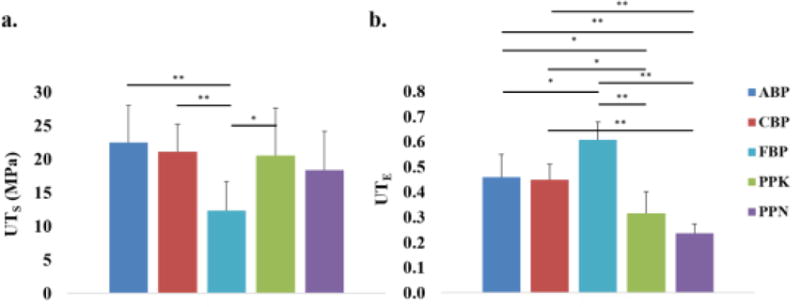
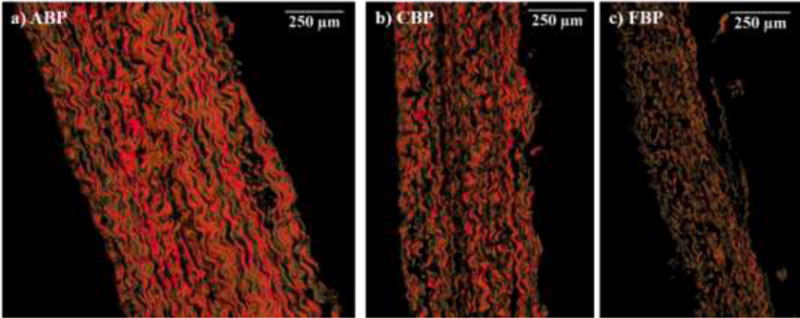
Results: ABP and CBP tissues were significantly stiffer and stronger than the younger FBP tissues. Histological analysis revealed a significantly larger concentration of thin immature collagen fibers in the FBP tissues than in the ABP and CBP tissues. While PP tissues were thinnest, they were stiffer and less extensible than the BP tissues.
Conclusions: Due to comparable mechanical properties but significantly reduced thickness, CBP tissue may be a more suitable material for TAV manufacturing than ABP tissue. FBP tissue, despite its reduced thickness and higher flexibility, was weaker and should be studied in more detail. Although PP tissues are the thinnest, they were least extensible and failed at earlier strain than BP tissues. The differences between PP and BP tissues should be further investigated and suggest that they should not be used interchangeably in the manufacturing of TAV.
Keywords: Aging; Biaxial testing; Bovine pericardium; Collagen; Porcine pericardium; Transcatheter aortic valve; Uniaxial testing.
Copyright © 2017 Elsevier Ltd. All rights reserved.
Figures
References
-
- Vesely I. The evolution of bioprosthetic heart valve design and its impact on durability. Cardiovascular Pathology. 2003;12(5):277–286. - PubMed
-
- Aguiari P, Fiorese M, Iop L, Gerosa G, Bagno A. Mechanical testing of pericardium for manufacturing prosthetic heart valves. Interactive CardioVascular and Thoracic Surgery. 2016;22(1):72–84. - PubMed
-
- I. Grand View Research. Cardiovascular and Soft Tissue Repair Patches Market Analysis by Application (Cardiac Repair, Vascular Repair, Pericardial Repair, Dural Repair, Soft Tissue Repair), by Raw Material (ePTFE, Biomaterial, Tissue Engineered Material) and Segment Forecasts To 2022. 2016
-
- Taramasso M, Pozzoli A, Latib A, La Canna G, Colombo A, Maisano F, Alfieri O. New devices for TAVI: technologies and initial clinical experiences. Nat Rev Cardiol. 2014;11(3):157–167. - PubMed
MeSH terms
Substances
Grants and funding
LinkOut - more resources
Full Text Sources
Other Literature Sources
Miscellaneous
