Review
. 2018 Dec 1;29(16):1633-1659.
doi: 10.1089/ars.2017.7086. Epub 2017 Sep 28.

Differential Impact of Flavonoids on Redox Modulation, Bioenergetics, and Cell Signaling in Normal and Tumor Cells: A Comprehensive Review

Affiliations
Review

Differential Impact of Flavonoids on Redox Modulation, Bioenergetics, and Cell Signaling in Normal and Tumor Cells: A Comprehensive Review

Asimina Kerimi et al. Antioxid Redox Signal. .

Abstract

Significance: Flavonoids can interact with multiple molecular targets to elicit their cellular effects, leading to changes in signal transduction, gene expression, and/or metabolism, which can, subsequently, affect the entire cell and organism. Immortalized cell lines, derived from tumors, are routinely employed as a surrogate for mechanistic studies, with the results extrapolated to tissues in vivo. Recent Advances: We review the activities of selected flavonoids on cultured tumor cells derived from various tissues in comparison to corresponding primary cells or tissues in vivo, mainly using quercetin and flavanols (epicatechin and (-)-epigallocatechin gallate) as exemplars. Several studies have indicated that flavonoids could retard cancer progression in vivo in animal models as well as in tumor cell models.

Critical issues: Extrapolation from in vitro and animal models to humans is not straightforward given both the extensive conjugation and complex microbiota-dependent metabolism of flavonoids after consumption, as well as the heterogeneous metabolism of different tumors.

Future directions: Comparison of data from studies on primary cells or in vivo are essential not only to validate results obtained from cultured cell models, but also to highlight whether any differences may be further exploited in the clinical setting for chemoprevention. Tumor cell models can provide a useful mechanistic tool to study the effects of flavonoids, provided that the limitations of each model are understood and taken into account in interpretation of the data.

Keywords: HepG2; cancer; glucose; hepatocyte; quercetin.


Conflict of interest statement

No competing financial interests exist.

Figures
<b>FIG. 1.</b>
FIG. 1.
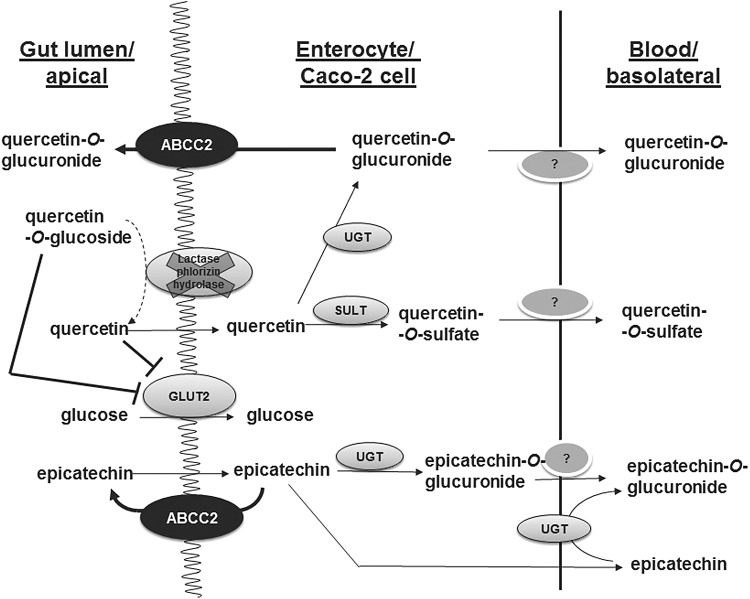
The metabolic reactions of quercetin and epicatechin in small intestine enterocytes and in differentiated Caco-2 cells, which, ultimately, lead to absorption and bioavailability. The uptake of glucose can also be attenuated by polyphenols at this site via inhibition of glucose transport. GLUT, glucose transporter; UGT, uridine diphosphate glucuronosyl transferase; SULT, sulfotranferase.
<b>FIG. 2.</b>
FIG. 2.
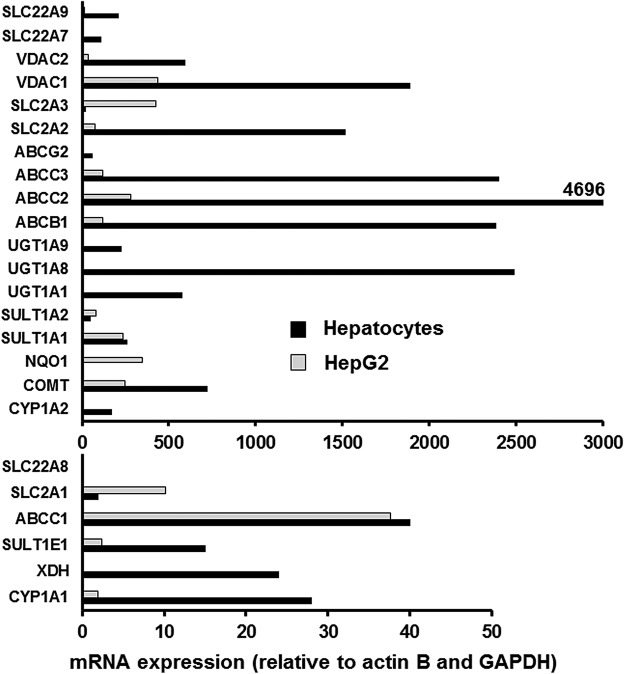
Comparison of mRNA expression of selected transporters and enzymes relevant to flavonoid action and metabolism in human hepatocytes and HepG2 cells. Data were obtained by using hepatocytes from six volunteers and from cultured HepG2 cells by using real time RT-PCR according to (92). ABC, ATP-binding cassette; COMT, catechol-O-methyltransferase; CYP, cytochrome P450; NQO1, quinone reductase oxidoreductase; RT-PCR, reverse transcriptase-polymerase chain reaction.
<b>FIG. 3.</b>
FIG. 3.
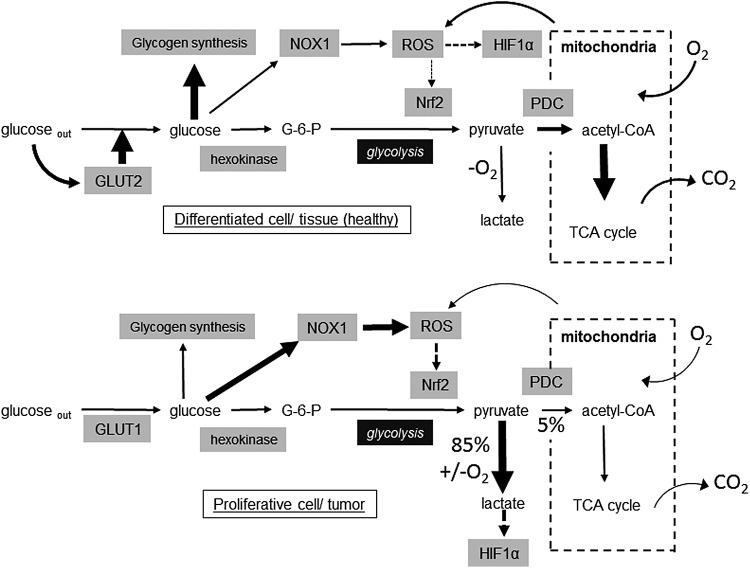
Illustrative metabolic differences between glucose utilization in hepatocytes and HepG2 cells. Information summarized from data presented and discussed in this review. HIF-1α, hypoxia-inducible factor-1α; NOX, NADPH oxidase; Nrf2, nuclear factor (erythroid-derived-2)-like 2; PDC, pyruvate dehydrogenase complex; ROS, reactive oxygen species; TCA, tricarboxylic acid.
<b>FIG. 4.</b>
FIG. 4.
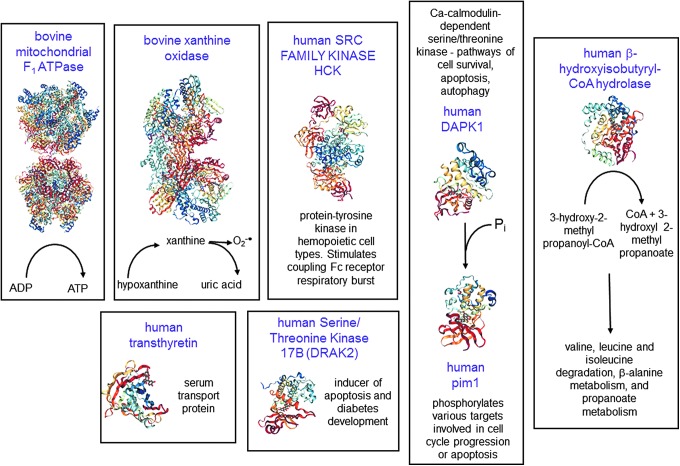
Molecular targets of quercetin. The proteins where crystal structures have been determined in complex with quercetin are shown. The name of the protein is shown in purple, and the function is also indicated. Structures shown are from the PDB (structures 5AUW, 4WNJ, 4LMU, 3NVY, 3LM5, 3BPT, 2JJ2, 2O3P, 2HCK). DAPK1, death-associated protein kinase 1; DRAK2, serine/threonine kinase 17B; PDB, Protein Data Bank.
<b>FIG. 5.</b>
FIG. 5.
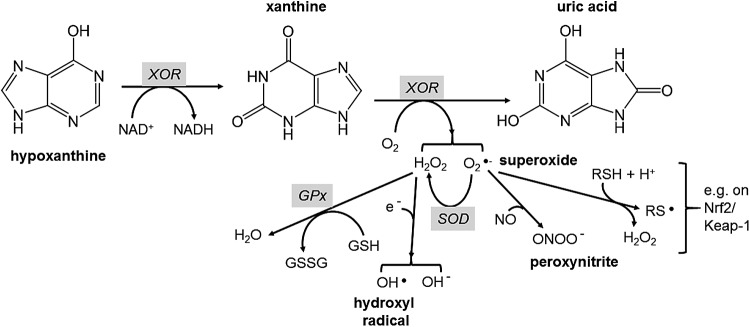
Reactions catalyzed by XOR leading to ROS and protein thiol oxidation. This large and complex enzyme is a flavin- and molybdenum-containing protein with iron-sulfur centers at the catalytic site. It catalyzes oxidation of both hypoxanthine and the intermediate, xanthine, to form uric acid. Under certain conditions, it produces excess hydrogen peroxide and superoxide (74, 115, 182), which can then undergo further reactions to generate intracellular ROS. Superoxide can undergo several reactions, including oxidation of thiol groups to produce a thiyl radical and hydrogen peroxide (264), which would account for the activation of Nrf2 by superoxide (183). NO, nitric oxide; XOR, xanthine oxidoreductase.
<b>FIG. 6.</b>
FIG. 6.
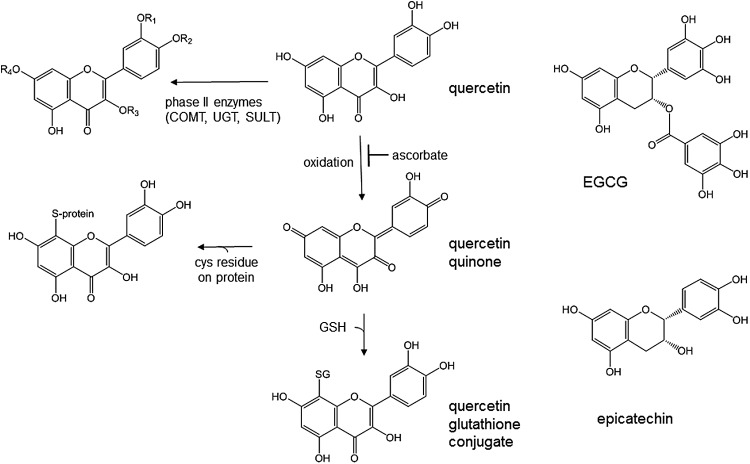
Formation of quercetin conjugates, adducts, and redox forms. The predominant route of metabolism of quercetin is conjugation by phase II enzymes, where R1 and R2 can be methyl groups, R1 can be sulfate, and R1, R2, R3, or R4 can be glucuronide moieties. Oxidation of quercetin yields superoxide and a more reactive quinone form, which can interact with glutathione or with cysteine residues on a protein such as Nrf2 or Keap-1. EGCG, (–)-epigallocatechin gallate.
<b>FIG. 7.</b>
FIG. 7.
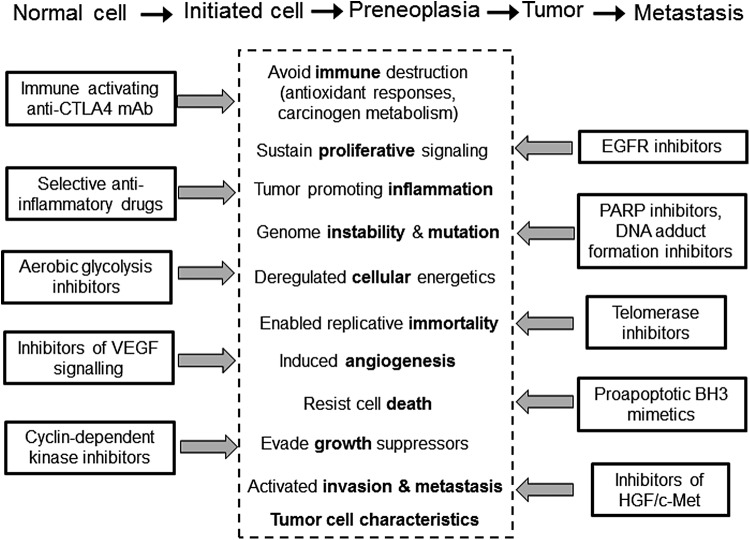
The defining characteristics of cancer cells. Adapted from Ref. (95).

References

    1. Actis-Goretta L, Leveques A, Giuffrida F, Romanov-Michailidis F, Viton F, Barron D, Duenas-Paton M, Gonzalez-Manzano S, Santos-Buelga C, Williamson G, and Dionisi F. Elucidation of (-)-epicatechin metabolites after ingestion of chocolate by healthy humans. Free Radic Biol Med 53: 787–795, 2012 - PubMed
    1. Adewole SO, Caxton-Martins EA, and Ojewole JA. Protective effect of quercetin on the morphology of pancreatic beta-cells of streptozotocin-treated diabetic rats. Afr J Tradit Complement Altern Med 4: 64–74, 2006 - PMC - PubMed
    1. Agullo G, Gamet L, Besson C, Demigne C, and Remesy C. Quercetin exerts a preferential cytotoxic effect on active dividing colon carcinoma HT29 and caco-2 cells. Cancer Lett 87: 55–63, 1994 - PubMed
    1. Ahlin G, Hilgendorf C, Karlsson J, Szigyarto CA, Uhlen M, and Artursson P. Endogenous gene and protein expression of drug-transporting proteins in cell lines routinely used in drug discovery programs. Drug Metab Dispos 37: 2275–2283, 2009 - PubMed
    1. Alam J, Stewart D, Touchard C, Boinapally S, Choi AMK, and Cook JL. Nrf2, a Cap'n'Collar transcription factor, regulates induction of the heme oxygenase-1 gene. J Biol Chem 274: 26071–26078, 1999 - PubMed

Publication types