


CB1 and CB2 Receptor Pharmacology
- PMID: 28826534
- PMCID: PMC5812699
- DOI: 10.1016/bs.apha.2017.03.007
CB1 and CB2 Receptor Pharmacology
Abstract
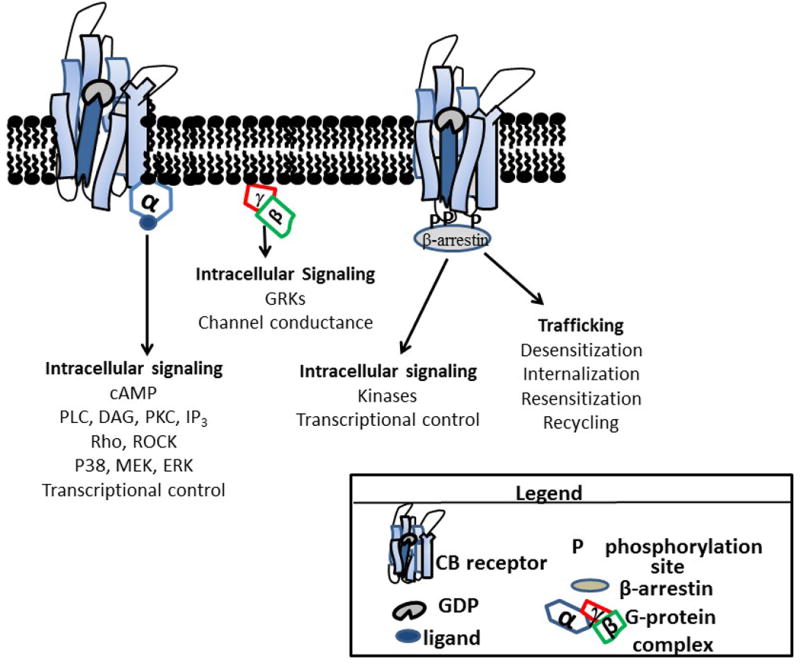
The CB1 and CB2 cannabinoid receptors (CB1R, CB2R) are members of the G protein-coupled receptor (GPCR) family that were identified over 20 years ago. CB1Rs and CB2Rs mediate the effects of Δ9-tetrahydrocannabinol (Δ9-THC), the principal psychoactive constituent of marijuana, and subsequently identified endogenous cannabinoids (endocannabinoids) anandamide and 2-arachidonoyl glycerol. CB1Rs and CB2Rs have both similarities and differences in their pharmacology. Both receptors recognize multiple classes of agonist and antagonist compounds and produce an array of distinct downstream effects. Natural polymorphisms and alternative splice variants may also contribute to their pharmacological diversity. As our knowledge of the distinct differences grows, we may be able to target select receptor conformations and their corresponding pharmacological responses. This chapter will discuss their pharmacological characterization, distribution, phylogeny, and signaling pathways. In addition, the effects of extended agonist exposure and how that affects signaling and expression patterns of the receptors are considered.
Keywords: Biased agonism; Cannabinoid; G protein; GPCR; Human; Polymorphism; Rodent; Splice variant; Tissue selectivity.
© 2017 Elsevier Inc. All rights reserved.
Conflict of interest statement
Conflict of Interest
The authors have no conflicts of interest to declare.
Figures
References
-
- Abood ME, Ditto KA, Noel MA, Showalter VM, Tao Q. Isolation and expression of mouse CB1 cannabinoid receptor gene: comparison of binding properties with those of native CB1 receptors in mouse brain and N18TG2 neuroblastoma cells. Biochem Pharmacol. 1997;53:207–214. - PubMed
-
- Abood ME, Sauss C, Fan F, Tilton CL, Martin BR. Development of behavioral tolerance to delta 9-THC without alteration of cannabinoid receptor binding or mRNA levels in whole brain. Pharmacol Biochem Behav. 1993;46(3):575–579. - PubMed
-
- Bagher AM, Laprairie RB, Kelly ME, Denovan-Wright EM. Co-expression of the human cannabinoid receptor coding region splice variants (hCB(1)) affects the function of hCB(1) receptor complexes. Eur J Pharmacol. 2013;721(1–3):341–354. - PubMed
Publication types
MeSH terms
Substances
Grants and funding
LinkOut - more resources
Full Text Sources
Other Literature Sources
Research Materials
