


Effect of national implementation of utstein recommendation from the global resuscitation alliance on ten steps to improve outcomes from Out-of-Hospital cardiac arrest: a ten-year observational study in Korea
- PMID: 28827263
- PMCID: PMC5724141
- DOI: 10.1136/bmjopen-2017-016925
Effect of national implementation of utstein recommendation from the global resuscitation alliance on ten steps to improve outcomes from Out-of-Hospital cardiac arrest: a ten-year observational study in Korea
Abstract
Objectives: The Utstein ten-step implementation strategy (UTIS) proposed by the Global Resuscitation Alliance, a bundle of community cardiopulmonary resuscitation (CPR) programs to improve outcomes after out-of-hospital cardiac arrests (OHCAs), has been developed. However, it is not documented whether UTIS programs are associated with better outcomes or not. The study aimed to test the association between the UTIS programme and better outcomes after OHCA.
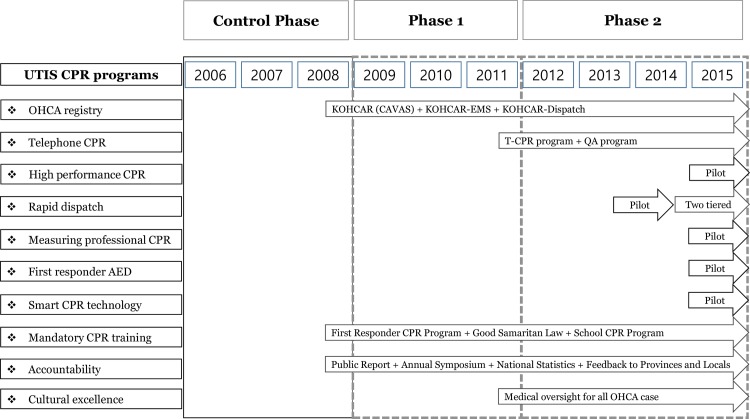
Methods: The study was a before- and after-intervention study. Adults OHCAs treated by emergency medical service (EMS) from 2006 to 2015 in Korea were collected, excluding patients witnessed by ambulance personnel and without outcomes. Phase 1 (2009-2011) after implementing three programs (national OHCA registry, obligatory CPR education, and public report of OHCA outcomes), and phase 2 (2012-2015) after implementing two programs (telephone-assisted CPR and EMS quality assurance programme) were compared with the control period (2006-2008) when no UTIS programme were implemented. The primary outcome was good neurological recovery (cerebral performance scale 1 or 2). We tested the association between the phases and outcomes, adjusting for confounders using a multivariate logistic regression model to calculate adjusted odds ratios (AORs) with 95% confidence intervals (CIs).
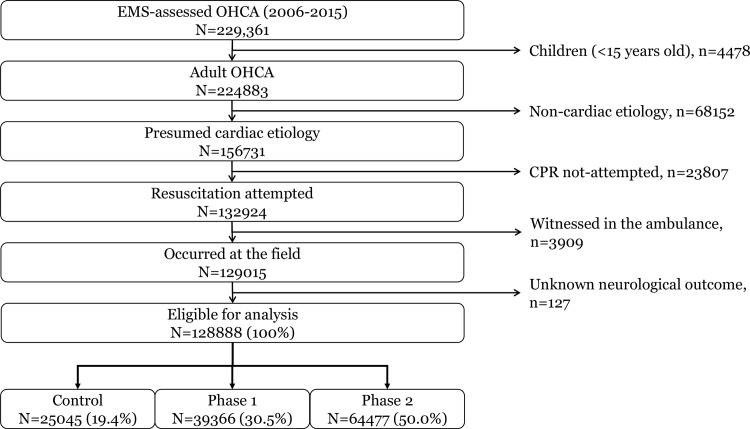
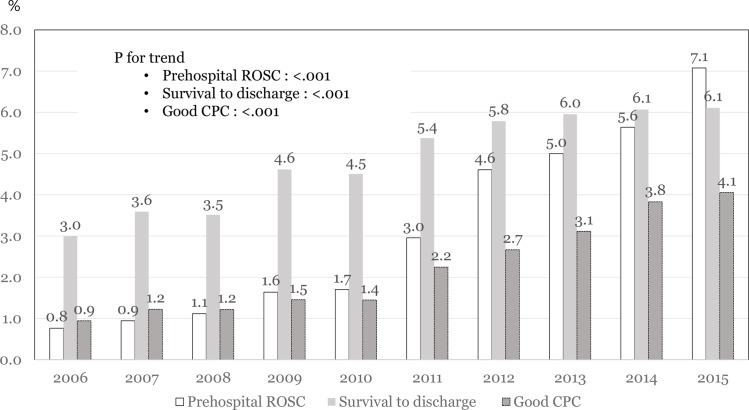
Results: A total of 1 28 888 eligible patients were analysed. The control, phase 1, and phase two study groups were 19.4%, 30.5%, and 50.0% of the whole, respectively. There were significant changes in pre-hospital ROSC (0.8% in 2006 and 7.1% in 2015), survival to discharge (3.0% in 2006 and 6.1% in 2015), and good neurological recovery (1.2% in 2006 and 4.1% in 2015). The AORs (95% CIs) for good neurological recovery were 1.82 (1.53-2.15) or phase 1 and 2.21 (1.78-2.75) for phase two compared with control phase.
Conclusion: The national implementation of the five UTIS programs was significantly associated with better OHCA outcomes in Korea.
Keywords: cardiopulmonary resuscitation; national health policy; out-of-hospital cardiac arrest; outcomes.
© Article author(s) (or their employer(s) unless otherwise stated in the text of the article) 2017. All rights reserved. No commercial use is permitted unless otherwise expressly granted.
Conflict of interest statement
Competing interests: No conflicts of interest are associated with this study.
Figures
References
-
- Travers AH, Perkins GD, Berg RA, et al. Part 3: adult Basic Life support and automated external defibrillation: 2015 International Consensus on Cardiopulmonary Resuscitation and Emergency Cardiovascular Care Science with treatment recommendations. Circulation 2015;132(16 Suppl 1):S51–83. 10.1161/CIR.0000000000000272 - DOI - PubMed
Publication types
MeSH terms
LinkOut - more resources
Full Text Sources
Other Literature Sources
Medical
