. 2017:2017:4915062.
doi: 10.1155/2017/4915062. Epub 2017 Jul 30.

Neutrophil Extracellular Trap Production in Patients with Colorectal Cancer In Vitro

Affiliations

Neutrophil Extracellular Trap Production in Patients with Colorectal Cancer In Vitro

J J R Richardson et al. Int J Inflam. 2017.

Abstract

Purpose: Neutrophil Extracellular Traps (NETs) are extracellular neutrophil derived DNA webs which have been implicated in cancer progression and in the development of metastases. NETs production in patients with colorectal cancer was investigated to elucidate their role and prognostic significance.

Methods: Systemic neutrophils were isolated from consecutive patients with colorectal cancer and from age-matched healthy volunteers. Neutrophils were stimulated to produce NETs which were quantified by a measure of the fluorescence of the extracellular DNA. The impact of cancer location, tumour stage, and patient outcomes (complications, length of stay, and mortality) on NET production was investigated.

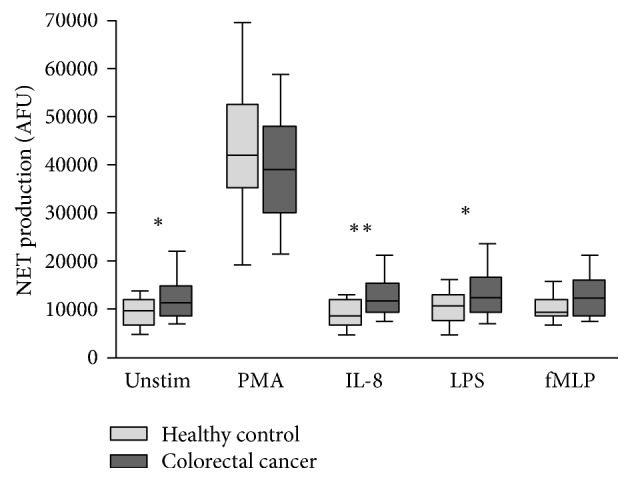
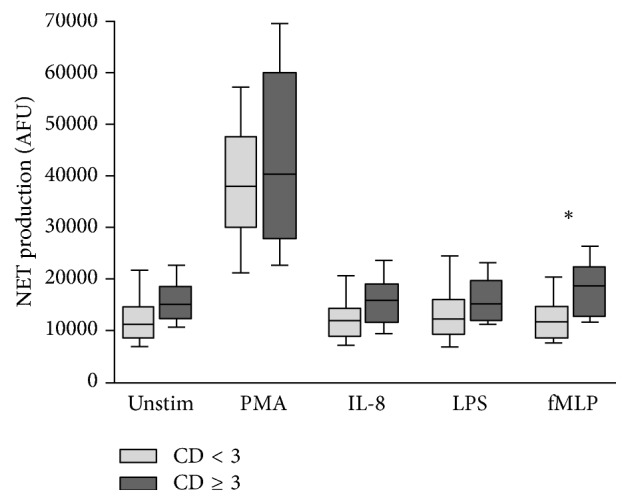
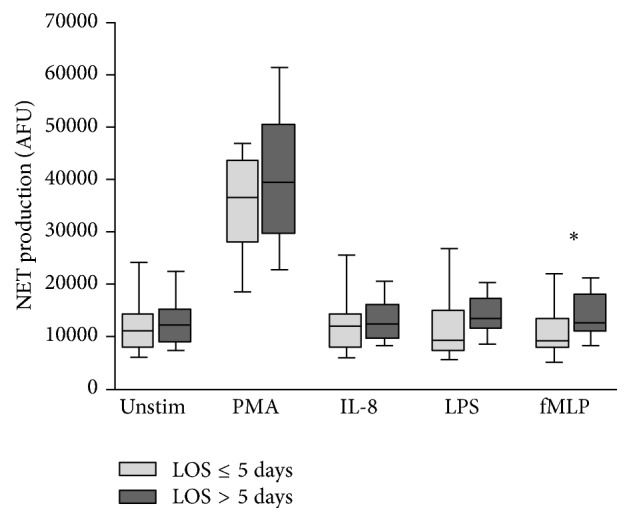
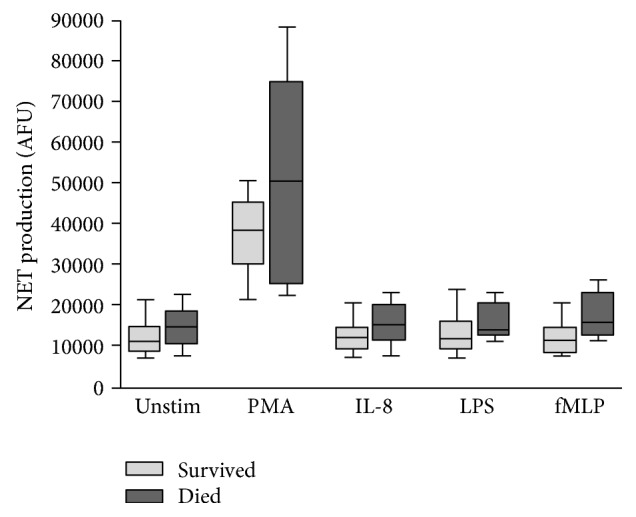
Results: Quantification of NET formation was performed in patients with colorectal cancer (n = 45) and in well-matched healthy individuals (n = 20). Significant increases in NETs production in response to no stimulant (9,735 AFU versus 11347 AFU, p = 0.0209), IL-8 (8,644 AFU versus 11,915 AFU, p = 0.0032), and LPS (10,576 AFU versus 12,473 AFU, p = 0.0428) were identified in patients with colorectal cancer. A significant increase in NETs production in response to fMLP was detected in patients who developed significant postoperative complications (11,760 AFU versus 18,340 AFU, p = 0.0242) and who had a prolonged hospital recovery (9,008 AFU versus 12,530 AFU, p = 0.0476). An increase in NETs production was also observed in patients who died, but this did not reach statistical significance. Cancer location and tumour stage did not appear to affect preoperative NETs production.

Conclusions: Patients with colorectal cancer have significantly increased NETs production in vitro when compared to healthy volunteers, possibly implicating them in cancer development. Adverse patient outcomes were associated with increased preoperative NETs production, which highlights them as potential therapeutic targets.


Figures
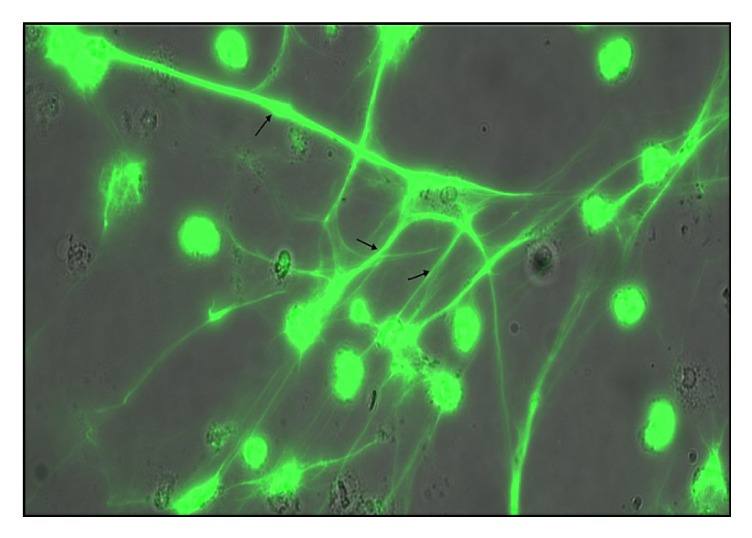
Figure 1
Figure 1
Fluorescent microscopy image of NETs (marked with arrows) following incubation with 25 μl PMA (1 mg/ml [1 : 800 then 1 : 10 dilution]).
Figure 2
Figure 2
Box-and-Whisker plot (10th–90th percentile) of NET production in healthy control subjects (n = 20) and patients with colorectal cancer (n = 45) in response to no stimulant (Unstim), PMA, IL-8, LPS, and fMLP. Statistical significance, measured by Mann–Whitney U test, is denoted by p < 0.05 and ∗∗p < 0.01.
Figure 3
Figure 3
Box-and-Whisker plot (10th–90th percentile) of NET production in patients with Clavien-Dindo classification < 3 (n = 38) versus Clavien-Dindo classification ≥ 3 (n = 6) in response to no stimulant (Unstim), PMA, IL-8, LPS, and fMLP. Statistical significance, measured by Mann–Whitney U test, is denoted by p < 0.05.
Figure 4
Figure 4
Box-and-Whisker plot (10th–90th percentile) of NET production in patients who had length of stay ≤ 5 days (n = 9) versus length of stay > 5 days (n = 35) in response to no stimulant (Unstim), PMA, IL-8, LPS, and fMLP. Statistical significance, measured by Mann–Whitney U test, is denoted by p < 0.05.
Figure 5
Figure 5
Box-and-Whisker plot (10th–90th percentile) of NET production in patients who survived (n = 39) versus those who died (n = 5) in response to no stimulant (Unstim), PMA, IL-8, LPS, and fMLP.
Figure 6
Figure 6
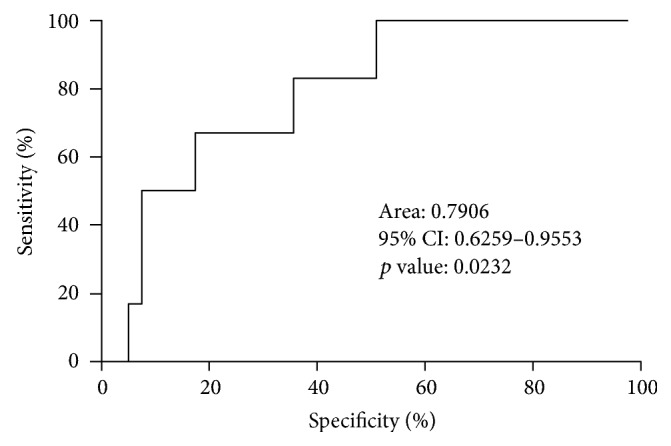
ROC curve of NET production in response to stimulation with fMLP for Clavien-Dindo classification < 3 (n = 38) versus Clavien-Dindo classification ≥ 3 (n = 6).

References

    1. Borregaard N. Neutrophils, from Marrow to Microbes. Immunity. 2010;33(5):657–670. doi: 10.1016/j.immuni.2010.11.011. - DOI - PubMed
    1. Cools-Lartigue J., Spicer J., McDonald B., et al. Neutrophil extracellular traps sequester circulating tumor cells and promote metastasis. Journal of Clinical Investigation. 2013;123(8):3446–3458. doi: 10.1172/JCI67484. - DOI - PMC - PubMed
    1. Sagiv J. Y., Michaeli J., Assi S., et al. Phenotypic diversity and plasticity in circulating neutrophil subpopulations in cancer. Cell Reports. 2015;10(4):562–573. doi: 10.1016/j.celrep.2014.12.039. - DOI - PubMed
    1. Brinkmann V., Reichard U., Goosmann C., et al. Neutrophil extracellular traps kill bacteria. Science. 2004;303(5663):1532–1535. doi: 10.1126/science.1092385. - DOI - PubMed
    1. Fuchs T. A., Abed U., Goosmann C., et al. Novel cell death program leads to neutrophil extracellular traps. The Journal of Cell Biology. 2007;176(2):231–241. doi: 10.1083/jcb.200606027. - DOI - PMC - PubMed

LinkOut - more resources