Definition and epidemiology of acute respiratory distress syndrome
- PMID: 28828357
- PMCID: PMC5537110
- DOI: 10.21037/atm.2017.06.62
Definition and epidemiology of acute respiratory distress syndrome
Abstract
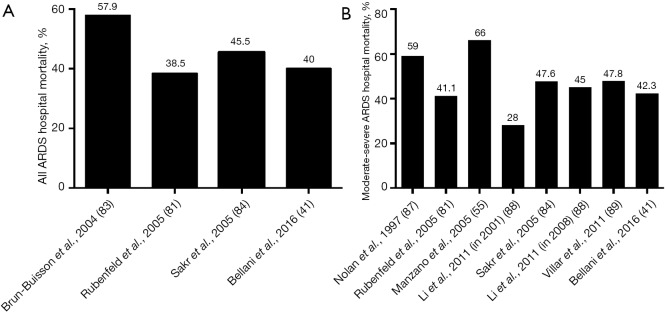
Fifty years ago, Ashbaugh and colleagues defined for the first time the acute respiratory distress syndrome (ARDS), one among the most challenging clinical condition of the critical care medicine. The scientific community worked over the years to generate a unified definition of ARDS, which saw its revisited version in the Berlin definition, in 2014. Epidemiologic information about ARDS is limited in the era of the new Berlin definition, and wide differences are reported among countries all over the world. Despite decades of study in the field of lung injury, ARDS is still so far under-recognized, with 2 out of 5 cases missed by clinicians. Furthermore, although advances of ventilator strategies in the management of ARDS associated with outcome improvements-such as protective mechanical ventilation, lower driving pressure, higher PEEP levels and prone positioning-ARDS appears to be undertreated and mortality remains elevated up to 40%. In this review, we cover the history that led to the current worldwide accepted Berlin definition of ARDS and we summarize the recent data regarding ARDS epidemiology.
Keywords: Acute respiratory distress syndrome (ARDS); definition; epidemiology.
Conflict of interest statement
Conflicts of Interest: The authors have no conflicts of interest to declare.
Figures
References
-
- Laennec RT; Classics of Medicine Library. A treatise on the diseases of the chest, in which they are described according to their anatomical characters, and their diagnosis established on a new principle by means of acoustick instruments. Birmingham, AL: Classics of Medicine Library, 1979.
Publication types
LinkOut - more resources
Full Text Sources
Other Literature Sources
Medical