


Effect of endurance exercise on microRNAs in myositis skeletal muscle-A randomized controlled study
- PMID: 28829792
- PMCID: PMC5568726
- DOI: 10.1371/journal.pone.0183292
Effect of endurance exercise on microRNAs in myositis skeletal muscle-A randomized controlled study
Abstract
Objective: To identify changes in skeletal muscle microRNA expression after endurance exercise and associate the identified microRNAs with mRNA and protein expression to disease-specific pathways in polymyositis (PM) and dermatomyositis (DM) patients.
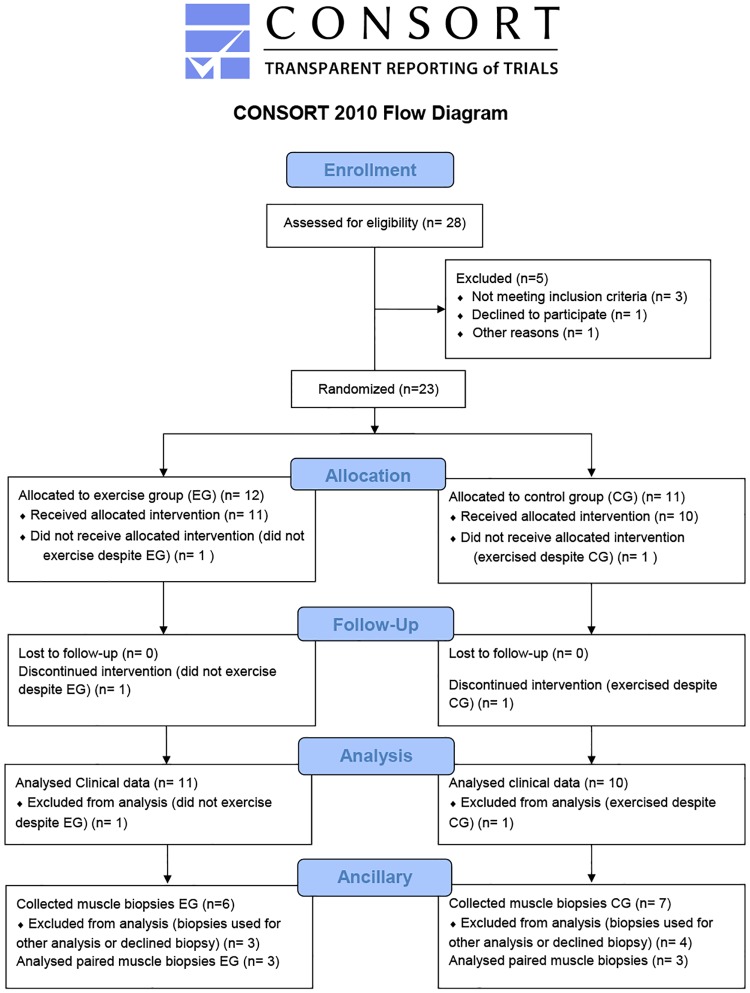
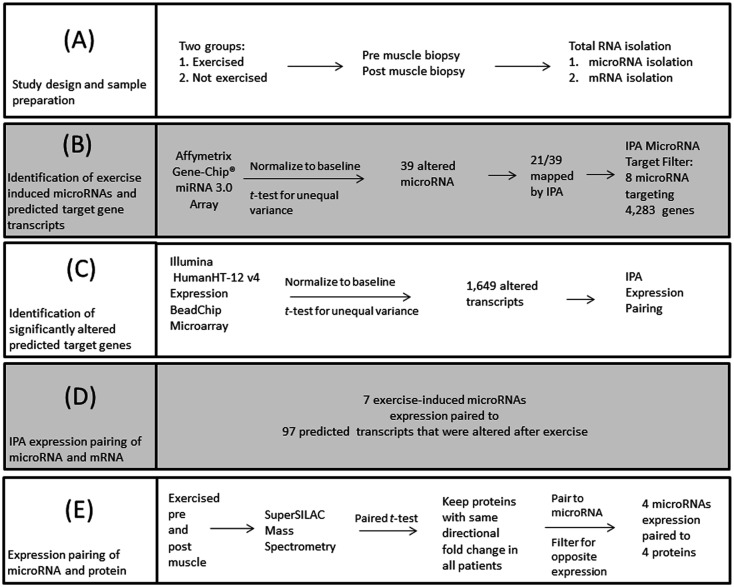
Methods: Following a parallel clinical trial design, patients with probable PM or DM, exercising less than once a week, and on stable medication for at least one month were randomized into two groups at Karolinska University Hospital: a 12-week endurance exercise group (n = 12) or a non-exercised control group (n = 11). Using an Affymetrix microarray, microRNA expression was determined in paired muscle biopsies taken before and after the exercise intervention from 3 patients in each group. Ingenuity pathway analysis with a microRNA target filter was used to identify microRNA transcript targets. These targets were investigated at the mRNA (microarray) and protein (mass spectrometry) levels in patients.
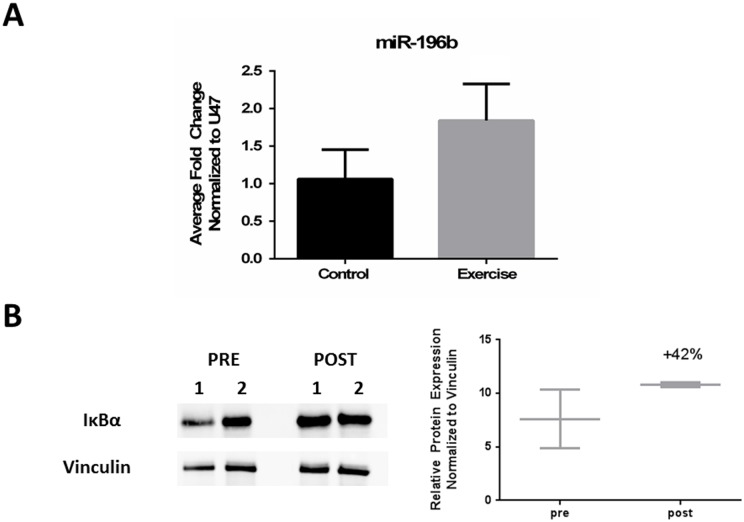
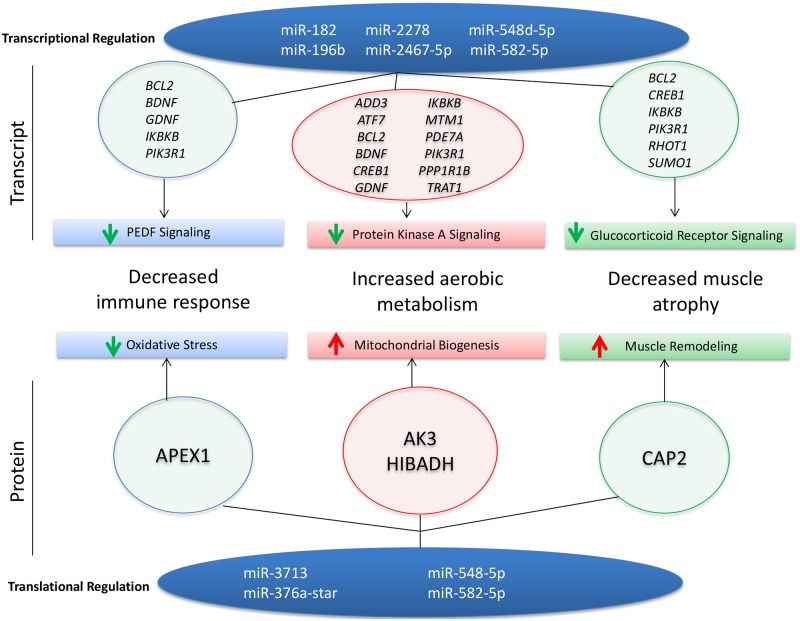
Results: Endurance exercise altered 39 microRNAs. The microRNAs with increased expression were predicted to target transcripts involved in inflammatory processes, metabolism, and muscle atrophy. Further, these target transcripts had an associated decrease in mRNA expression in exercised patients. In particular, a decrease in the NF-κB regulator IKBKB was associated with an increase in its target microRNA (miR-196b). At the protein level, there was an increase in mitochondrial proteins (AK3, HIBADH), which were associated with a decrease in microRNAs that were predicted to regulate their expression.
Conclusion: Improvement in disease phenotype after exercise is associated with increasing microRNAs that target and downregulate immune processes at the transcript level, as well as decreasing microRNAs that target and upregulate mitochondrial content at the protein level. Therefore, microRNAs may improve disease by decreasing immune responses and increasing mitochondrial biogenesis.
Trial registration: ClinicalTrials.gov NCT01184625.
Conflict of interest statement
Figures
References
-
- Hengstman GJ, van den Hoogen FH, van Engelen BG. Treatment of the inflammatory myopathies: update and practical recommendations. Expert opinion on pharmacotherapy. 2009;10(7):1183–90. Epub 2009/05/02. doi: 10.1517/14656560902913815 . - DOI - PubMed
-
- Harris-Love MO, Shrader JA, Koziol D, Pahlajani N, Jain M, Smith M, et al. Distribution and severity of weakness among patients with polymyositis, dermatomyositis and juvenile dermatomyositis. Rheumatology (Oxford). 2009;48(2):134–9. Epub 2008/12/17. doi: 10.1093/rheumatology/ken441 . - DOI - PMC - PubMed
-
- Tansley SL, McHugh NJ. Myositis specific and associated autoantibodies in the diagnosis and management of juvenile and adult idiopathic inflammatory myopathies. Curr Rheumatol Rep. 2014;16(12):464 Epub 2014/12/04. doi: 10.1007/s11926-014-0464-1 . - DOI - PubMed
-
- Malik A, Hayat G, Kalia JS, Guzman MA. Idiopathic Inflammatory Myopathies: Clinical Approach and Management. Frontiers in neurology. 2016;7:64 Epub 2016/06/01. doi: 10.3389/fneur.2016.00064 . - DOI - PMC - PubMed
-
- Braun TP, Marks DL. The regulation of muscle mass by endogenous glucocorticoids. Frontiers in physiology. 2015;6:12 Epub 2015/02/19. doi: 10.3389/fphys.2015.00012 . - DOI - PMC - PubMed
Publication types
MeSH terms
Substances
Associated data
Grants and funding
LinkOut - more resources
Full Text Sources
Other Literature Sources
Medical
Molecular Biology Databases
Miscellaneous
