


A history of hybrids? Genomic patterns of introgression in the True Geese
- PMID: 28830337
- PMCID: PMC5568201
- DOI: 10.1186/s12862-017-1048-2
A history of hybrids? Genomic patterns of introgression in the True Geese
Abstract
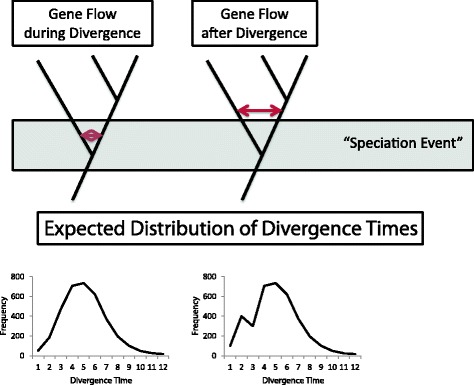
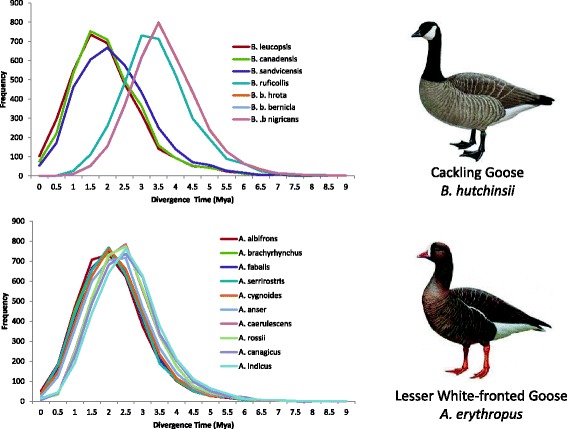
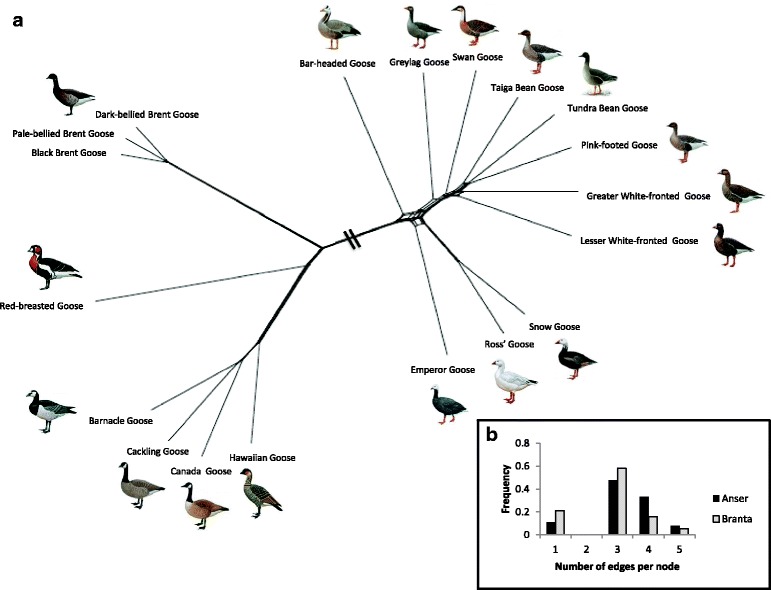
Background: The impacts of hybridization on the process of speciation are manifold, leading to distinct patterns across the genome. Genetic differentiation accumulates in certain genomic regions, while divergence is hampered in other regions by homogenizing gene flow, resulting in a heterogeneous genomic landscape. A consequence of this heterogeneity is that genomes are mosaics of different gene histories that can be compared to unravel complex speciation and hybridization events. However, incomplete lineage sorting (often the outcome of rapid speciation) can result in similar patterns. New statistical techniques, such as the D-statistic and hybridization networks, can be applied to disentangle the contributions of hybridization and incomplete lineage sorting. We unravel patterns of hybridization and incomplete lineage sorting during and after the diversification of the True Geese (family Anatidae, tribe Anserini, genera Anser and Branta) using an exon-based hybridization network approach and taking advantage of discordant gene tree histories by re-sequencing all taxa of this clade. In addition, we determine the timing of introgression and reconstruct historical effective population sizes for all goose species to infer which demographic or biogeographic factors might explain the observed patterns of introgression.
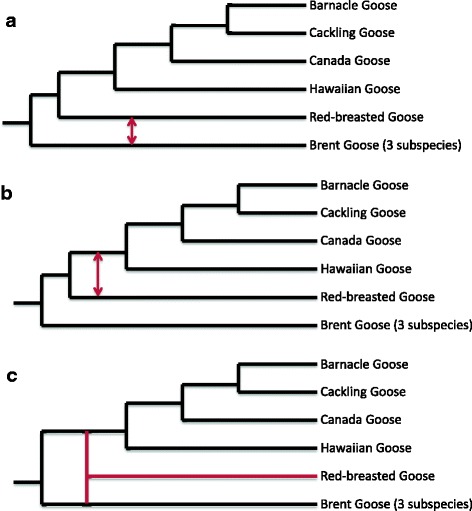
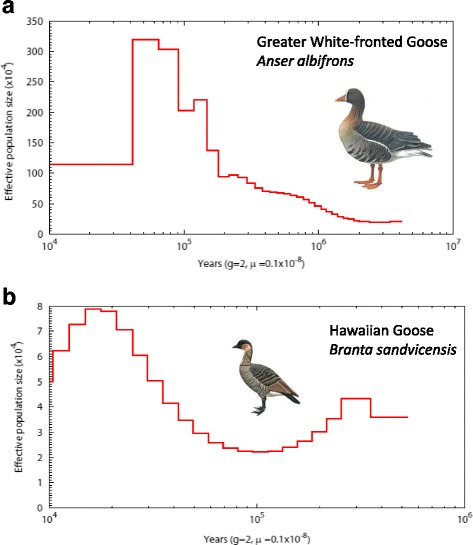
Results: We find indications for ancient interspecific gene flow during the diversification of the True Geese and were able to pinpoint several putative hybridization events. Specifically, in the genus Branta, both the ancestor of the White-cheeked Geese (Hawaiian Goose, Canada Goose, Cackling Goose and Barnacle Goose) and the ancestor of the Brent Goose hybridized with Red-breasted Goose. One hybridization network suggests a hybrid origin for the Red-breasted Goose, but this scenario seems unlikely and it not supported by the D-statistic analysis. The complex, highly reticulated evolutionary history of the genus Anser hampered the estimation of ancient hybridization events by means of hybridization networks. The reconstruction of historical effective population sizes shows that most species showed a steady increase during the Pliocene and Pleistocene. These large effective population sizes might have facilitated contact between diverging goose species, resulting in the establishment of hybrid zones and consequent gene flow.
Conclusions: Our analyses suggest that the evolutionary history of the True Geese is influenced by introgressive hybridization. The approach that we have used, based on genome-wide phylogenetic incongruence and network analyses, will be a useful procedure to reconstruct the complex evolutionary histories of many naturally hybridizing species groups.
Keywords: D-statistic; Hybridization; PSMC; Phylogenetic Networks; Phylogenomics.
Conflict of interest statement
Ethics approval and consent to participate
The collection of blood samples (Submission 2,013,001.b) has been approved by the Ethical Committee for Animal Experiments (Dierexperimentencommissie [DEC]) at Wageningen University.
Consent for publication
Not applicable.
Competing interests
The authors declare that they have no competing interests.
Publisher’s Note
Springer Nature remains neutral with regard to jurisdictional claims in published maps and institutional affiliations.
Figures
References
MeSH terms
LinkOut - more resources
Full Text Sources
Other Literature Sources
