


Intermediate-term outcome after PSMA-PET guided high-dose radiotherapy of recurrent high-risk prostate cancer patients
- PMID: 28830532
- PMCID: PMC5568206
- DOI: 10.1186/s13014-017-0877-x
Intermediate-term outcome after PSMA-PET guided high-dose radiotherapy of recurrent high-risk prostate cancer patients
Abstract
Background: By the use of PSMA positron emission tomography (PET) detection of prostate cancer lesions with a high sensitivity and specificity combined with a favorable lesion to background contrast is feasible. Therefore, PSMA-PET is increasingly used for planning of radiotherapy treatment; however, any data on intermediate-term outcome is missing so far.
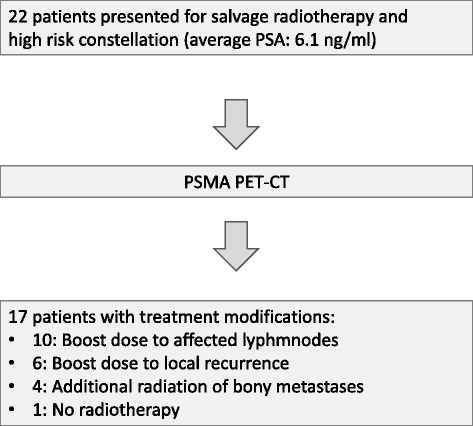
Methods: Patients with high-risk or very high risk prostate cancer, referred for salvage radiotherapy (SRT, n = 22) between 2013 and 2015, underwent PSMA-PET prior to therapy. Irradiation was planned on PET data with boost to macroscopic tumors/metastases. Treatment related toxicity was measured using Common Terminology Criteria for Adverse Events (CTCAE, v4.0).
Result: Findings in PSMA-PET led to treatment modifications in 77% of SRT patients compared to available CT information. One patient did not receive irradiation due to disseminated disease, the other patients received increased boost doses to macroscopic disease and/or inclusion of additional target volumes. Toxicity was low as only 2 patients reported toxicities > grade 1. With a Median follow-up time of 29 in patients that were not lost to follow-up, prolonged PSA responses below baseline were observed in the majority of patients (14 of 20). In hormone-naïve SRT patients (n = 11), radiotherapy led to prolonged PSA decrease in 8/11 patients, however with 3 of these 8 patients receiving repeated PSMA based irradiation of novel lesions during follow-up.
Conclusion: PSMA-PET guided planning of radiotherapy led to change of treatment in the majority of patients. Treatment related toxicity was well tolerated and promising results regarding intermediate-term PSA decrease were observed.
Trial registration: No trial registration was performed due to retrospective evaluation.
Keywords: Image based radiotherapy; PSA response; Prostate-cancer; Psma-pet; Salvage radiotherapy.
Conflict of interest statement
Ethics approval and consent to participate
All procedures performed in studies involving human participants were in accordance with the ethical standards of the institutional and/or national research committee and with the 1964 Helsinki declaration and its later amendments or comparable ethical standards. Evaluation of the data was approved by the Institutional Ethics Committee (EA4/168/16).
Consent for publication
Not applicable.
Competing interests
The authors declare that they have no competing interests.
Publisher’s Note
Springer Nature remains neutral with regard to jurisdictional claims in published maps and institutional affiliations.
Figures

References
-
- Valicenti RK, Thompson I, Albertsen P, Davis BJ, Goldenberg SL, Wolf JS, et al. Adjuvant and salvage radiation therapy after prostatectomy: American Society for Radiation Oncology/American urological association guidelines. Int J Radiat Oncol Biol Phys. 2013;86:822–828. doi: 10.1016/j.ijrobp.2013.05.029. - DOI - PubMed
-
- Peeters STH, Heemsbergen WD, Koper PCM, van Putten WLJ, Slot A, Dielwart MFH, et al. Dose-response in radiotherapy for localized prostate cancer: results of the Dutch multicenter randomized phase III trial comparing 68 Gy of radiotherapy with 78 Gy. J Clin Oncol. 2006;24:1990–1996. doi: 10.1200/JCO.2005.05.2530. - DOI - PubMed
MeSH terms
LinkOut - more resources
Full Text Sources
Other Literature Sources
Medical
Research Materials
Miscellaneous
