. 2017 Aug 22;8(4):e00665-17.
doi: 10.1128/mBio.00665-17.

MERS-CoV Accessory ORFs Play Key Role for Infection and Pathogenesis

Affiliations

MERS-CoV Accessory ORFs Play Key Role for Infection and Pathogenesis

Vineet D Menachery et al. mBio. .

Abstract

While dispensable for viral replication, coronavirus (CoV) accessory open reading frame (ORF) proteins often play critical roles during infection and pathogenesis. Utilizing a previously generated mutant, we demonstrate that the absence of all four Middle East respiratory syndrome CoV (MERS-CoV) accessory ORFs (deletion of ORF3, -4a, -4b, and -5 [dORF3-5]) has major implications for viral replication and pathogenesis. Importantly, attenuation of the dORF3-5 mutant is primarily driven by dysregulated host responses, including disrupted cell processes, augmented interferon (IFN) pathway activation, and robust inflammation. In vitro replication attenuation also extends to in vivo models, allowing use of dORF3-5 as a live attenuated vaccine platform. Finally, examination of ORF5 implicates a partial role in modulation of NF-κB-mediated inflammation. Together, the results demonstrate the importance of MERS-CoV accessory ORFs for pathogenesis and highlight them as potential targets for surveillance and therapeutic treatments moving forward.IMPORTANCE The initial emergence and periodic outbreaks of MERS-CoV highlight a continuing threat posed by zoonotic pathogens to global public health. In these studies, mutant virus generation demonstrates the necessity of accessory ORFs in regard to MERS-CoV infection and pathogenesis. With this in mind, accessory ORF functions can be targeted for both therapeutic and vaccine treatments in response to MERS-CoV and related group 2C coronaviruses. In addition, disruption of accessory ORFs in parallel may offer a rapid response platform to attenuation of future emergent strains based on both SARS- and MERS-CoV accessory ORF mutants.

Keywords: MERS-CoV; SARS-CoV; coronavirus; live vector vaccines; reverse genetics.


Figures

FIG 1
FIG 1
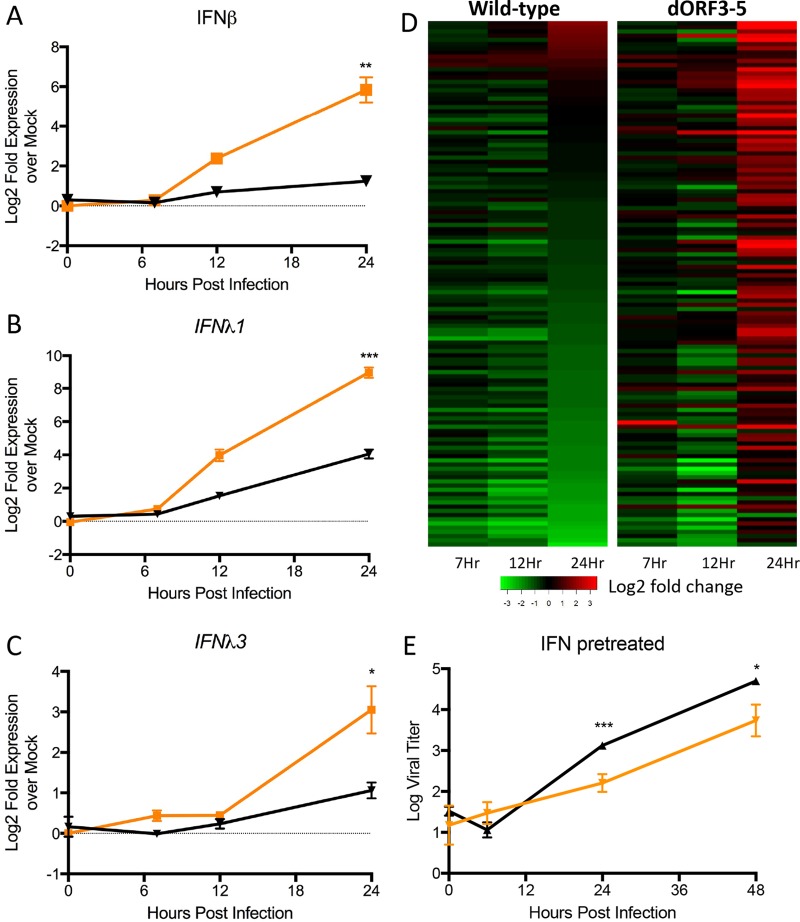
dORF3-5 attenuation mediated by host responses. (A and B) Calu-3 2B4 cells (A) and primary human airway epithelial cells (B) infected with wild-type MERS-CoV (black) or the dORF3-5 mutant (orange) at an MOI of 0.01 and monitored over the study time course. (C) Calu-3 2B4 cells infected at an MOI of 5. (D) RNA expression of the dORF3-5 mutant relative to wild-type virus infection. Clusters are defined by functional category and identified by differential expression score. P values are representative of Student’s t test: *, P < 0.05; ***, P < 0.001.
FIG 2
FIG 2
dORF3-5 mutant induces augmented IFN responses. (A to C) RNA expression of IFN-β (A), IFN-λ1 (B), and IFN-λ3 (C) following infection of Calu-3 2B4 cells with WT MERS-CoV (black) or the dORF3-5 mutant (orange) at an MOI of 5. (D) Consensus interferon-stimulated gene expression (log2 fold expression relative to mock infection) following wild-type or dORF3-5 mutant infection. (E) Vero cells treated with type I IFN (1,000 U) 16 h prior to infection with either WT MERS-CoV (black) or the dORF3-5 mutant (orange). P values are representative of Student’s t test: *, P < 0.05; **, P < 0.01; ***, P <0.001.
FIG 3
FIG 3
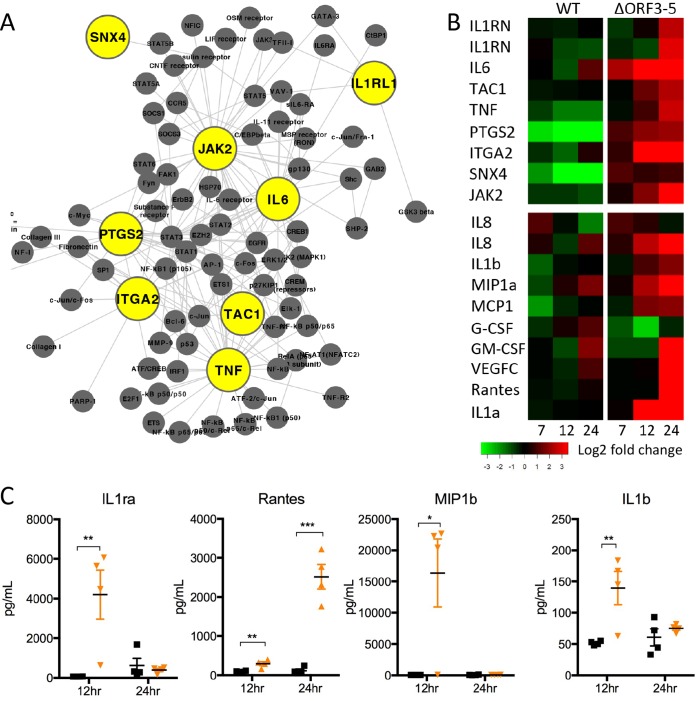
dORF3-5 mutant induces NF-κB-mediated inflammation. (A) Key gene regulators (yellow) and connections (gray) were identified by association with “positive regulation of inflammatory process,” representing genes that were upregulated at both 12 and 24 h in the dORF3-5 mutant virus relative to WT. (B) Expression of inflammatory regulators (top panel) and cytokines (bottom panel, log2 fold expression relative to mock infected) following WT (left) and dORF3-5 mutant infection. (C) Production of inflammatory cytokines following infection with WT (black) or dORF3-5 mutant (orange) virus 12 and 24 h postinfection of Calu-3 2B4 cells. P values are representative of Student’s t test: *, P < 0.05; **, P < 0.01; ***, P < 0.001.
FIG 4
FIG 4
dORF3-5 mutation attenuates in vivo replication and protects from lethal challenge. (A) Lung titer from CRISPR-generated 288-330+/+ mice infected with WT (black) or dORF3-5 mutant (orange) virus at days 2 and 4. (B and C) Weight loss (B) and lung titer (C) following infection of mice vaccinated with WT (black) or dORF3-5 mutant (orange) virus or mock infected (gray). (D) Plaque reduction neutralization with sera from mice vaccinated with the WT (black) or dORF3-5 mutant (orange). The P value is representative of Student’s t test: ***, P < 0.001.
FIG 5
FIG 5
dORF3-5 mutation attenuates the virulent MERS-CoV strain. (A and B) Weight loss (A) and lung titers (B) following infection of CRISPR-generated 288-330+/+ mice infected with MERS-CoV MA1 (black) or dORF3-5 MA1 (orange) at days 2 and 4. (C) Production of inflammatory cytokines following infection with mouse-adapted WT (black) or dORF3-5 mutant (orange) virus 2 or 4 days postinfection. P values are representative of Student’s t test: *, P < 0.05; ***, P <0.001.
FIG 6
FIG 6
ORF5 plays role in modulation of NF-κB-mediated inflammation. (A) Heat maps were constructed from a set of group 2C coronaviruses, including consensus bat HKU4 (BtCoV-HKU4), consensus bat HKU5 (BtCoV-HKU5), MERS-CoV Uganda (PREDICT/PDF-2180 [3]), and hedgehog (HH) CoV VMC (ErinaceusCoV [42]), using alignment data paired with neighbor-joining phylogenetic trees built in Geneious (v.9.1.5) and visualized in EvolView (EvolGenius). The trees show the degree of genetic similarity of MERS-CoV ORFs across group 2C. (B) Primary human airway epithelial cells infected with WT (black) or dORF5 mutant virus at an MOI of 0.01. (B to F) Calu-3 2B4 cells infected with WT (black) or dORF5 mutant virus at an MOI of 5. (C and D) Viral replication (C) and RNA expression analysis (D) of dORF5 mutant relative to wild-type virus infection. Clusters were defined by functional category and identified by differential expression score. (E and F) RNA expression of IFN-β (E) and IFN-λ1 (F) following infection. (G) Production of inflammatory cytokines following infection with WT (black) or dORF5 mutant (red) virus 12 h postinfection of Calu-3 2B4 cells. P values are representative of Student’s t test: **, P < 0.01; ***, P < 0.001.

References

    1. Zumla A, Hui DS, Perlman S. 2015. Middle East respiratory syndrome. Lancet 386:995–1007. doi:10.1016/S0140-6736(15)60454-8. - DOI - PMC - PubMed
    1. WHO 17 September 2015. Middle East respiratory syndrome coronavirus (MERS-CoV)—Saudi Arabia. World Healthy Organization, Geneva, Switzerland: http://www.who.int/csr/don/17-september-2015-mers-saudi-arabia/en/.
    1. Anthony SJ, Gilardi K, Menachery VD, Goldstein T, Ssebide B, Mbabazi R, Navarrete-Macias I, Liang E, Wells H, Hicks A, Petrosov A, Byarugaba DK, Debbink K, Dinnon KH, Scobey T, Randell SH, Yount BL, Cranfield M, Johnson CK, Baric RS, Lipkin WI, Mazet JAK. 2017. Further evidence for bats as the evolutionary source of Middle East respiratory syndrome coronavirus. mBio 8:e00373-17. doi:10.1128/mBio.00373-17. - DOI - PMC - PubMed
    1. Reusken CB, Raj VS, Koopmans MP, Haagmans BL. 2016. Cross host transmission in the emergence of MERS coronavirus. Curr Opin Virol 16:55–62. doi:10.1016/j.coviro.2016.01.004. - DOI - PMC - PubMed
    1. Haagmans BL, van den Brand JM, Raj VS, Volz A, Wohlsein P, Smits SL, Schipper D, Bestebroer TM, Okba N, Fux R, Bensaid A, Solanes Foz D, Kuiken T, Baumgärtner W, Segalés J, Sutter G, Osterhaus AD. 2016. An orthopoxvirus-based vaccine reduces virus excretion after MERS-CoV infection in dromedary camels. Science 351:77–81. doi:10.1126/science.aad1283. - DOI - PubMed

Publication types