


Caterpillars lack a resident gut microbiome
- PMID: 28830993
- PMCID: PMC5594680
- DOI: 10.1073/pnas.1707186114
Caterpillars lack a resident gut microbiome
Abstract
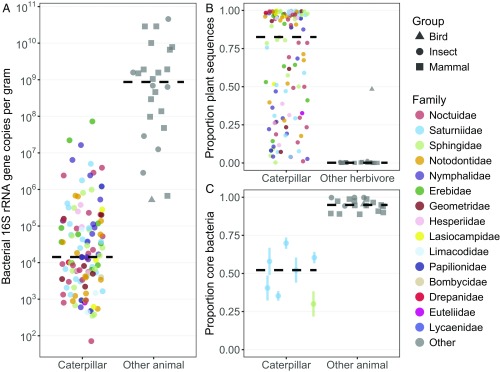
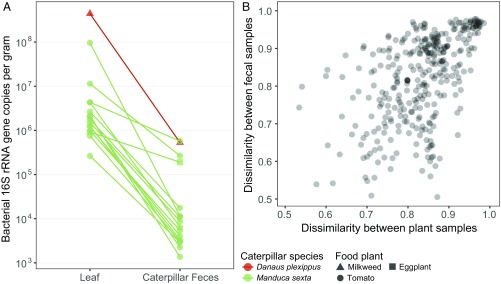
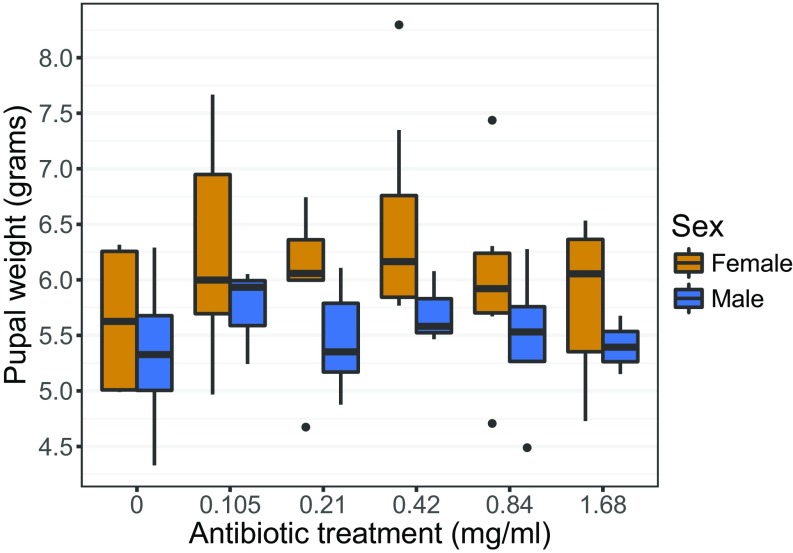
Many animals are inhabited by microbial symbionts that influence their hosts' development, physiology, ecological interactions, and evolutionary diversification. However, firm evidence for the existence and functional importance of resident microbiomes in larval Lepidoptera (caterpillars) is lacking, despite the fact that these insects are enormously diverse, major agricultural pests, and dominant herbivores in many ecosystems. Using 16S rRNA gene sequencing and quantitative PCR, we characterized the gut microbiomes of wild leaf-feeding caterpillars in the United States and Costa Rica, representing 124 species from 15 families. Compared with other insects and vertebrates assayed using the same methods, the microbes that we detected in caterpillar guts were unusually low-density and variable among individuals. Furthermore, the abundance and composition of leaf-associated microbes were reflected in the feces of caterpillars consuming the same plants. Thus, microbes ingested with food are present (although possibly dead or dormant) in the caterpillar gut, but host-specific, resident symbionts are largely absent. To test whether transient microbes might still contribute to feeding and development, we conducted an experiment on field-collected caterpillars of the model species Manduca sexta Antibiotic suppression of gut bacterial activity did not significantly affect caterpillar weight gain, development, or survival. The high pH, simple gut structure, and fast transit times that typify caterpillar digestive physiology may prevent microbial colonization. Moreover, host-encoded digestive and detoxification mechanisms likely render microbes unnecessary for caterpillar herbivory. Caterpillars illustrate the potential ecological and evolutionary benefits of independence from symbionts, a lifestyle that may be widespread among animals.
Keywords: Lepidoptera; herbivory; insects; mutualism; symbiosis.
Conflict of interest statement
The authors declare no conflict of interest.
Figures
References
-
- Sudakaran S, Kost C, Kaltenpoth M. Symbiont acquisition and replacement as a source of ecological innovation. Trends Microbiol. 2017;25:375–390. - PubMed
-
- Janson EM, Stireman JO, 3rd, Singer MS, Abbot P. Phytophagous insect-microbe mutualisms and adaptive evolutionary diversification. Evolution. 2008;62:997–1012. - PubMed
-
- Frago E, Dicke M, Godfray HCJ. Insect symbionts as hidden players in insect-plant interactions. Trends Ecol Evol. 2012;27:705–711. - PubMed
-
- Sommer F, Bäckhed F. The gut microbiota–Masters of host development and physiology. Nat Rev Microbiol. 2013;11:227–238. - PubMed
Publication types
MeSH terms
Substances
Associated data
LinkOut - more resources
Full Text Sources
Other Literature Sources
