


Patient-Reported Outcomes Are Better after Oncoplastic Breast Conservation than after Mastectomy and Autologous Reconstruction
- PMID: 28831358
- PMCID: PMC5548581
- DOI: 10.1097/GOX.0000000000001419
Patient-Reported Outcomes Are Better after Oncoplastic Breast Conservation than after Mastectomy and Autologous Reconstruction
Abstract
Oncoplastic breast-conserving surgery (OBCS) avoids mastectomy for larger tumors, but patient-reported outcomes are unknown.
Methods: The BREAST-Q questionnaire was distributed to 333 women following therapeutic mammaplasty or latissimus dorsi (LD) miniflap since 1991 [tumor diameter, 32.5 (5-100) mm). QScore software generated scores/100 for breast appearance, physical, emotional, and sexual wellbeing. Outcomes following therapeutic mammaplasty and LD miniflap were compared and qualitative data analyzed to identify common themes relating to satisfaction.
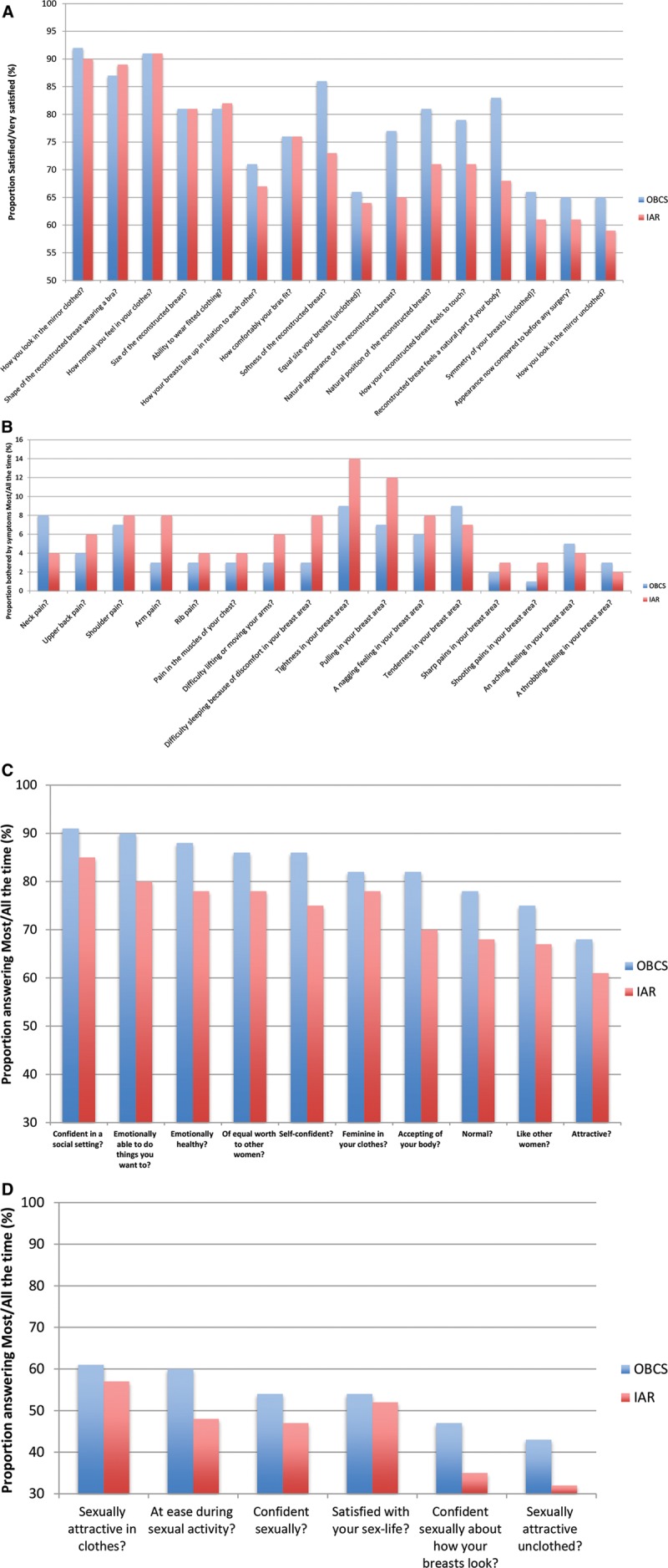
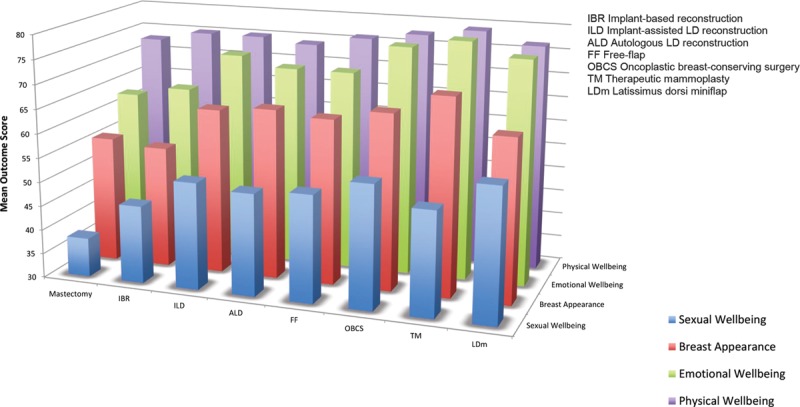
Results: One hundred fifty (45%) women responded [mammaplasty versus LD miniflap, 52% versus 42%; age, 52 (30-83) years; follow-up, 84 (4-281) months). Eighty-nine percent rated OBCS better than mastectomy, > 80% recommending it to others. Mean outcome scores for breast appearance, physical, and emotional wellbeing were high and persisted beyond 15 years. Therapeutic mammaplasty patients were significantly more satisfied than those undergoing LD miniflap with the shape (P < 0.05), the size (P < 0.005), and the natural feel of the treated breast (P = 0.01). They demonstrated similar scores for physical and emotional wellbeing and a lower score for sexual wellbeing than LD miniflap patients. More LD miniflap patients reported back/shoulder symptoms and were more likely to report upper back pain (P < 0.05), but very few (< 5%) were concerned about donor-site appearance. Overall satisfaction with surgical outcomes was high in both OBCS groups (82% "excellent/very good") but greatest after therapeutic mammaplasty (P < 0.005).
Conclusions: Patients report long-lasting satisfaction after OBCS and outcomes that compare very favorably with those reported following mastectomy and immediate autologous reconstruction.
Conflict of interest statement
Disclosure: The authors have no financial interest to declare in relation to the content of this article. The Article Processing Charge was paid for by the Wessex Cancer Research Fund.
Figures
References
-
- van Dongen JA, Voogd AC, Fentiman IS, et al. Long-term results of a randomized trial comparing breast-conserving therapy with mastectomy: European Organization for Research and Treatment of Cancer 10801 trial. J Natl Cancer Inst. 2000;92:1143–1150.. Available at http://www.ncbi.nlm.nih.gov/pubmed/10904087. Accessed August 18, 2016. - PubMed
-
- Jacobson JA, Danforth DN, Cowan KH, et al. Ten-year results of a comparison of conservation with mastectomy in the treatment of stage I and II breast cancer. N Engl J Med. 1995;332:907–911.. - PubMed
-
- Jeevan R, Cromwell D, Browne J, van der Meulen J; National Mastectomy and Breast Reconstruction Audit; 2011. Available at https://www.rcseng.ac.uk/surgeons/research/surgical-research/docs/nation.... Accessed August 19, 2016.
-
- Cochrane RA, Valasiadou P, Wilson ARM, et al. Cosmesis and satisfaction after breast-conserving surgery correlates with the percentage of breast volume excised. Br J Surg. 2003;90:1505–1509.. - PubMed
-
- Rietjens M, Urban CA, Rey PC, et al. Long-term oncological results of breast conservative treatment with oncoplastic surgery. Breast. 2007;16:387–395.. - PubMed
LinkOut - more resources
Full Text Sources
Other Literature Sources
Research Materials