Review
. 2017 Dec;144(14):1871-1880.
doi: 10.1017/S0031182017001469. Epub 2017 Aug 23.

Biological factors that impinge on Chagas disease drug development

Affiliations
Review

Biological factors that impinge on Chagas disease drug development

Amanda F Francisco et al. Parasitology. 2017 Dec.

Abstract

Chagas disease is caused by infection with the insect-transmitted protozoan Trypanosoma cruzi, and is the most important parasitic infection in Latin America. The current drugs, benznidazole and nifurtimox, are characterized by limited efficacy and toxic side-effects, and treatment failures are frequently observed. The urgent need for new therapeutic approaches is being met by a combined effort from the academic and commercial sectors, together with major input from not-for-profit drug development consortia. With the disappointing outcomes of recent clinical trials against chronic Chagas disease, it has become clear that an incomplete understanding of parasite biology and disease pathogenesis is impacting negatively on the development of more effective drugs. In addition, technical issues, including difficulties in establishing parasitological cure in both human patients and animal models, have greatly complicated the assessment of drug efficacy. Here, we outline the major questions that need to be addressed and discuss technical innovations that can be exploited to accelerate the drug development pipeline.

Keywords: Trypanosoma cruzi; Chagas disease; disease pathogenesis; drug development.


Figures
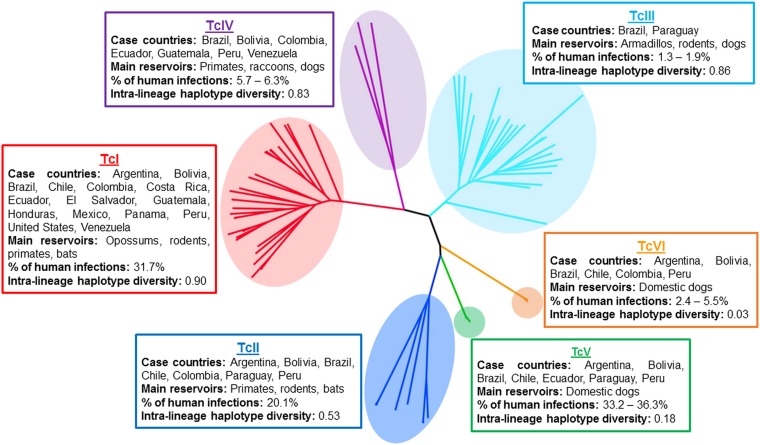
Fig. 1.
Fig. 1.
Key features of the Trypanosoma cruzi major genetic lineages. The phylogenetic tree was reconstructed using multi-locus microsatellite genotype data, adapted from Lewis et al. (2011). Haplotype diversity is based on mitochondrial gene sequences for COII and ND1 reported in Lewis et al. (2011), and the values shown indicate the probability that two randomly selected haplotypes will be different. The percentage of human infections is estimated from metadata compiled by Brenière et al. (2016), which encompass all isolates derived from human infections (n = 1902) and typed to each lineage. These values may reflect historical variation in sampling intensities between endemic areas.
Fig. 2.
Fig. 2.
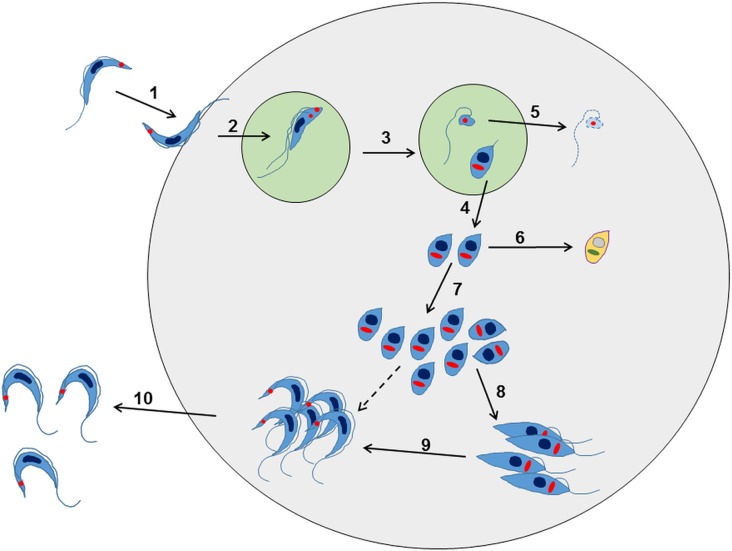
Overview of the intracellular life cycle of Trypanosoma cruzi in the mammalian host. (1) The metacyclic trypomastigote binds to receptors on the host cell surface resulting in the parasite being taken up into a parasitophorous vacuole. This occurs regardless of whether or not the host cell is phagocytic. (2) The parasite undergoes an asymmetric cell division following replication of the kinetoplast (red circle) and flagellum, but not the nucleus (Kurup and Tarleton, 2014). (3) This results in one daughter cell being a replication competent amastigote with a short flagellum, and the other being a dysnuclear flagellated cytoplasmic fragment. (4) The amastigote escapes into the cytoplasm and begins replication by binary fission. (5) The remaining parasite component is degraded by the proteasome and its antigens are presented on the surface. (6) Some amastigotes may become metabolically quiescent, although this is yet to be proven. Such amastigotes could reside long term in chronically infected tissue. (7) The amastigotes continue to replicate. (8) Amastigotes differentiate into an intracellular epimastigote-like form. It is not clear whether this is an obligate stage, or if they can go straight from amastigotes to trypomastigotes (dashed arrow). (9) The parasites finally differentiate into the flagellated bloodstream trypomastigotes, lyse the host cell and escape into the bloodstream or tissue fluids (10).
Fig. 3.
Fig. 3.
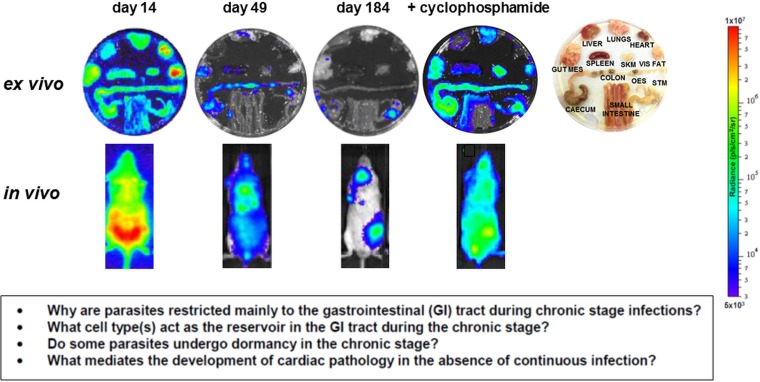
Parasite tropism during Trypanosoma cruzi infections in a mouse model. BALB/c mice infected with bioluminescent T. cruzi strain CL Brener (Lewis et al. 2014) were imaged at various stages post-infection, as indicated. Upper; ex vivo imaging of organs/tissues removed from mice and soaked in D-luciferin. The identity of each organ/tissue is indicated (right). Lower; in vivo imaging of infected mice. The bioluminescence images on the right-hand side are of a chronically infected mouse which has been immunosuppressed by cyclophosphamide treatment (Lewis et al. 2014). Heat-maps are on log10 scales and indicate intensity of bioluminescence from low (blue) to high (red). Inset: summary of the major unanswered questions.

References

    1. Álvarez J. M., Fonseca R., Borges da Silva H., Marinho C. R., Bortoluci K. R., Sardinha L. R., Epiphanio S. and D'Império Lima M. R. (2014). Chagas disease: still many unsolved issues. Mediators of Inflammation 2014, 912965. - PMC - PubMed
    1. Assíria Fontes Martins T., de Figueiredo Diniz L., Mazzeti A. L., da Silva do Nascimento Á. F., Caldas S., Caldas I. S., de Andrade I. M., Ribeiro I. and Bahia M. T. (2015). Benznidazole/itraconazole combination treatment enhances anti-Trypanosoma cruzi activity in experimental Chagas disease. PLoS ONE 10, e0128707. - PMC - PubMed
    1. Bellotti G., Bocchi E. A., de Moraes A. V., Higuchi M. L., Barbero-Marcial M., Sosa E., Esteves-Filho A., Kalil R., Weiss R., Jatene A. and Pileggi F. (1996). In vivo detection of Trypanosoma cruzi antigens in hearts of patients with chronic Chagas’ heart disease. American Heart Journal 131, 301–307. - PubMed
    1. Benvenuti L. A., Roggério A., Nishiya A. S., Campos S. V., Fiorelli A. I. and Levi J. E. (2014). Trypanosoma cruzi persistence in the native heart is associated with high-grade myocarditis, but not with Chagas’ disease reactivation after heart transplantation. The Journal of Heart and Lung Transplantation 33, 698–703. - PubMed
    1. Bermejo D. A., Amezcua Vesely M. C., Khan M., Acosta Rodríguez E. V., Montes C. L., Merino M. C., Toellner K. M., Mohr E., Taylor D., Cunningham A. F. and Gruppi A. (2011). Trypanosoma cruzi infection induces a massive extrafollicular and follicular splenic B-cell response which is a high source of non-parasite-specific antibodies. Immunology 132, 123–133. - PMC - PubMed

MeSH terms