


Triceps Tendon Ruptures: A Systematic Review
- PMID: 28832209
- PMCID: PMC5684929
- DOI: 10.1177/1558944716677338
Triceps Tendon Ruptures: A Systematic Review
Abstract
Background: Triceps tendon ruptures (TTR) are an uncommon injury. The aim of this systematic review was to classify diagnostic signs, report outcomes and rerupture rates, and identify potential predisposing risk factors in all reported cases of surgical treated TTR.
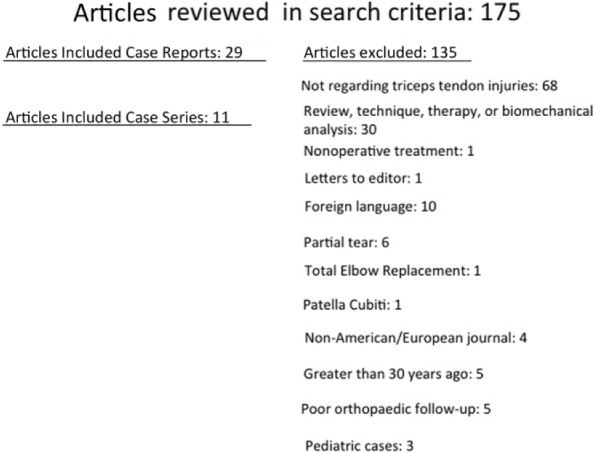
Methods: A literature search collecting surgical treated cases of TTR was performed, identifying 175 articles, 40 of which met inclusion criteria, accounting for 262 patients. Data were pooled and analyzed focusing on medical comorbidities, presence of a fleck fracture on the preoperative lateral elbow x-ray film (Dunn-Kusnezov Sign [DKS]), outcomes, and rerupture rates.
Results: The average age of injury was 45.6 years. The average time from injury to day of surgery was 24 days while 10 patients had a delay in diagnosis of more than 1 month. Renal disease (10%) and anabolic steroid use (7%) were the 2 most common medical comorbidities. The DKS was present in 61% to 88% of cases on the lateral x-ray film. Postoperatively, 89% of patients returned to preinjury level of activity, and there was a 6% rerupture rate at an average follow-up of 34.6 months. The vast majority (81%) of the patients in this review underwent repair via suture fixation.
Conclusions: TTR is an uncommon injury. Risks factors for rupture include renal disease and anabolic steroid use. Lateral elbow radiographs should be scrutinized for the DKS in patients with extension weakness. Outcomes are excellent following repair, and rates of rerupture are low.
Keywords: avulsion; renal disease; rupture; steroid; triceps tendon.
Conflict of interest statement
Figures
References
-
- Anzel SH, Covey KW, Weiner AD, Lipscomb PR. Disruption of muscles and tendons: an analysis of 1,014 cases. Surgery. 1959;45:406-414. - PubMed
-
- Bach BR, Jr, Warren RF, Wickiewicz TL. Triceps rupture. A case report and literature review. Am J Sports Med. 1987;15(3):285-289. - PubMed
-
- Bava ED, Barber FA, Lund ER. Clinical outcome after suture anchor repair for complete traumatic rupture of the distal triceps tendon. Arthroscopy. 2012;28(8):1058-1063. - PubMed
Publication types
MeSH terms
Substances
LinkOut - more resources
Full Text Sources
Other Literature Sources
Research Materials
Miscellaneous
