. 2017 Dec;158(12):2386-2395.
doi: 10.1097/j.pain.0000000000001040.

Multiple sites and actions of gabapentin-induced relief of ongoing experimental neuropathic pain

Affiliations

Multiple sites and actions of gabapentin-induced relief of ongoing experimental neuropathic pain

Kirsty Bannister et al. Pain. 2017 Dec.

Abstract

Gabapentin (GBP) is a first-line therapy for neuropathic pain, but its mechanisms and sites of action remain uncertain. We investigated GBP-induced modulation of neuropathic pain following spinal nerve ligation (SNL) in rats. Intravenous or intrathecal GBP reversed evoked mechanical hypersensitivity and produced conditioned place preference (CPP) and dopamine (DA) release in the nucleus accumbens (NAc) selectively in SNL rats. Spinal GBP also significantly inhibited dorsal horn wide-dynamic-range neuronal responses to a range of evoked stimuli in SNL rats. By contrast, GBP microinjected bilaterally into the rostral anterior cingulate cortex (rACC), produced CPP, and elicited NAc DA release selectively in SNL rats but did not reverse tactile allodynia and had marginal effects on wide-dynamic-range neuronal activity. Moreover, blockade of endogenous opioid signaling in the rACC prevented intravenous GBP-induced CPP and NAc DA release but failed to block its inhibition of tactile allodynia. Gabapentin, therefore, can potentially act to produce its pain relieving effects by (a) inhibition of injury-induced spinal neuronal excitability, evoked hypersensitivity, and ongoing pain and (b) selective supraspinal modulation of affective qualities of pain, without alteration of reflexive behaviors. Consistent with previous findings of pain relief from nonopioid analgesics, GBP requires engagement of rACC endogenous opioid circuits and downstream activation of mesolimbic reward circuits reflected in learned pain-motivated behaviors. These findings support the partial separation of sensory and affective dimensions of pain in this experimental model and suggest that modulation of affective-motivational qualities of pain may be the preferential mechanism of GBP's analgesic effects in patients.


Conflict of interest statement

Conflict of interest statement

The authors have no conflict of interest to declare.

Figures
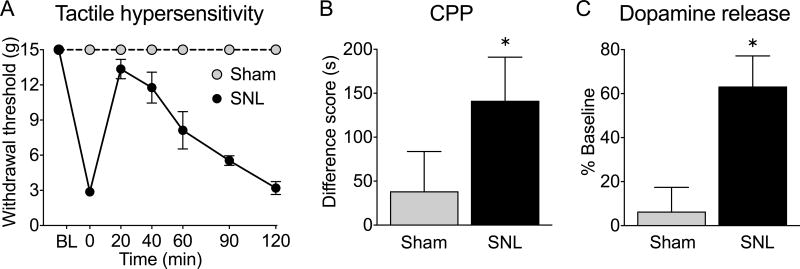
Figure 1
Figure 1. Effects of intravenous gabapentin on tactile allodynia, CPP and NAc dopamine release in SNL rats
(A) Intravenous administration of gabapentin (50 mg/kg) temporarily reversed nerve injury-induced tactile allodynia in SNL rats (sham: n=7; SNL: n=9;). (B) Rats with neuropathic pain but not sham operated animals demonstrated preference for the gabapentin-paired chamber as shown by significantly increased difference score, suggesting that i.v. gabapentin relieves ongoing neuropathic pain (sham: n=10; SNL: n=17; *p < 0.05 compared with pre-conditioning time spent in chamber). (C) I.v. gabapentin increased DA efflux in the NAc shell of SNL but not sham-operated animals demonstrating rewarding effects of pain relief (sham: n=11; SNL: n=12; *p < 0.05 compared to the sham group). Data are means ±SEMs.
Figure 2
Figure 2. Pretreatment with β-FNA into the rACC of SNL rats blocks intravenous gabapentin induced CPP and dopamine efflux in NAc while the anti-allodynic effects are preserved
(A) SNL rats were pretreated 20–24 h before testing with irreversible opioid receptor antagonist β-FNA (3 µg) or vehicle (saline) into the rACC. The efficacy and time course of anti-allodynic effects of i.v. gabapentin were statistically indistinguishable in both groups (saline: n=4; β-FNA: n=6). (B) In contrast, rACC β-FNA reduced the ability of i.v. gabapentin to elicit CPP in SNL rats (saline: n=7; β-FNA: n=12; *p < 0.05 compared with pre-conditioning time spent in chamber). (C) Pretreatment with rACC β-FNA eliminated dopamine release in response to i.v. gabapentin (saline: n=8; β-FNA: n=9; *p < 0.05). Data are means ±SEMs.
Figure 3
Figure 3. Effects of intrathecal gabapentin on pain thresholds, CPP, NAc dopamine release and the activity of WDR neurons in SNL rats
SNL surgeries produced (A) tactile allodynia and (B) thermal hyperalgesia in rats when tested 14 days following spinal nerve ligation. Intrathecal administration of gabapentin (200 µg) blocked SNL-induced tactile allodynia and thermal hyperalgesia (saline: n= 9; GBP: n= 10). (C) Rats with SNL demonstrated significant increase in the time spent in the i.th. gabapentin-paired chamber while sham-operated rats showed no preference (sham: n= 10; SNL: n= 12; *p < 0.05 compared with pre-conditioning time spent in chamber). (D) In SNL rats i.th. gabapentin but not i.th. saline elicited dopamine efflux in NAc shell (saline: n=7; GBP: n=8). (E) In SNL rats, spinal application of gabapentin inhibited responses of WDR neurons to noxious mechanical stimulation with von Frey filaments of increasing strength (n=5; *p < 0.05 compared to pre-drug baseline). Spinal application of gabapentin inhibited responses of WDR neurons to noxious (48°C) heat (n=5; *p < 0.05 compared to pre-drug baseline). (F) After SNL, significant inhibitory effects of spinal gabapentin were observed for Aδ-fiber, C-fiber, Input and Brush responses (n=5; *p < 0.05 compared to pre-drug baseline). Data are means ±SEMs.
Figure 4
Figure 4. Effects of gabapentin administration into the rACC on tactile allodynia, CPP, NAc dopamine release and the activity of WDR neurons in SNL rats
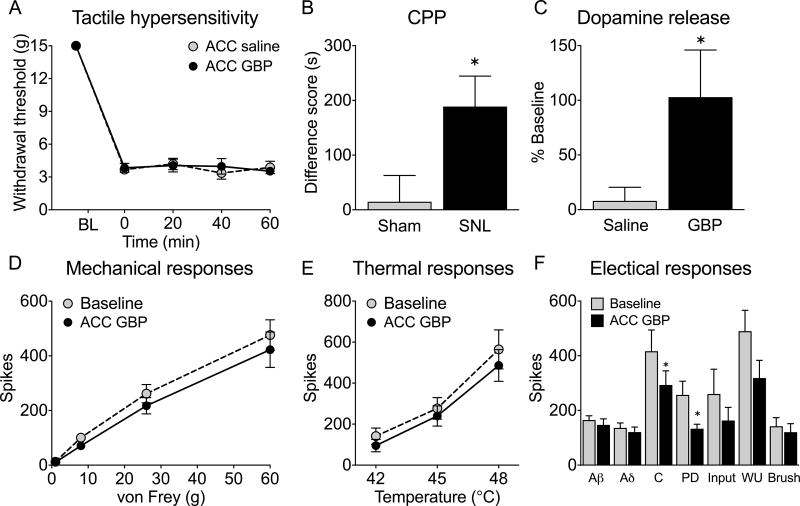
(A) Bilateral administration of gabapentin into the rACC (100 µg) did not reverse SNL-induced tactile hypersensitivity (n=5 in each group). (B) In contrast, rACC gabapentin produced CPP selectively in SNL but not sham rats (n=8 in each group; *p < 0.05 compared with pre-conditioning time spent in chamber). (C) Local injection of gabapentin into the rACC also increased the levels of extracellular dopamine in the NAc only in SNL rats (saline: n=8; GBP: n=5; *p < 0.05). (D) In SNL rats, rACC administration of gabapentin had no effect on the responses of WDR neurons to noxious mechanical stimulation (n=5). (E) Gabapentin injections into the rACC had no effect on the responses of WDR neurons to heat stimulation (n=5). (F) Significant inhibitory effects of rACC gabapentin were observed for C-fiber and Post Discharge responses (n=5; *p < 0.05 compared to pre-drug baseline). Data are means ±SEMs.

References

    1. Attal N, Brasseur L, Parker F, Chauvin M, Bouhassira D. Effects of gabapentin on the different components of peripheral and central neuropathic pain syndromes: a pilot study. Eur Neurol. 1998;40(4):191–200. - PubMed
    1. Backonja MM, Stacey B. Neuropathic pain symptoms relative to overall pain rating. J Pain. 2004;5(9):491–497. - PubMed
    1. Bauer CS, Nieto-Rostro M, Rahman W, Tran-Van-Minh A, Ferron L, Douglas L, Kadurin I, Sri Ranjan Y, Fernandez-Alacid L, Millar NS, Dickenson AH, Lujan R, Dolphin AC. The increased trafficking of the calcium channel subunit alpha2delta-1 to presynaptic terminals in neuropathic pain is inhibited by the alpha2delta ligand pregabalin. J Neurosci. 2009;29(13):4076–4088. - PMC - PubMed
    1. Ben-Menachem E, Persson LI, Hedner T. Selected CSF biochemistry and gabapentin concentrations in the CSF and plasma in patients with partial seizures after a single oral dose of gabapentin. Epilepsy Res. 1992;11(1):45–49. - PubMed
    1. Bennett MI, Simpson KH. Gabapentin in the treatment of neuropathic pain. Palliat Med. 2004;18(1):5–11. - PubMed